Mass Defect & Binding Energy (3 of 7), Beta Decay of Cesium 137
TL;DR
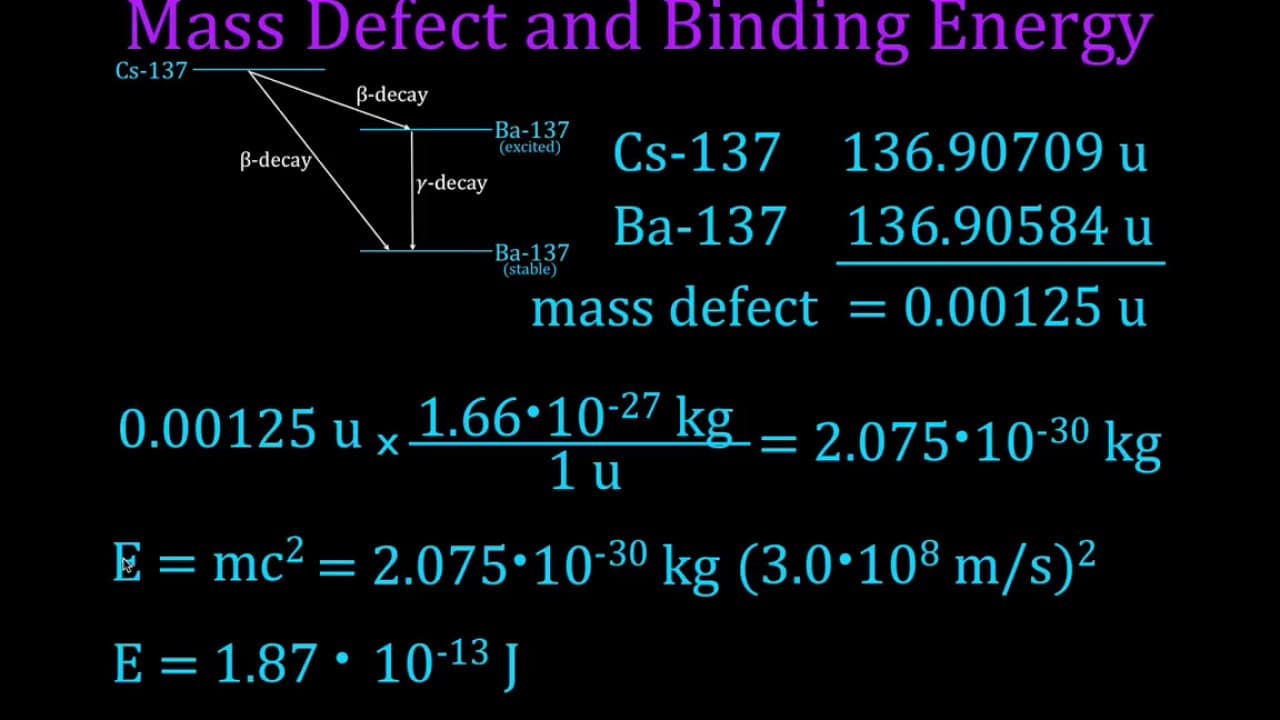
Calculating energy released in beta decay of cesium 137 through mass defect analysis.
Transcript
okay into this video as you can see we're going to be going over a mass defect in radioactive decay and we're gonna calculate the amount of energy released during the beta decay of cesium 137 so let's get started okay this is the case can just light show this looks kind of cool I thought let the case game for what cesium 137 season 130 decays to a ... Read More
Key Insights
- ❓ Beta decay involves the transformation of a neutron to a proton, emitting an electron.
- 💆 Mass defect, the difference in mass before and after decay, is converted into energy.
- 😀 Einstein's equation (E=mc^2) is used to calculate binding energy during decay.
- 😑 Energy released during beta decay is expressed in mega electron volts.
- 🇦🇪 Conversion of units from atomic mass units to kilograms is necessary for energy calculations.
- 🙂 The binding energy in joules is determined by the mass defect and speed of light squared.
- 💆 The energy released during decay is a result of converting mass defect into binding energy.
Install to Summarize YouTube Videos and Get Transcripts
Explore YouTube Video Summarizer or Get YouTube Transcript Extractor
Questions & Answers
Q: What is beta decay and how does it differ from other types of radioactive decay?
Beta decay involves the conversion of a neutron into a proton releasing an electron, whereas alpha decay emits an alpha particle. The atomic number increases by one in beta decay, retaining the same mass number.
Q: How is mass defect utilized in calculating the energy released during radioactive decay?
Mass defect, the difference in mass before and after decay, is converted into energy via Einstein's equation (E=mc^2) to determine the amount of energy released during the decay process.
Q: Why is it necessary to convert atomic mass units into kilograms for calculating binding energy?
Einstein's equation requires mass in kilograms to calculate binding energy. By converting atomic mass units to kilograms, the mass defect can be directly converted into energy in joules.
Q: How is the final energy released in beta decay expressed and why is it converted into electron volts?
The final energy released is expressed in mega electron volts for easier understanding of the energy scale involved. Converting joules to electron volts simplifies the expression of energy released in particle physics.
Summary & Key Takeaways
-
Explains beta decay process from cesium 137 to barium 137 through an intermediate excited state with gamma decay.
-
Demonstrates calculation of energy released by converting mass defect into binding energy using Einstein's equation.
-
Concludes with the final energy released in mega electron volts during the beta decay process.
Read in Other Languages (beta)
Share This Summary 📚
Summarize YouTube Videos and Get Video Transcripts with 1-Click
Try YouTube Summary with ChatGPT & Claude or YouTube Transcript Generator
Explore More Summaries from Step by Step Science 📚
Summarize YouTube Videos and Get Video Transcripts with 1-Click
Try YouTube Summary with ChatGPT & Claude or YouTube Transcript Generator