What Is Collision Theory and How Does It Relate to Maxwell-Boltzmann Distribution?
TL;DR
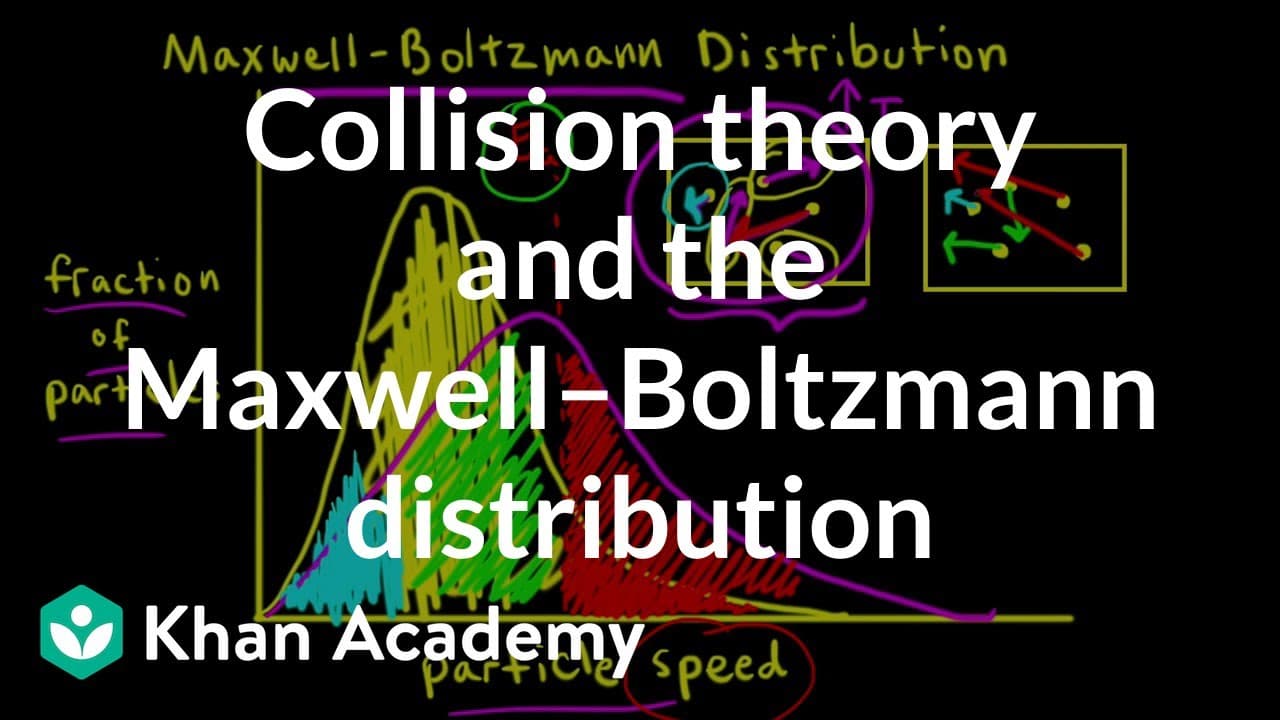
Collision theory states that for a reaction to occur, particles must collide with sufficient kinetic energy and the correct orientation to overcome the activation energy barrier. The Maxwell-Boltzmann distribution illustrates the range of particle speeds in a gas sample, showing that increasing temperature boosts the number of particles with enough energy to surpass the activation energy for a reaction.
Transcript
- [Instructor] Collision theory can be related to Maxwell-Boltzmann distributions. And first we'll start with collision theory. Collision theory says that particles must collide in the proper orientation and with enough kinetic energy to overcome the activation energy barrier. So let's look at the reaction where A reacts with B and C to form AB plu... Read More
Key Insights
- 💥 Collision theory explains the conditions necessary for a reaction to occur, including proper orientation and sufficient kinetic energy.
- 🥇 The activation energy is the energy barrier that particles must overcome for a reaction to take place.
- 🫢 Maxwell-Boltzmann distribution represents the range of particle speeds in a gas sample.
- #️⃣ Increasing the temperature increases the number of particles with enough kinetic energy to overcome the activation energy barrier.
- 🐎 The area under the curve in a Maxwell-Boltzmann distribution represents the relative number of particles at different speeds.
- ✋ Higher temperature results in a broader Maxwell-Boltzmann distribution curve.
- 💩 Collision theory can be related to the concept of hitting a golf ball with enough force to overcome potential energy barriers.
Install to Summarize YouTube Videos and Get Transcripts
Explore YouTube Video Summarizer or Get YouTube Transcript Extractor
Questions & Answers
Q: What does collision theory state?
Collision theory states that for a reaction to occur, particles must collide with the proper orientation and enough kinetic energy to overcome the activation energy barrier.
Q: How does Maxwell-Boltzmann distribution represent particle speeds?
Maxwell-Boltzmann distribution represents the range of speeds at which particles in a gas sample are moving, with slower particles having lower kinetic energy and faster particles having higher kinetic energy.
Q: How does increasing the temperature affect the Maxwell-Boltzmann distribution?
Increasing the temperature causes the peak height of the Maxwell-Boltzmann distribution to drop and the curve to become broader. This results in an increase in the number of particles with enough kinetic energy to overcome the activation energy barrier.
Q: What happens if particles do not collide with enough energy?
If particles do not collide with enough energy, they will simply bounce off each other and the reaction will not occur. This is because they cannot overcome the activation energy barrier.
Summary & Key Takeaways
-
Collision theory explains that particles must collide with the right orientation and sufficient kinetic energy to overcome the activation energy barrier for a reaction to occur.
-
Maxwell-Boltzmann distribution represents the range of speeds at which particles in a gas sample are moving, with slower particles having lower kinetic energy and faster particles having higher kinetic energy.
-
Increasing the temperature changes the Maxwell-Boltzmann distribution, increasing the number of particles with enough kinetic energy to overcome the activation energy for a reaction.
Read in Other Languages (beta)
Share This Summary 📚
Summarize YouTube Videos and Get Video Transcripts with 1-Click
Try YouTube Summary with ChatGPT & Claude or YouTube Transcript Generator
Explore More Summaries from Khan Academy 📚



Summarize YouTube Videos and Get Video Transcripts with 1-Click
Try YouTube Summary with ChatGPT & Claude or YouTube Transcript Generator