Stanford CS25: V2 I Neuroscience-Inspired Artificial Intelligence
TL;DR
A model is developed to separate the structure and experiences in the brain's cognitive map, with evidence from neuroscience supporting the existence of a cognitive map for spatial navigation and other complex tasks.
Transcript
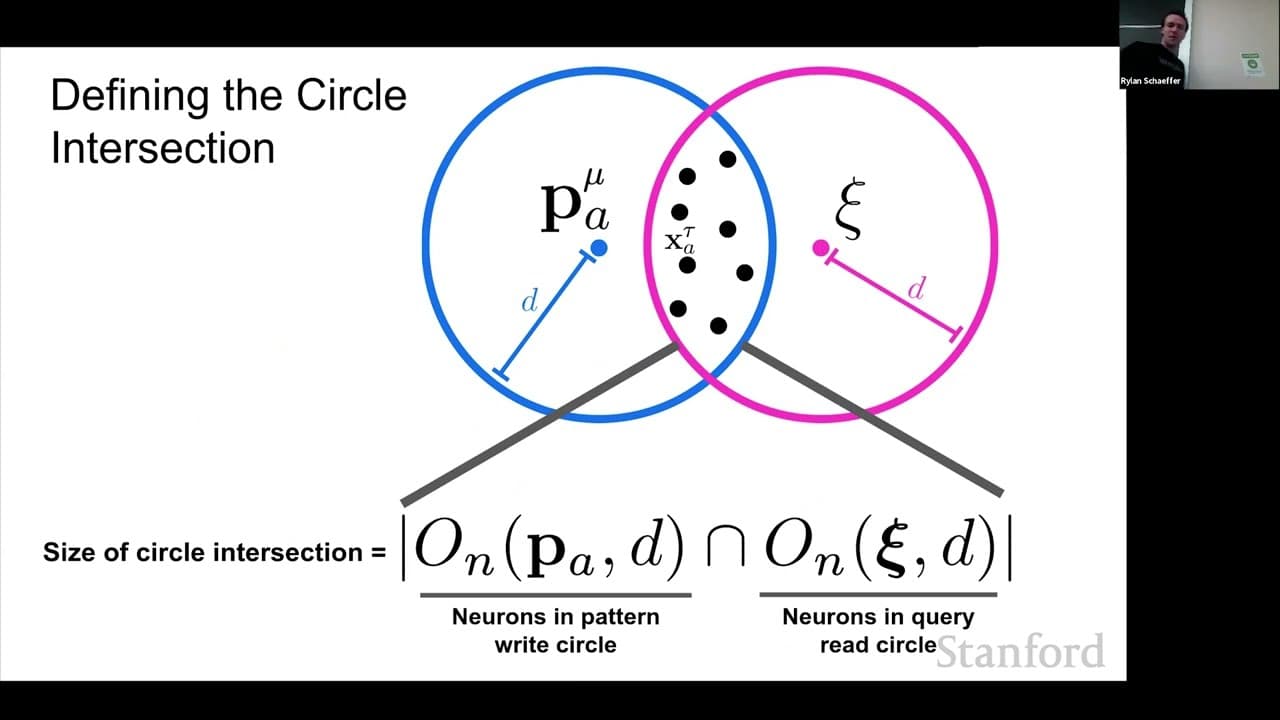
hello um it's fun fun to be here um so the work I'm presenting today uh title of it is attention approximates Sports distributed memory um and this was done in collaboration with Genghis palavon um and my PhD advisor is Gabriel Crimea um so why should you care about this work um we show that the heuristic attention operation can be implemented with... Read More
Key Insights
- 👨🔬 Spatial navigation research has provided evidence for the existence of place cells and grid cells in the hippocampus and entorhinal cortex, supporting the concept of a cognitive map.
- 💁 Patients with hippocampal damage and studies using transitive inference tasks have further highlighted the role of the hippocampus and entorhinal cortex in memory formation, relational reasoning, and non-spatial cognition.
- 💁 The model presented in the content aims to separate the spatial structure encoded by grid cells from the experiential information represented by the lateral entorhinal cortex, with the hippocampus serving as the binding element.
Install to Summarize YouTube Videos and Get Transcripts
Explore YouTube Video Summarizer or Get YouTube Transcript Extractor
Questions & Answers
Q: How do grid cells and place cells in the hippocampus contribute to spatial navigation?
Grid cells in the entorhinal cortex encode a hexagonal lattice of positions in space, while place cells in the hippocampus specifically respond in individual locations. Together, they provide a precise representation of an organism's position in its environment.
Q: Does the model incorporate non-spatial information processing in the hippocampus and entorhinal cortex?
Yes, evidence from patients with hippocampal damage and neuroimaging studies suggests that the hippocampus and entorhinal cortex are involved in various cognitive tasks, such as memory recall, imagination, and relational reasoning. The model aims to capture these non-spatial aspects in addition to spatial navigation.
Q: How does the model separate the structure and experiences in the brain's cognitive map?
The model utilizes a factorization approach, where the grid cells in the entorhinal cortex represent the underlying structure, and the lateral entorhinal cortex encodes the experiential information. This separation allows for the reusability of structural knowledge in new situations.
Q: Can the model be applied to non-spatial tasks?
Yes, the model's framework of separating structure and experiences can be extended to non-spatial tasks that involve pattern recognition, inference, and imagination. The lateral entorhinal cortex would encode the experiential information specific to the task, while the grid cells in the entorhinal cortex would represent the underlying structure.
Summary & Key Takeaways
-
Spatial navigation research in rodents has shown the existence of place cells and grid cells in the hippocampus and entorhinal cortex, which encode specific locations in space.
-
Patients with hippocampal damage exhibit severe amnesia, demonstrating the involvement of the hippocampus in memory formation and recall.
-
The entorhinal cortex has been found to respond to abstract cognitive tasks, such as imagining scenarios and navigating in abstract spaces.
-
The model aims to separate the structural information represented by grid cells and the experiential information represented by the lateral entorhinal cortex, which are then bound together in the hippocampus.
Read in Other Languages (beta)
Share This Summary 📚
Summarize YouTube Videos and Get Video Transcripts with 1-Click
Try YouTube Summary with ChatGPT & Claude or YouTube Transcript Generator
Explore More Summaries from Stanford Online 📚

Summarize YouTube Videos and Get Video Transcripts with 1-Click
Try YouTube Summary with ChatGPT & Claude or YouTube Transcript Generator