Stanford Seminar - Foundations of Spatial Perception for Robotics
TL;DR
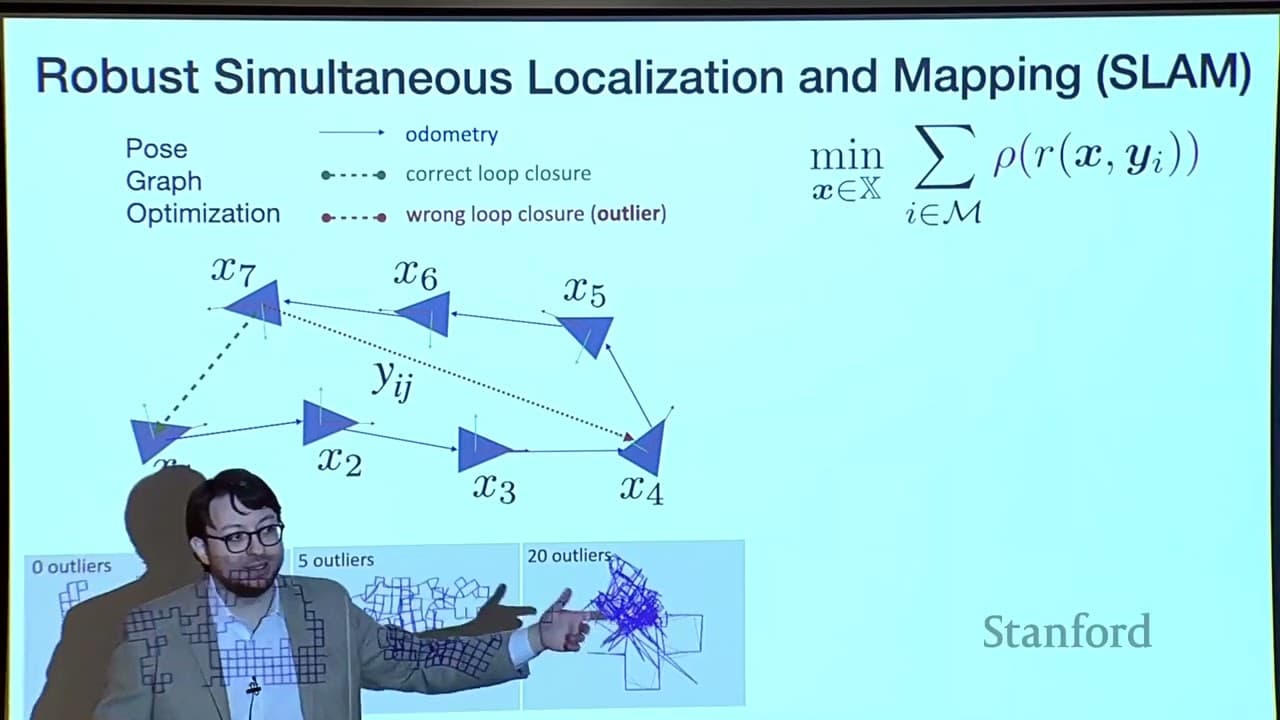
This presentation covers recent progress in perception for robotics, including robust estimation algorithms, hierarchical representations for mapping, and self-supervised learning for object pose estimation.
Transcript
I gave like you know my seminar last year but it's great to come back in person and get the actual like you know Stanford Stanford experience I think the Stanford experience started this morning in my Uber to the to the university had talks about Consciousness with the Uber driver so I was really getting The Full Experience there um so So the plan ... Read More
Key Insights
- ❓ Robust estimation algorithms enable unprecedented robustness in localization and mapping problems, improving navigation capabilities in robotics.
- 👻 S-Graphs provide a comprehensive representation of environments, allowing for metric, semantic, and hierarchical understanding for better decision-making and interaction.
- 🤳 Self-supervised learning leverages robust estimation algorithms to improve neural network performance without the need for labeled data, enhancing object pose estimation capabilities.
Install to Summarize YouTube Videos and Get Transcripts
Explore YouTube Video Summarizer or Get YouTube Transcript Extractor
Questions & Answers
Q: How do robust estimation algorithms improve localization and mapping problems?
Robust estimation algorithms minimize the impact of outliers in measurements, such as inaccurate or noisy data, to improve the accuracy and reliability of localization and mapping. These algorithms use robust cost functions to minimize the influence of outliers in the optimization process.
Q: How does the S-Graph representation enhance understanding of environments?
The S-Graph representation allows for metric, semantic, and hierarchical understanding of environments by organizing the information into layers of increasing abstraction. This enables robots to reason about rooms, objects, and relations between them, making it easier to perform complex tasks and interactions.
Q: What is the significance of self-supervised learning in object pose estimation?
Self-supervised learning allows neural networks to improve their performance without the need for labeled data. By using robust estimation algorithms to generate pseudolabels from unlabeled data, the network can learn to estimate object poses more accurately over time, enhancing perception capabilities.
Q: How does the use of logic tensor networks enhance learning in outdoor environments?
Logic tensor networks enforce logical constraints during the training of neural networks, ensuring that the network's predictions are consistent with the spatial ontology defined for outdoor environments. This helps improve performance, especially when there is limited training data.
Summary & Key Takeaways
-
The speaker discusses their work on special perception and vision-based navigation for robotics, with a focus on applications that are safety critical, high integrity, and highly interactive.
-
They introduce the concept of S-Graphs, which are hierarchical map representations that enable metric, semantic, and hierarchical understanding of the environment.
-
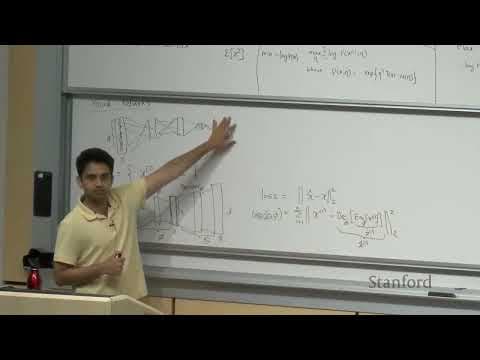
They also present their research on self-supervised learning for object pose estimation, using robust estimation algorithms to improve neural network performance without the need for labeled data.
Read in Other Languages (beta)
Share This Summary 📚
Summarize YouTube Videos and Get Video Transcripts with 1-Click
Try YouTube Summary with ChatGPT & Claude or YouTube Transcript Generator
Explore More Summaries from Stanford Online 📚

Summarize YouTube Videos and Get Video Transcripts with 1-Click
Try YouTube Summary with ChatGPT & Claude or YouTube Transcript Generator