Inverse Z-Transform Type 2) Problem 4 - Z Transform - Engineering Mathematics 3
TL;DR
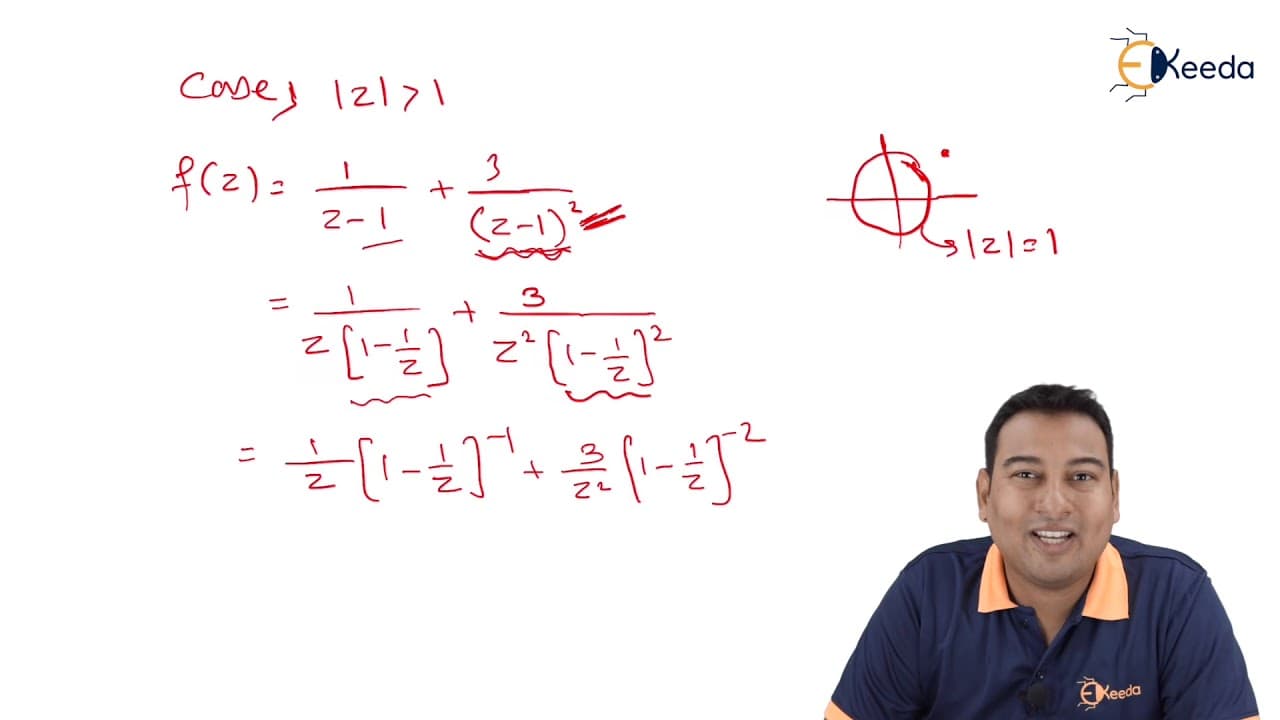
This video explains how to find the inverse Z-transform of a quadratic equation by using partial fraction decomposition and expanding the equation.
Transcript
hello friends in this video we'll be discussing inverse z-transform that is our type 2 and problem number 3 welcome back friends till now we are done with three examples now we are going to discuss the fourth one our aim is to find inverse z-transform that means converting problem from Z to K so this is the given example here we need to find invers... Read More
Key Insights
- 🤪 Partial fraction decomposition is an important step in finding the inverse Z-transform of a quadratic equation.
- ❓ The region of convergence determines the validity of the solution.
- 🧑🏭 Taking common factors and expanding the equation help simplify the problem.
Install to Summarize YouTube Videos and Get Transcripts
Explore YouTube Video Summarizer or Get YouTube Transcript Extractor
Questions & Answers
Q: How is the inverse Z-transform of a quadratic equation found?
The inverse Z-transform of a quadratic equation can be found using partial fraction decomposition to determine the values of a and b. Then, the equation is simplified and expanded to obtain the general term of the series.
Q: What is the significance of the region of convergence (ROC)?
The region of convergence determines the values of Z for which the given Z-transform is convergent. In this example, the ROC is defined as mod Z > 1, indicating that the solution is valid for Z values outside the unit circle.
Q: What are the steps involved in finding the inverse Z-transform?
The steps include taking common factors, converting the equation into the 1 plus 1 minus format, expanding the equation using the appropriate formulas, and simplifying the equation to obtain the general term of the series.
Q: How can the coefficient of Z raised to minus K be determined?
The coefficient of Z raised to minus K can be determined by observing the pattern in the equation. In this example, the coefficient is determined by the value of k minus 1.
Summary & Key Takeaways
-
The video discusses an example problem where the inverse Z-transform of a quadratic equation needs to be found.
-
The problem involves using partial fraction decomposition to determine the values of a and b.
-
The region of convergence (ROC) and the case where the absolute value of Z is greater than 1 is considered.
-
The equation is then simplified and expanded to find the general term of the series.
Read in Other Languages (beta)
Share This Summary 📚
Summarize YouTube Videos and Get Video Transcripts with 1-Click
Try YouTube Summary with ChatGPT & Claude or YouTube Transcript Generator
Explore More Summaries from Ekeeda 📚




Summarize YouTube Videos and Get Video Transcripts with 1-Click
Try YouTube Summary with ChatGPT & Claude or YouTube Transcript Generator