Products
Features
YouTube Video Summarizer
Summarize YouTube videos
Web & PDF Highlighter
Highlight web pages & PDFs
Chat with PDF
Ask any PDF questions with AI
Ask AI Clone
Chat with your highlights & memories
Audio Transcriber
Transcribe audio files to text
Glasp Reader
Read and highlight articles
Kindle Highlight Export
Export your Kindle highlights
Idea Hatch
Hatch ideas from your highlights
Integrations
Obsidian Plugin
Notion Integration
Pocket Integration
Instapaper Integration
Medium Integration
Readwise Integration
Snipd Integration
Hypothesis Integration
Apps & Extensions
Chrome Extension
Safari Extension
Edge Add-ons
Firefox Add-ons
iOS App
Android App
Discover
Discover
Ideas
Discover new ideas and insights
Articles
Curated articles and insights
Books
Book recommendations by great minds
Posts
Essays and notes from readers
Quotes
Inspiring quotes collection
Videos
Curated videos and summaries
Explore Glasp
Glasp Newsletter
Weekly insights and updates
Glasp Talk
Interview series with great minds
Glasp Blog
Latest news and articles
Glasp Use Cases
Learn how others use Glasp
Build & Support
Glasp API
Access Glasp's API for developers
MCP Connector
Connect Glasp to Claude & ChatGPT
Community
Glasp Reddit Community
Students
Student discount and benefits
FAQs
Frequently Asked Questions
AboutPricing
DashboardLog inSign up

33. Neural Nets and the Learning Function
May 16, 2019
by
MIT OpenCourseWare
YouTube video player
33. Neural Nets and the Learning Function

TL;DR

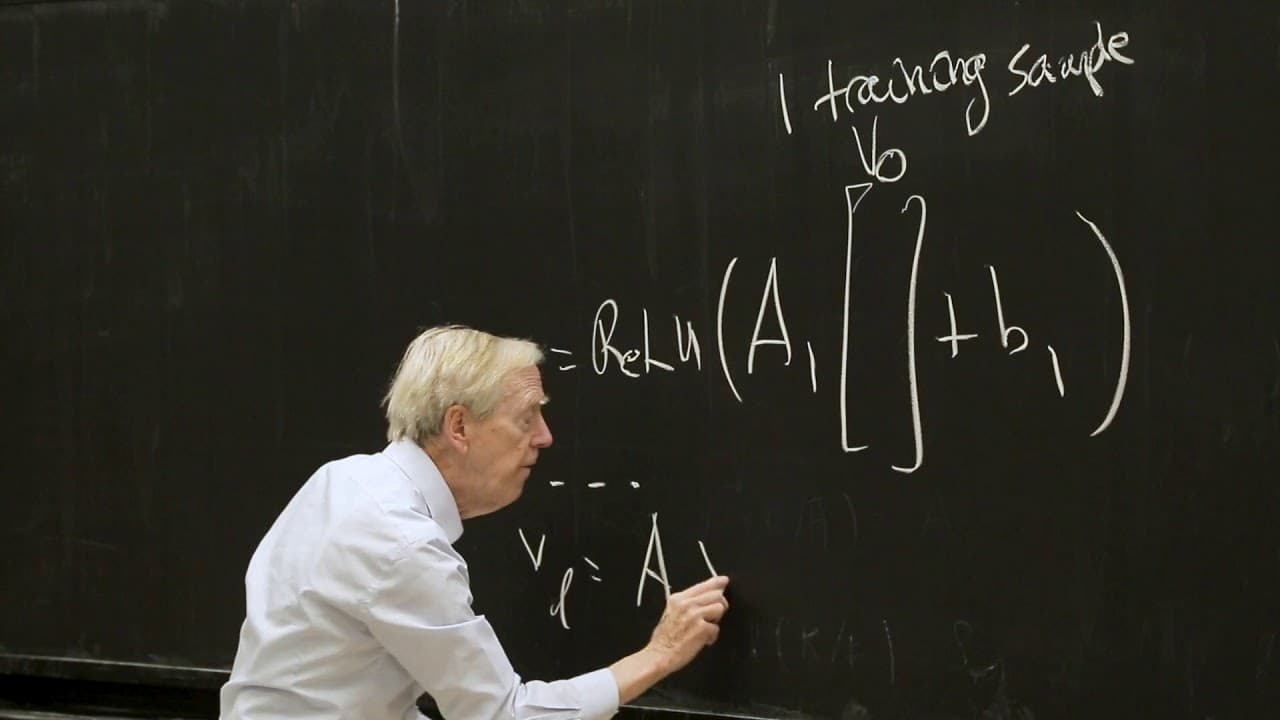
Gilbert Strang discusses the construction of neural nets, the function optimization process, and the concept of distance matrices.

Transcript

The following content is provided under a Creative Commons license. Your support will help MIT OpenCourseWare continue to offer high quality educational resources for free. To make a donation or to view additional materials from hundreds of MIT courses, visit MIT OpenCourseWare at ocw.mit.edu. GILBERT STRANG: OK, so actually, I know where people ar... Read More

Key Insights

  • 🏋️ Neural nets optimize a learning function by adjusting weights and feature vectors.
  • 😥 Distance matrices provide information about the distances between points in space, allowing for the determination of their positions.
  • 🫚 The Cholesky Factorization is a useful method for computing square roots of matrices.

Install to Summarize YouTube Videos and Get Transcripts

Explore YouTube Video Summarizer or Get YouTube Transcript Extractor

Questions & Answers

Q: What is the main function of neural nets?

The main function of neural nets is to optimize the learning function, which is applied to training data to minimize loss through gradient descent or stochastic gradient descent.

Q: How do distance matrices relate to neural nets?

Distance matrices provide information about the distances between points in space, which can be used to find the positions of these points. This is useful in applications such as wireless sensor networks and molecular shape analysis.

Q: How can the construction of neural nets be improved?

The construction of neural nets can be improved by considering the weights (x) and feature vectors (v) as separate variables and optimizing them accordingly. This allows for more flexibility and efficient learning.

Q: What are the main applications of distance matrices?

Distance matrices are commonly used in wireless sensor networks, molecular shape analysis, and machine learning to infer the positions of points in space based on the distances between them.

Summary & Key Takeaways

  • Gilbert Strang discusses the construction of neural nets and the learning function that is optimized by gradient descent or stochastic gradient descent.

  • The learning function is applied to training data to minimize loss, with the weights and feature vectors being the main variables.

  • Distance matrices are also explored, and their applications in wireless sensor networks, molecular shapes, and machine learning are discussed.


Read in Other Languages (beta)

English

Share This Summary 📚

Summarize YouTube Videos and Get Video Transcripts with 1-Click

Download browser extensions on:

Try YouTube Summary with ChatGPT & Claude or YouTube Transcript Generator

Explore More Summaries from MIT OpenCourseWare 📚
29. Modern Electronic Structure Theory: Electronic Correlation thumbnail
29. Modern Electronic Structure Theory: Electronic Correlation
MIT OpenCourseWare
Carbon Dioxide Concentration (Intro to Solid-State Chemistry) thumbnail
Carbon Dioxide Concentration (Intro to Solid-State Chemistry)
MIT OpenCourseWare
17. Motor systems and brain states, part 3 thumbnail
17. Motor systems and brain states, part 3
MIT OpenCourseWare
Lecture 1A: Overview and Introduction to Lisp thumbnail
Lecture 1A: Overview and Introduction to Lisp
MIT OpenCourseWare
Wire Drawing (Intro to Solid-State Chemistry) thumbnail
Wire Drawing (Intro to Solid-State Chemistry)
MIT OpenCourseWare
3.3.5 The Framingham Heart Study - Video 3: A Logistical Regression Model thumbnail
3.3.5 The Framingham Heart Study - Video 3: A Logistical Regression Model
MIT OpenCourseWare

Summarize YouTube Videos and Get Video Transcripts with 1-Click

Download browser extensions on:

Try YouTube Summary with ChatGPT & Claude or YouTube Transcript Generator

Apps & Extensions

  • Chrome Extension
  • Safari Extension
  • Edge Add-ons
  • Firefox Add-ons
  • iOS App
  • Android App

Key Features

  • YouTube Video Summarizer
  • Web & PDF Summarizer
  • Web & PDF Highlighter
  • Chat with PDF
  • Ask AI Clone
  • Audio Transcriber
  • Glasp Reader
  • Kindle Highlight Export
  • Idea Hatch

Integrations

  • Obsidian Plugin
  • Notion Integration
  • Pocket Integration
  • Instapaper Integration
  • Medium Integration
  • Readwise Integration
  • Snipd Integration
  • Hypothesis Integration

More Features

  • APIs
  • MCP Connector
  • Blog & Post
  • Embed Links
  • Image Highlight
  • Personality Test
  • Quote Shots

Company

  • About us
  • Blog
  • Community
  • FAQs
  • Job Board
  • Newsletter
  • Pricing
Terms

•

Privacy

•

Guidelines

© 2026 Glasp Inc. All rights reserved.