Lecture 6: Propagators and Green Functions
TL;DR
The propagator in quantum field theory is a powerful object used to compute functions at later times, but there are limitations due to the lack of a position operator and the contradiction with Lorentz symmetry.
Transcript
[SQUEAKING] [RUSTLING] [CLICKING] PROFESSOR: So at the end of last lecture, we start talking about this propagator. So in non-relativistic quantum mechanics, in the Heisenberg picture, we can introduce this position eigenvector corresponding to the eigenvalue of the position operator at time t with eigenvalue x. And then from this object, you can c... Read More
Key Insights
- 👻 The propagator in quantum field theory is a powerful object that allows us to compute functions at later times.
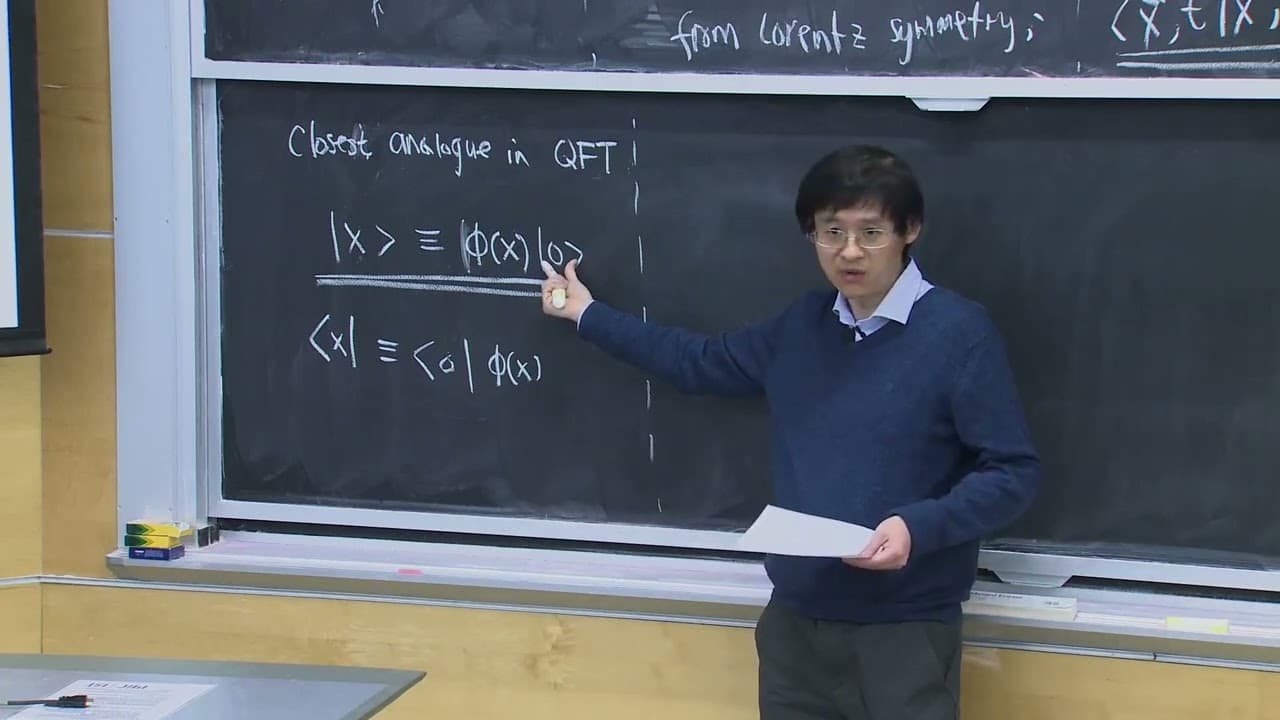
- 🖤 In quantum field theory, there is no natural way to define a localized state due to the lack of a position operator and the contradiction with Lorentz symmetry.
- 😚 The G plus function is the closest analog to a position eigenstate in quantum field theory, but it is only approximately localized within a distance of 1/m.
- 👾 The G plus function and other similar functions have specific properties due to symmetries, such as dependence on the difference between points and commutation for space-like separations.
Install to Summarize YouTube Videos and Get Transcripts
Explore YouTube Video Summarizer or Get YouTube Transcript Extractor
Questions & Answers
Q: Why can't we define a localized state in quantum field theory like in non-relativistic quantum mechanics?
In quantum field theory, the lack of a position operator and the absence of a natural definition for a localized state prevents us from defining such states. This is due to the fact that x is no longer an operator, but a label, making it impossible to define an eigenvector associated with a localized state.
Q: How does the lack of a position operator in quantum field theory contradict Lorentz symmetry?
The lack of a position operator in quantum field theory leads to a fundamental contradiction with Lorentz symmetry. This is because a localized state in space is not Lorentz covariant, meaning it does not transform nicely under Lorentz transformations. Therefore, the concept of a localized state in quantum field theory is not compatible with Lorentz symmetry.
Q: What is the closest analog to a position eigenstate in quantum field theory?
The closest analog to a position eigenstate in quantum field theory is the G plus function, which is defined as the overlap between two approximate localized states. It depends on the distance between two points in four-dimensional space-time and can be used to compute functions at later times.
Q: How does the G plus function behave when the two points are at equal time?
When the two points in the G plus function are at equal time, the function is not proportional to a delta function, meaning it is not a perfectly localized state. However, it is approximately localized within a distance of 1/m, where m is the mass of the particle. It is important to note that the G plus function is not genuinely localized, but it becomes very small at distances greater than 1/m.
Summary & Key Takeaways
-
The propagator is a key concept in non-relativistic quantum mechanics to compute functions at a later time. However, in quantum field theory, there is no natural way to define a localized state like in quantum mechanics due to the lack of a position operator.
-
The lack of a position operator in quantum field theory is due to the fact that x is no longer an operator, but rather a label. This also presents a fundamental contradiction with Lorentz symmetry.
-
The closest analog to a position eigenstate in quantum field theory is the G plus function, which depends on the distance between two points in four-dimensional space-time.
Read in Other Languages (beta)
Share This Summary 📚
Summarize YouTube Videos and Get Video Transcripts with 1-Click
Try YouTube Summary with ChatGPT & Claude or YouTube Transcript Generator
Explore More Summaries from MIT OpenCourseWare 📚
Summarize YouTube Videos and Get Video Transcripts with 1-Click
Try YouTube Summary with ChatGPT & Claude or YouTube Transcript Generator