Worked example: Using the ideal gas law to calculate number of moles | AP Chemistry | Khan Academy
TL;DR
Calculate the number of moles in a breath using the Ideal Gas Law and convert it to molecules.
Transcript
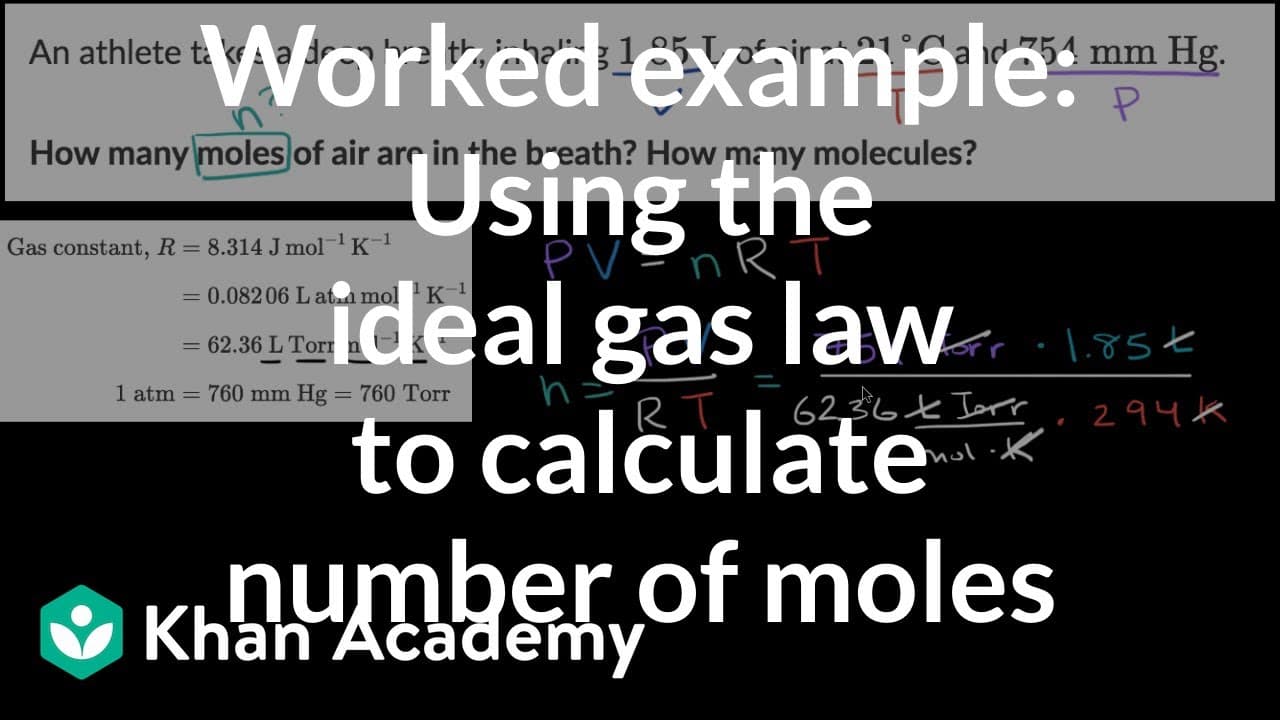
- [Instructor] We're told an athlete takes a deep breath, inhaling 1.85 liters of air at 21 degrees Celsius and 754 millimeters of mercury. How many moles of air are in the breath? How many molecules? So pause this video, and see if you can figure this out on your own. All right, now let's work through this together. So let's think about what they ... Read More
Key Insights
- 🫢 The Ideal Gas Law relates pressure, volume, temperature, and the number of moles of a gas.
- 🫢 The equation PV = nRT can be rearranged to solve for the number of moles. Divide the product of pressure and volume by the product of the ideal gas constant and temperature.
- #️⃣ The number of moles can be converted to the number of molecules by multiplying it by Avogadro's number (approximately 6.022 x 10^23).
- 😒 It is important to use appropriate units and conversions when applying the Ideal Gas Law.
- 🛝 Significant figures need to be considered when rounding the final results.
- 🫢 The Ideal Gas Law is a fundamental concept in chemistry and is commonly used in various calculations involving gases.
- #️⃣ Avogadro's number represents the number of molecules in one mole of a substance and is a fundamental constant in chemistry.
Install to Summarize YouTube Videos and Get Transcripts
Explore YouTube Video Summarizer or Get YouTube Transcript Extractor
Questions & Answers
Q: What is the Ideal Gas Law and how does it relate pressure, volume, temperature, and the number of moles?
The Ideal Gas Law is represented by the equation PV = nRT, where P is pressure, V is volume, n is the number of moles, R is the ideal gas constant, and T is temperature. It shows that pressure times volume is equal to the product of the number of moles, ideal gas constant, and temperature.
Q: How do we solve for the number of moles using the Ideal Gas Law?
By rearranging the Ideal Gas Law equation, we can solve for the number of moles (n). Divide both sides of the equation by RT, so n = PV / RT. Plug in the given values for pressure (P), volume (V), ideal gas constant (R), and temperature (T) to calculate the number of moles.
Q: How do we convert mmHg to Torr for pressure calculations?
In a first-year chemistry class, a millimeter of mercury (mmHg) can be viewed as equivalent to a Torr. Therefore, you can use the given pressure in mmHg directly as the value in Torr.
Q: How do we convert degrees Celsius to Kelvin for temperature calculations?
To convert degrees Celsius to Kelvin, simply add 273 to the given temperature in degrees Celsius. This conversion is necessary because the ideal gas constant is typically given in units of liter Torr per mole Kelvin.
Summary & Key Takeaways
-
The Ideal Gas Law relates pressure, volume, temperature, and the number of moles of a gas.
-
To calculate the number of moles in a given breath, divide the product of pressure and volume by the product of the ideal gas constant and temperature.
-
Each mole of a gas contains approximately 6.022 x 10^23 molecules, so to find the number of molecules in the breath, multiply the number of moles by Avogadro's number.
Read in Other Languages (beta)
Share This Summary 📚
Summarize YouTube Videos and Get Video Transcripts with 1-Click
Try YouTube Summary with ChatGPT & Claude or YouTube Transcript Generator
Explore More Summaries from Khan Academy 📚



Summarize YouTube Videos and Get Video Transcripts with 1-Click
Try YouTube Summary with ChatGPT & Claude or YouTube Transcript Generator