Alkene + Br2 + H2O
TL;DR
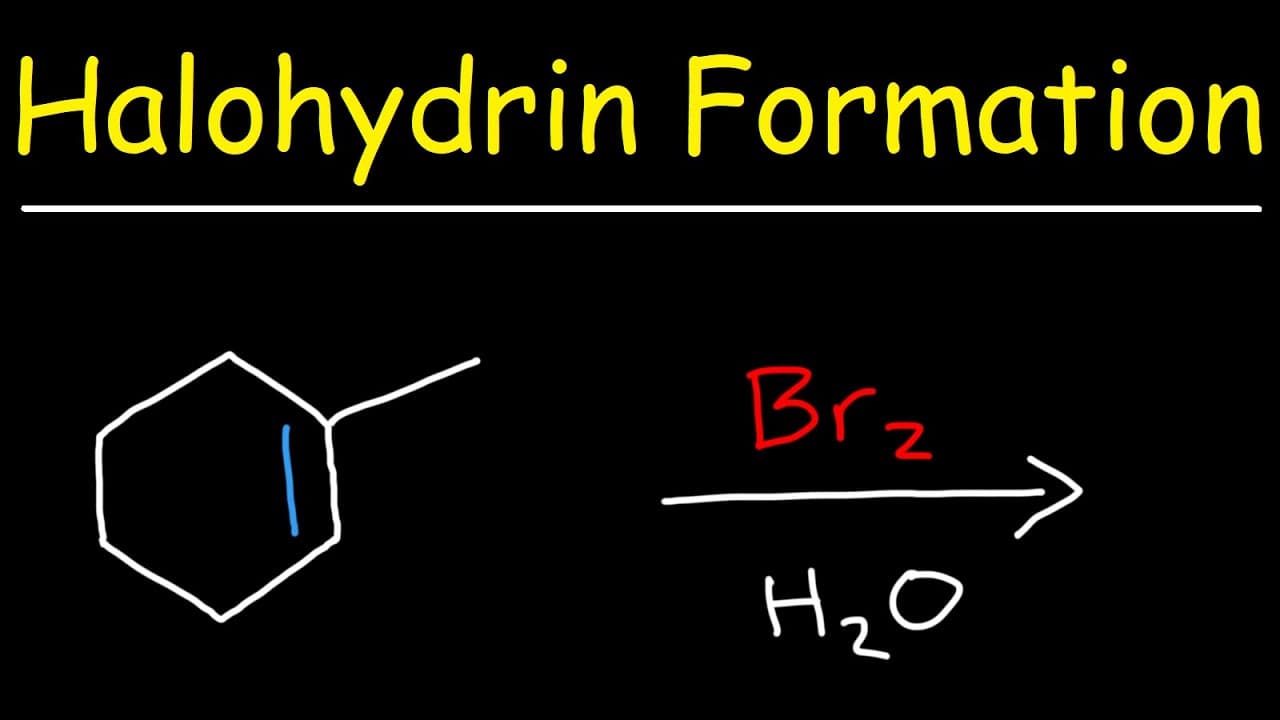
This video explains the reaction between an alkene and bromine in water, resulting in the formation of a halo hydrant with selective product distribution based on the primary and secondary carbons. The reaction can yield stereoisomers due to chirality of the secondary carbon.
Transcript
in this video we're gonna talk about the reaction between an alkene and bromine in the presence of water so this reaction is going to produce a product known as a halo hydrant but for this example more specifically a bromo hydron now there's two carbons that are of interest in this reaction the primary carbon in the double bond and the secondary ca... Read More
Key Insights
- 😇 The reaction between an alkene and bromine in the presence of water forms a halo hydrant, specifically a bromo hydron.
- 🫀 Selective distribution of the hydroxyl group and bromine atom occurs on the more substituted secondary carbon and the less substituted primary carbon, respectively.
- ❓ Stereoisomers can be obtained due to the chirality of the secondary carbon, resulting in a potential mixture of products.
- 💦 Water acts as a nucleophile, preferentially attacking the secondary carbon despite the greater accessibility of the primary carbon.
- 👊 The reaction proceeds through an electrophilic addition mechanism, involving the alkene attacking the bromine atom, forming a cyclic intermediate.
- 💦 The mechanism continues with water acting as a nucleophile, attacking the secondary carbon, and an additional water molecule abstracting a proton to yield the halo hydrogen product.
- 🙃 The reaction exhibits anti-addition stereochemistry, with the hydroxyl group and bromine atom positioned on opposite sides of the product.
Install to Summarize YouTube Videos and Get Transcripts
Explore YouTube Video Summarizer or Get YouTube Transcript Extractor
Questions & Answers
Q: What is the product obtained when an alkene reacts with bromine in the presence of water?
The reaction yields a halo hydrant, specifically a bromo hydron. The hydroxyl group preferentially attaches to the more substituted secondary carbon, while the bromine atom attaches to the less substituted primary carbon.
Q: Why does water prefer to attack the secondary carbon instead of the more accessible primary carbon?
While the primary carbon is more accessible for nucleophilic attack, the secondary carbon's partial positive charge due to resonance stabilization draws the nucleophile (water) towards itself, resulting in the attack on the secondary carbon.
Q: How does the stereochemistry of the carbon atoms in the alkene affect the reaction?
The reaction proceeds with anti-addition, meaning that the hydroxyl group and the bromine atom are on opposite sides of the product. If the hydroxyl group is placed in the front, the bromine atom will be at the back, and vice versa, resulting in a mixture of stereoisomers.
Q: What happens if a one methyl cyclohexene is reacted with bromine in the presence of water?
The major product of this reaction will have the hydroxyl group attached to the more substituted (tertiary) double bonded carbon and the bromine atom attached to the secondary carbon. However, the reaction can also yield an enantiomer with the positions of the hydroxyl group and bromine atom switched.
Summary & Key Takeaways
-
The reaction between an alkene and bromine in water produces a halo hydrant, specifically a bromo hydron, with distinct product distributions on the primary and secondary carbons.
-
The more substituted secondary carbon gains a hydroxyl group, while the less substituted primary carbon gains a bromine atom as the product of this VG o selective reaction.
-
Stereochemistry plays a role, with the secondary carbon being chiral, resulting in a potential mixture of stereoisomers.
Read in Other Languages (beta)
Share This Summary 📚
Summarize YouTube Videos and Get Video Transcripts with 1-Click
Try YouTube Summary with ChatGPT & Claude or YouTube Transcript Generator
Explore More Summaries from The Organic Chemistry Tutor 📚



Summarize YouTube Videos and Get Video Transcripts with 1-Click
Try YouTube Summary with ChatGPT & Claude or YouTube Transcript Generator