Products
Features
YouTube Video Summarizer
Summarize YouTube videos
Web & PDF Highlighter
Highlight web pages & PDFs
Chat with PDF
Ask any PDF questions with AI
Ask AI Clone
Chat with your highlights & memories
Audio Transcriber
Transcribe audio files to text
Glasp Reader
Read and highlight articles
Kindle Highlight Export
Export your Kindle highlights
Idea Hatch
Hatch ideas from your highlights
Integrations
Obsidian Plugin
Notion Integration
Pocket Integration
Instapaper Integration
Medium Integration
Readwise Integration
Snipd Integration
Hypothesis Integration
Apps & Extensions
Chrome Extension
Safari Extension
Edge Add-ons
Firefox Add-ons
iOS App
Android App
Discover
Discover
Ideas
Discover new ideas and insights
Articles
Curated articles and insights
Books
Book recommendations by great minds
Posts
Essays and notes from readers
Quotes
Inspiring quotes collection
Videos
Curated videos and summaries
Explore Glasp
Glasp Newsletter
Weekly insights and updates
Glasp Talk
Interview series with great minds
Glasp Blog
Latest news and articles
Glasp Use Cases
Learn how others use Glasp
Build & Support
Glasp API
Access Glasp's API for developers
MCP Connector
Connect Glasp to Claude & ChatGPT
Community
Glasp Reddit Community
Students
Student discount and benefits
FAQs
Frequently Asked Questions
AboutPricing
DashboardLog inSign up

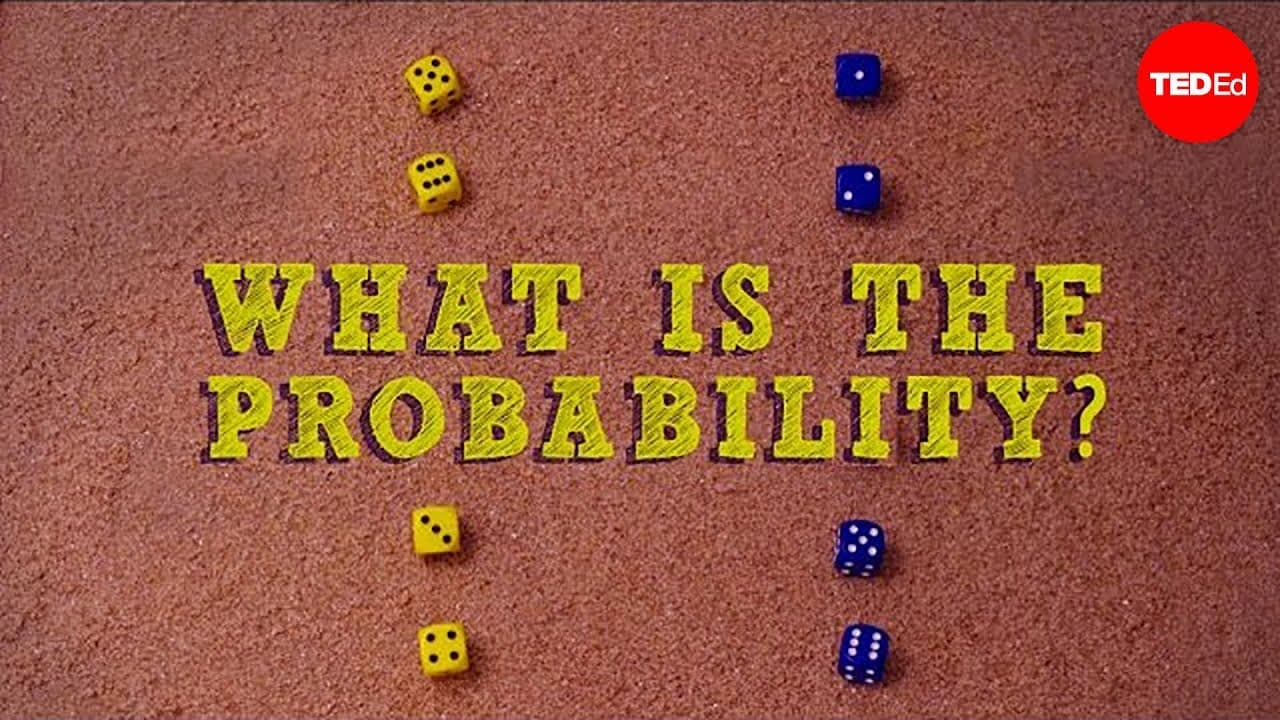
The last banana: A thought experiment in probability - Leonardo Barichello
1.6M views
•
February 23, 2015
by
TED-Ed
YouTube video player
The last banana: A thought experiment in probability - Leonardo Barichello

TL;DR

Understanding the probability behind winning a dice game on a desert island.

Transcript

You and a fellow castaway are stranded on a desert island playing dice for the last banana. You've agreed on these rules: You'll roll two dice, and if the biggest number is one, two, three or four, player one wins. If the biggest number is five or six, player two wins. Let's try twice more. Here, player one wins, and here it's player two. So who ... Read More

Key Insights

  • 🎲 Player two has a higher chance of winning the dice game on the island due to probability.
  • 🏆 Understanding the distribution of outcomes is crucial to predicting the winner in a random event.
  • 🤩 The joint probability of independent events plays a key role in determining overall success.
  • 🤣 Random events like dice rolling might not adhere to expected probabilities in a small number of instances.
  • ⌛ Repeating random events numerous times helps outcomes approach their theoretical probabilities.
  • ❓ Theoretical probabilities provide insights into the likelihood of particular outcomes in random events.

Install to Summarize YouTube Videos and Get Transcripts

Explore YouTube Video Summarizer or Get YouTube Transcript Extractor

Questions & Answers

Q: Why does player two have a higher chance of winning the dice game?

Player two has a 56% chance of winning because the probability favors outcomes where five or six is the highest number rolled on the dice, which happens more frequently.

Q: How can we calculate the probability of each player winning?

The probability of each player winning can be calculated by listing all possible combinations, understanding the frequency of outcomes, and multiplying the probabilities of independent events.

Q: Why is it important to consider the joint probability of independent events in this dice game?

Considering the joint probability helps determine the overall likelihood of a specific outcome, such as a player winning, by multiplying the probabilities of individual events occurring.

Q: Why are random events like dice rolling considered unpredictable?

Random events like dice rolling are unpredictable because even though theoretical probabilities can be calculated, actual outcomes can vary in a small number of events due to the element of chance.

Summary & Key Takeaways

  • Players roll two dice to win the last banana on a desert island.

  • Player two actually has a 56% chance of winning each match due to the probability distribution.

  • The chance of winning depends on the combination of numbers rolled on the dice.


Read in Other Languages (beta)

English

Share This Summary 📚

Summarize YouTube Videos and Get Video Transcripts with 1-Click

Download browser extensions on:

Try YouTube Summary with ChatGPT & Claude or YouTube Transcript Generator

Explore More Summaries from TED-Ed 📚
The tragic myth of Orpheus and Eurydice - Brendan Pelsue thumbnail
The tragic myth of Orpheus and Eurydice - Brendan Pelsue
TED-Ed
What Do Global Greetings Reveal About Peace? thumbnail
What Do Global Greetings Reveal About Peace?
TED-Ed
A glimpse of teenage life in ancient Rome - Ray Laurence thumbnail
A glimpse of teenage life in ancient Rome - Ray Laurence
TED-Ed
Can you solve "Einstein’s Riddle"? - Dan Van der Vieren thumbnail
Can you solve "Einstein’s Riddle"? - Dan Van der Vieren
TED-Ed
Why good ideas get trapped in the valley of death— and how to rescue them thumbnail
Why good ideas get trapped in the valley of death— and how to rescue them
TED-Ed
How to spot a pyramid scheme - Stacie Bosley thumbnail
How to spot a pyramid scheme - Stacie Bosley
TED-Ed

Summarize YouTube Videos and Get Video Transcripts with 1-Click

Download browser extensions on:

Try YouTube Summary with ChatGPT & Claude or YouTube Transcript Generator

Apps & Extensions

  • Chrome Extension
  • Safari Extension
  • Edge Add-ons
  • Firefox Add-ons
  • iOS App
  • Android App

Key Features

  • YouTube Video Summarizer
  • Web & PDF Summarizer
  • Web & PDF Highlighter
  • Chat with PDF
  • Ask AI Clone
  • Audio Transcriber
  • Glasp Reader
  • Kindle Highlight Export
  • Idea Hatch

Integrations

  • Obsidian Plugin
  • Notion Integration
  • Pocket Integration
  • Instapaper Integration
  • Medium Integration
  • Readwise Integration
  • Snipd Integration
  • Hypothesis Integration

More Features

  • APIs
  • MCP Connector
  • Blog & Post
  • Embed Links
  • Image Highlight
  • Personality Test
  • Quote Shots

Company

  • About us
  • Blog
  • Community
  • FAQs
  • Job Board
  • Newsletter
  • Pricing
Terms

•

Privacy

•

Guidelines

© 2026 Glasp Inc. All rights reserved.