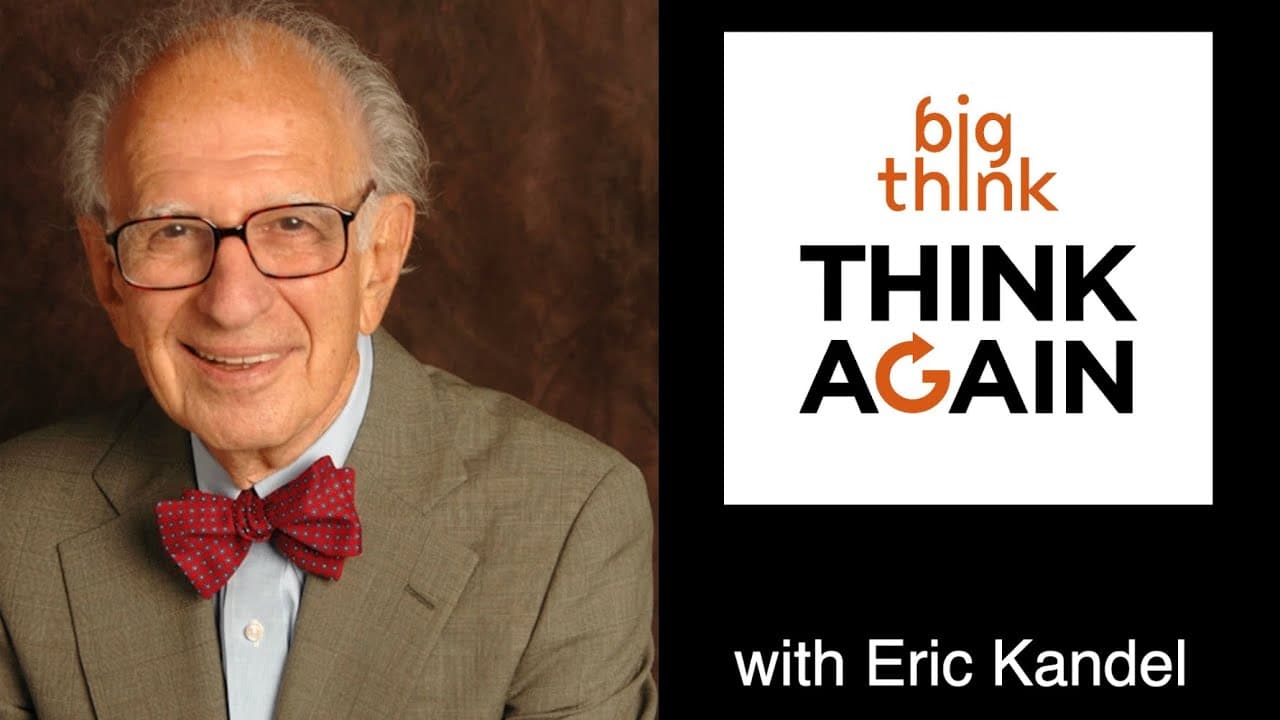
Eric Kandel - Think Again Podcast - The Eye of the Beholder
TL;DR
- Nobel laureate Eric Kandel discusses memory, art, reductionism, and the divide between science and humanities.
Transcript
hi there I'm Jason guts and you're listening to think again a big fink podcast since 2008 big thing has been sharing big ideas and little doses from some of the most creative thinkers around on the think again podcast we take ourselves out of our comfort zone surprising my guests and me your host we have unexpected interview clips from big thinks a... Read More
Key Insights
- 🥰 Kandel's exploration of reductionism bridges the gap between art and science for deeper understanding.
- 🧑🔬 Memory unreliability challenges scientists to grasp its complex biological underpinnings.
- 😨 The discussion on demagoguery and fear relates historical experiences to contemporary political dynamics.
- ❓ The necessity of empirical testing in psychology reshapes traditional psychoanalytic approaches.
- 🤯 The merging of cognitive psychology and brain science leads to deeper insights in understanding the mind.
Install to Summarize YouTube Videos and Get Transcripts
Explore YouTube Video Summarizer or Get YouTube Transcript Extractor
Questions & Answers
Q: How does Eric Kandel address the divide between humanities and sciences?
Kandel asserts that scientists can also have humanistic aspirations, illustrated by the study of memory to understand human identity. He emphasizes that the arts and sciences share common methodologies and goals.
Q: What is reductionism in art and brain science according to Kandel?
Reductionism involves simplifying complex phenomena into their component parts to gain new insights. Kandel cites examples in modern art and science, such as focusing on color in painting to convey emotion.
Q: What challenges exist in understanding memory according to Kandel?
Kandel discusses the reliability and unreliability of memory, highlighting how memories can be modified over time without awareness. The brain's susceptibility to disruption and distortion during memory formation poses a major challenge for understanding memory processes.
Q: How does Kandel connect history with current political fear dynamics?
Drawing from his personal experience during Hitler's rise in Austria, Kandel reflects on fear-induced behaviors and demagoguery. His observations on how fear impacts group dynamics and stereotyping shed light on contemporary political environments.
Summary & Key Takeaways
-
Professor Eric Kandel explores the cultural divide between humanities and sciences, emphasizing humanistic goals in scientific research.
-
Reductionism in art and brain science is discussed, highlighting how artists and scientists simplify complex problems for deeper insights.
-
Kandel delves into memory, describing its reliability and unreliability, and the need to understand the biological basis of memory.
Read in Other Languages (beta)
Share This Summary 📚
Summarize YouTube Videos and Get Video Transcripts with 1-Click
Try YouTube Summary with ChatGPT & Claude or YouTube Transcript Generator
Explore More Summaries from Big Think 📚



Summarize YouTube Videos and Get Video Transcripts with 1-Click
Try YouTube Summary with ChatGPT & Claude or YouTube Transcript Generator