Security - Polarity
TL;DR
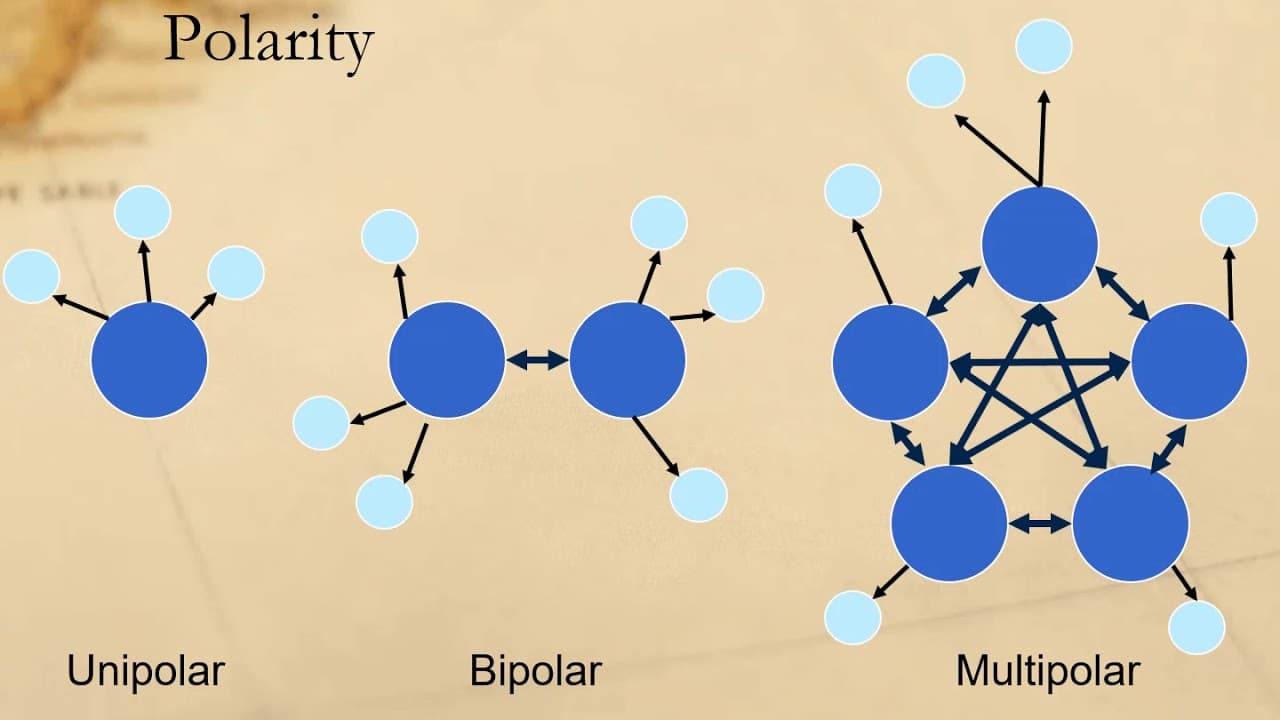
Polarity in international relations refers to the number of major powers or poles in the international system, which determines the distribution of power and likelihood of conflict.
Transcript
Hey everyone. Noah Zerbe here. This is one in a series of a number of short videos where we're going to be looking at key concepts in international relations. This video deals specifically with the idea of polarity. The idea of polarity is central to understanding the distribution of power in the international system. But what exactly do we mean by... Read More
Key Insights
- ✊ Polarity in international relations refers to the concentration of power and the number of major powers or poles in the international system.
- 🇺🇸 Unipolar systems have a single dominant power, such as the United States after the Cold War.
- 🇺🇸 Bipolar systems involve two dominant powers or blocs, like the United States and the Soviet Union during the Cold War.
- ✊ Multipolar systems have three or more major powers competing for dominance.
- 💭 Different schools of thought have varying views on the stability and conflict-proneness of each system of polarity.
- ✊ Polarity is a central concept in realist analysis, emphasizing the distribution of power and its impact on the likelihood of conflict.
- 🎖️ Polarity also includes economic and cultural influence, not just military force.
Install to Summarize YouTube Videos and Get Transcripts
Explore YouTube Video Summarizer or Get YouTube Transcript Extractor
Questions & Answers
Q: How is polarity defined in international relations?
Polarity refers to the number of major powers or poles in the international system, representing the concentration of economic and military capabilities.
Q: What are the three types of polarity?
The three types of polarity are unipolar (one dominant power), bipolar (two dominant powers), and multipolar (three or more major powers).
Q: What are some examples of unipolar systems?
The United States immediately after the Cold War is an example of a unipolar system, where a single dominant power exerted extensive influence over global affairs.
Q: Which system of polarity is considered the most stable?
Different scholars have different opinions. Some argue that unipolar systems tend to be the most stable, while others believe bipolar systems are more stable due to the relative balance between the two dominant powers.
Q: Are multipolar systems more or less prone to war?
There are conflicting theories. Classical realists suggest that multipolar systems are the least war-prone, while neorealists argue that the unpredictability of multipolar systems increases the likelihood of conflict.
Summary & Key Takeaways
-
Polarity refers to the concentration of economic and military power in the international system, determining the distribution of power and the likelihood of conflict.
-
There are three types of polarity: unipolar (one dominant power), bipolar (two dominant powers), and multipolar (three or more major powers).
-
Different schools of thought debate which system of polarity is most stable and least conflict-prone.
Read in Other Languages (beta)
Share This Summary 📚
Summarize YouTube Videos and Get Video Transcripts with 1-Click
Try YouTube Summary with ChatGPT & Claude or YouTube Transcript Generator
Explore More Summaries from Noah Zerbe 📚




Summarize YouTube Videos and Get Video Transcripts with 1-Click
Try YouTube Summary with ChatGPT & Claude or YouTube Transcript Generator