How To Discover Weird New Particles | Emergent Quantum Quasiparticles
TL;DR
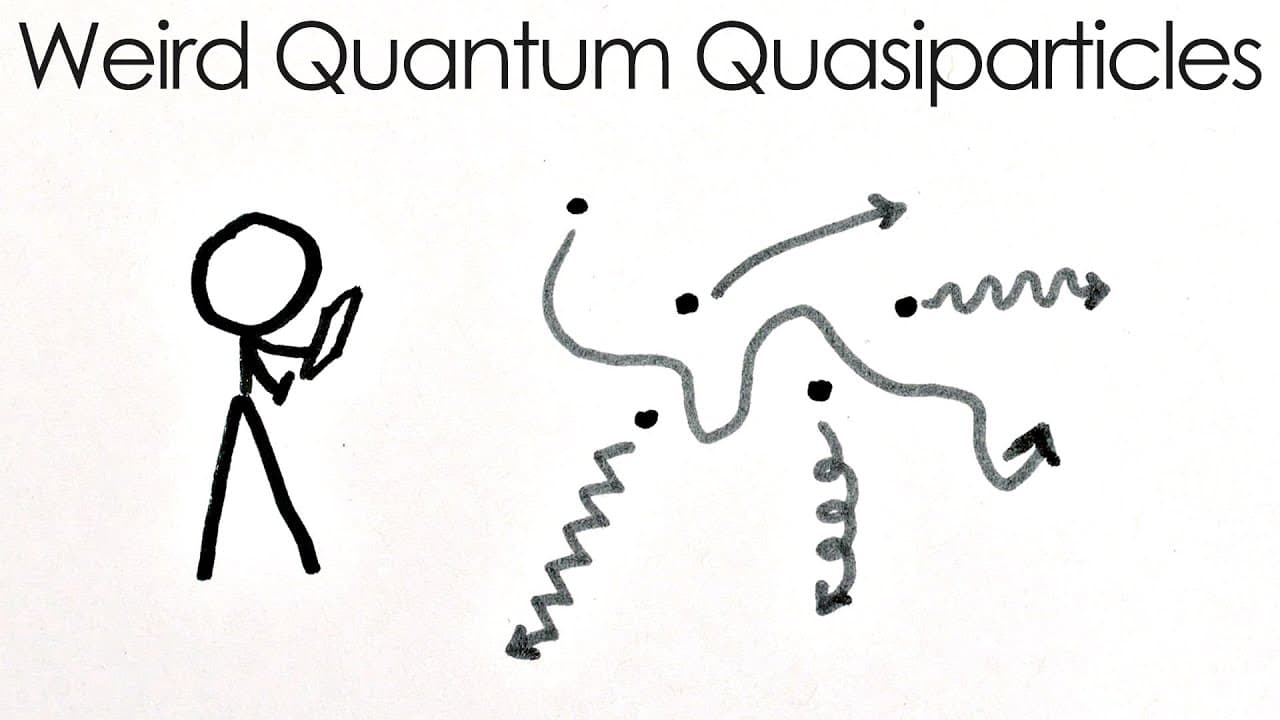
Physicists use three approaches to discover and catalog new particles: building composite particles, smashing particles together, and exploring particle-like behaviors through collective quantum interactions.
Transcript
Physicists love particles, and with good reason – almost everything in the universe is made up of particles, so the physicist’s approach to understanding the universe is to understand the particles that make it up. If you want to discover and catalogue new particles (which physicists do), here are three approaches you can take. First, you can take ... Read More
Key Insights
- ❓ The physicist's approach to understanding the universe is by studying particles that make it up.
- 😒 Physicists use three approaches to discover and catalog new particles: building composites, smashing particles, and exploring particle-like behaviors through collective quantum interactions.
- 🈸 Materials with emergent particles have practical technological applications.
- 🥶 Composite particles are created by sticking together old particles.
- 👶 Smashing particles together sometimes reveals new fundamental building blocks.
- ❓ Emergent particles in materials exhibit diverse and bizarre behaviors.
- 🌍 Discovering fundamental particles is dependent on the natural world, while emergent particles can be actively found and curated.
Install to Summarize YouTube Videos and Get Transcripts
Explore YouTube Video Summarizer or Get YouTube Transcript Extractor
Questions & Answers
Q: What are the three approaches physicists use to discover and catalog new particles?
The three approaches are building composite particles, smashing particles together, and exploring particle-like behaviors through collective quantum interactions.
Q: What are composite particles, and how are they created?
Composite particles are new particles formed by sticking together old particles that scientists already know about. They are built by chemists and molecular biologists, similar to building with Legos.
Q: How do physicists try to discover new fundamental building blocks of the universe?
Physicists smash old particles together with increasing violence in hopes of breaking them apart into previously unknown constituents or exciting new particles into existence from the underlying quantum fields.
Q: What are emergent particles, and how are they different from fundamental particles?
Emergent particles are not fundamental constituents of the universe but rather particles that emerge when collections of electrons are put together in certain materials. They exhibit diverse and bizarre behaviors that are different from fundamental particles.
Summary & Key Takeaways
-
Physicists understand the universe by studying particles that make it up and aim to discover and catalog new particles.
-
Three approaches to finding new particles are building composite particles, smashing particles together, and exploring particle-like behaviors through collective quantum interactions.
-
Materials with emergent particles have practical technological applications in electronics, computer chips, magnets, and more.
Read in Other Languages (beta)
Share This Summary 📚
Summarize YouTube Videos and Get Video Transcripts with 1-Click
Try YouTube Summary with ChatGPT & Claude or YouTube Transcript Generator
Explore More Summaries from minutephysics 📚


Summarize YouTube Videos and Get Video Transcripts with 1-Click
Try YouTube Summary with ChatGPT & Claude or YouTube Transcript Generator