How Does the Franklin Effect Help Build Relationships?
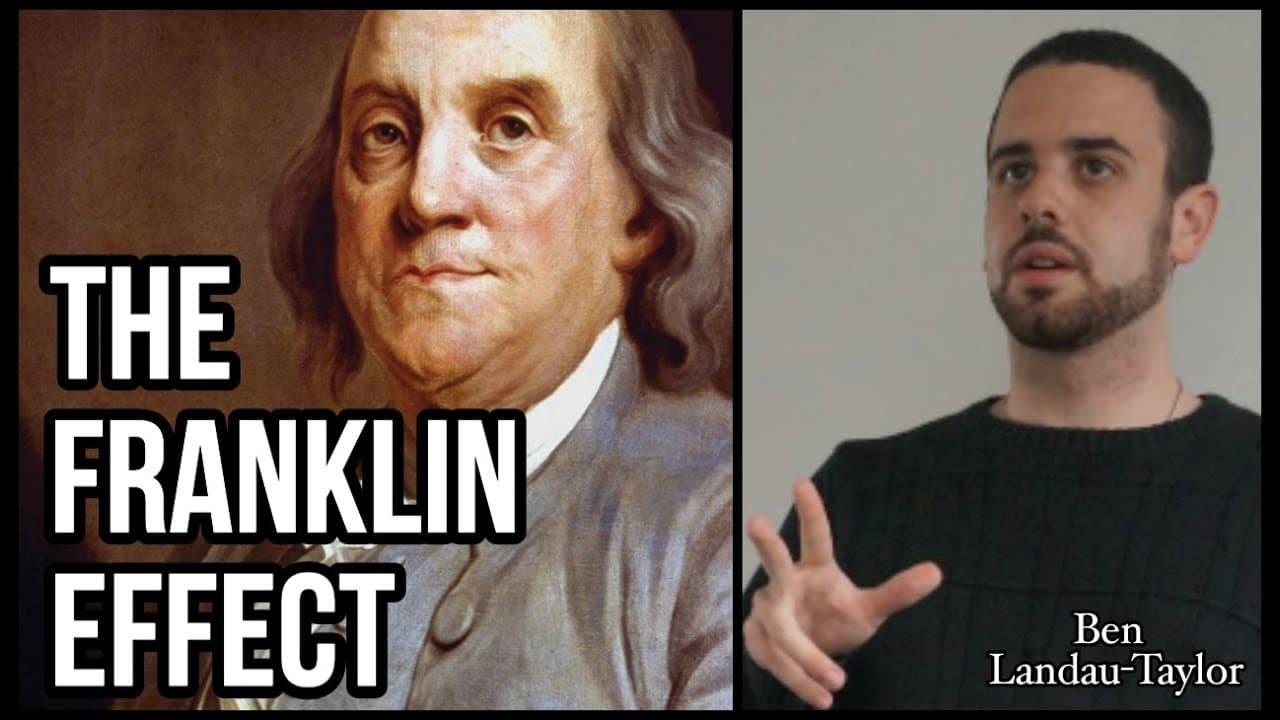
TL;DR
The Franklin Effect suggests that asking someone for a favor can strengthen relationships, as people feel closer to those they help. This occurs due to cognitive dissonance, where the helper views themselves as a friend because they did a positive action. For effective networking, it's crucial to reciprocate and provide value in return to solidify these connections.
Transcript
it Ben Franklin's autobiography he tells a story of how he turned one of his rivals in the Pennsylvania General Assembly into an ongoing friend and Ally and it started with asking this rifle to lend him a book and this was the beginning of an ongoing relationship and back and forth which ended with them being pretty close and he makes the general p... Read More
Key Insights
- 😷 Building relationships often involves asking for favors, as it establishes a sense of friendship and value.
- 🖐️ Cognitive dissonance plays a role in favorholders' behavior, as they align their actions with their self-perception.
- ❓ The outcome of favors depends on how they are utilized, with positive outcomes reinforcing the relationship.
- ❓ Strategic individuals should avoid assuming irrationality in behavior they don't understand and instead seek to understand potential hidden knowledge.
- 🏛️ Networking and relationship-building require reciprocity and demonstrating the ability to provide value in return.
- 🫒 Personal experiences suggest that receiving a favor without follow-up and reciprocation may result in a short-lived relationship.
- 💦 Demonstrating the ability to work well with a favor received can be a powerful demonstration of one's value as a potential ally or friend.
Install to Summarize YouTube Videos and Get Transcripts
Explore YouTube Video Summarizer or Get YouTube Transcript Extractor
Questions & Answers
Q: How did Ben Franklin build a relationship with his rival in the Pennsylvania General Assembly?
Ben Franklin asked his rival to lend him a book, initiating a relationship that eventually led to them becoming friends. This technique showcases the power of asking for favors.
Q: What is cognitive dissonance?
Cognitive dissonance is a psychological concept where people try to align their actions with their self-perception and created stories. In the case of favorholders, they may develop a story that they are helpful, leading them to continue doing favors.
Q: How does the outcome of a favor depend on the recipient's actions?
If the favor is wasted and not utilized effectively, it may negatively impact the relationship. However, if the favor is beneficial and reciprocated, it can strengthen the bond and lay the foundation for a valuable relationship.
Q: Why do people make the mistake of assuming behavior they don't understand is irrational?
Strategic individuals may assume that behavior they find silly is irrational because they believe they possess a deeper understanding of the world. However, it is important to consider that successful individuals may have insights and knowledge that others do not.
Summary & Key Takeaways
-
Ben Franklin's autobiography shares a story of how he turned one of his rivals into a friend by asking him for a favor.
-
Psychologists explain this phenomenon as cognitive dissonance, where people conform to the story they create for themselves after doing a favor.
-
Personal experiences show that the outcome of a favor depends on how it is utilized, with positive outcomes reinforcing the relationship.
Read in Other Languages (beta)
Share This Summary 📚
Summarize YouTube Videos and Get Video Transcripts with 1-Click
Try YouTube Summary with ChatGPT & Claude or YouTube Transcript Generator
Explore More Summaries from Samo Burja 📚




Summarize YouTube Videos and Get Video Transcripts with 1-Click
Try YouTube Summary with ChatGPT & Claude or YouTube Transcript Generator