The Guarani Language
TL;DR
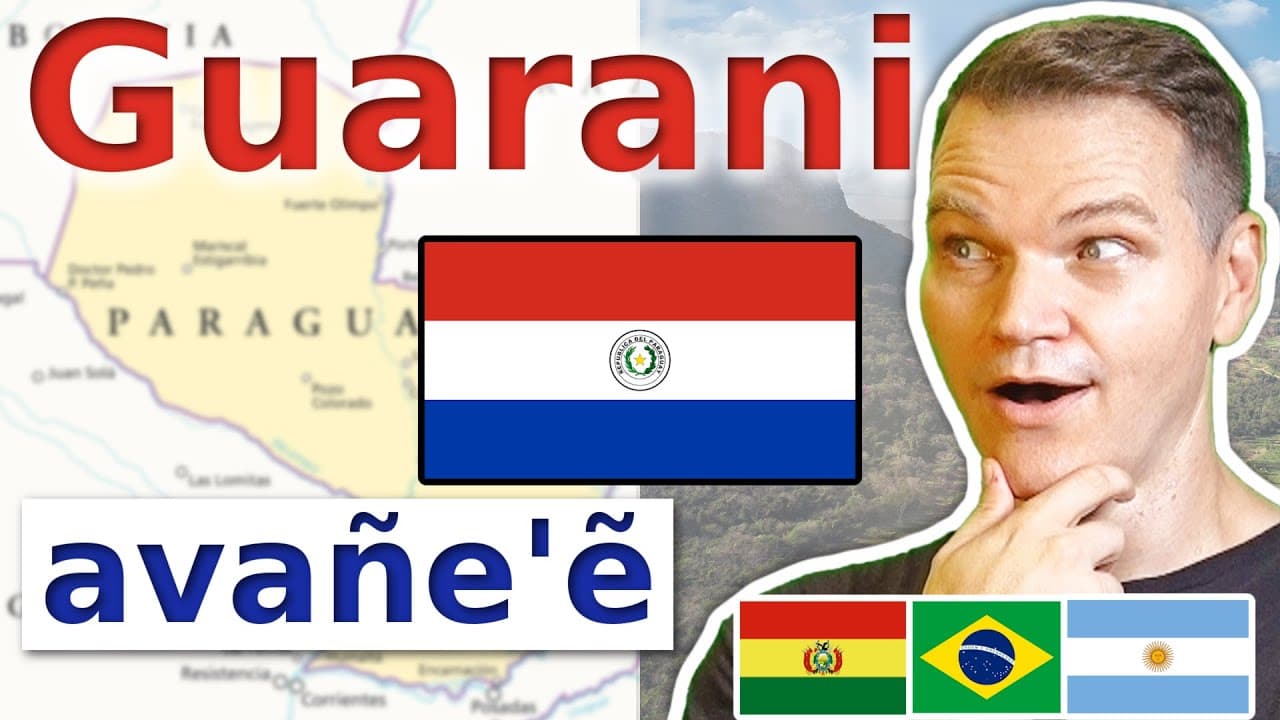
Guarani is a resilient indigenous language widely spoken in Paraguay.
Transcript
since the colonization of the Americas a huge number of indigenous languages have disappeared and of the remaining ones most are endangered but one language that has been remarkably resilient is guani also known by its endonym guani is not just an official language of Paraguay alongside Spanish but it's also spoken by the majority of the population... Read More
Key Insights
- Guarani is an indigenous language that has remained resilient despite the disappearance of many other indigenous languages since the colonization of the Americas.
- Guarani is an official language of Paraguay alongside Spanish and is spoken by the majority of the population, including many non-indigenous people.
- The language is part of the Tupi-Guarani branch of the Tupan language family and has several varieties, some of which have low mutual intelligibility.
- Historically, Guarani was not a written language until Jesuit missionaries documented it, creating a standardized form and educational materials.
- The language survived colonial times partly due to the isolated location of Spanish settlements and the Jesuit missions that used Guarani for conversion efforts.
- Guarani experienced repression and revival over time, with the language being used for nationalist purposes and eventually being recognized as an official language in 1992.
- Jopara, a mixture of Guarani and Spanish, is commonly spoken, with the degree of mixing varying by region and demographic.
- Guarani is a highly agglutinative language, featuring complex verb conjugations and a unique system of nasal harmony and vowel distinctions.
Install to Summarize YouTube Videos and Get Transcripts
Explore YouTube Video Summarizer or Get YouTube Transcript Extractor
Questions & Answers
Q: Why has Guarani remained resilient compared to other indigenous languages?
Guarani has remained resilient due to several factors, including its status as an official language of Paraguay and its widespread use among both indigenous and non-indigenous populations. Historically, the isolated location of Spanish settlements and the Jesuit missions' use of the language for conversion efforts helped preserve it. Additionally, Guarani was used as a nationalist tool, which further cemented its place in Paraguayan society.
Q: What role did Jesuit missionaries play in the history of Guarani?
Jesuit missionaries played a crucial role in the history of Guarani by being the first to document and describe the language. They developed a standardized form of Guarani, created dictionaries, grammars, and textbooks, and used the language in their missionary work to convert indigenous people to Catholicism. This documentation and standardization were vital in preserving and promoting the use of Guarani during colonial times.
Q: How is Jopara different from traditional Guarani?
Jopara is a form of Guarani that involves heavy code-switching with Spanish, incorporating elements of Spanish grammar and vocabulary. It ranges from mostly Guarani with some Spanish elements to mostly Spanish with Guarani elements, depending on the speaker and context. In contrast, traditional Guarani is less influenced by Spanish and is often used in more formal or educational settings.
Q: What are some unique linguistic features of Guarani?
Guarani is an agglutinative language, meaning it uses prefixes and suffixes to express grammatical distinctions rather than separate words. It features nasal harmony, where nasality spreads to adjacent parts of a word, and has six pairs of vowels with nasal equivalents. The language also distinguishes between inclusive and exclusive 'we' and has flexible word order in sentences.
Q: How has Guarani been used in Paraguayan politics?
Guarani has been used in Paraguayan politics as a tool for nationalist pride, particularly during times of war. It was employed to rally the population and foster a sense of national identity. In the mid-20th century, populist politicians began to speak more favorably of Guarani to appeal to the Guarani-speaking majority, leading to its recognition as a national language in 1967 and an official language in 1992.
Q: What challenges does Guarani face in terms of language resources?
Guarani faces challenges in terms of language resources, as there are limited materials available for learners. While Duolingo offers a course for Spanish speakers, it is underdeveloped, and other resources are often basic or focused on grammar rather than comprehensive language learning. This lack of resources makes it difficult for non-native speakers to learn and engage with the language fully.
Q: How does Guarani handle tense and aspect in verbs?
In Guarani, verbs without specific tense marking can be interpreted as either present or past, depending on context. There are also tense and aspect markers that can be added to verbs. For example, the suffix 'kuri' indicates the distant past, while 'ta' marks the future tense. Aspect can be shown with postpositions like 'ma' for progressive actions, and negation involves a circumfix surrounding the verb.
Q: What is the significance of demonstratives in Guarani?
Demonstratives in Guarani are significant because they provide several distinctions beyond the simple near and far found in English. Guarani demonstratives can indicate near, middle distance, far distance, absent or previously mentioned, and unseen but audible objects. This complexity allows for precise communication about the location and relevance of objects in conversation.
Summary & Key Takeaways
-
Guarani, an indigenous language of South America, has shown remarkable resilience against the backdrop of disappearing indigenous languages. It is an official language in Paraguay and is spoken by a significant majority of the population, including non-indigenous people, making it an integral part of the country's cultural identity.
-
The language's survival is attributed to historical factors such as the Jesuit missionaries who documented and standardized it, the isolated location of Spanish settlements, and its use as a nationalist tool. Despite periods of repression, Guarani gained official status alongside Spanish in 1992, securing its place in modern society.
-
Guarani's complex linguistic features include a highly agglutinative structure, nasal harmony, and a dynamic interaction with Spanish known as Jopara. This blending of languages varies across different regions and demographics, reflecting the language's adaptability and ongoing evolution in response to cultural and social influences.
Read in Other Languages (beta)
Share This Summary 📚
Summarize YouTube Videos and Get Video Transcripts with 1-Click
Try YouTube Summary with ChatGPT & Claude or YouTube Transcript Generator
Explore More Summaries from Langfocus 📚

Summarize YouTube Videos and Get Video Transcripts with 1-Click
Try YouTube Summary with ChatGPT & Claude or YouTube Transcript Generator