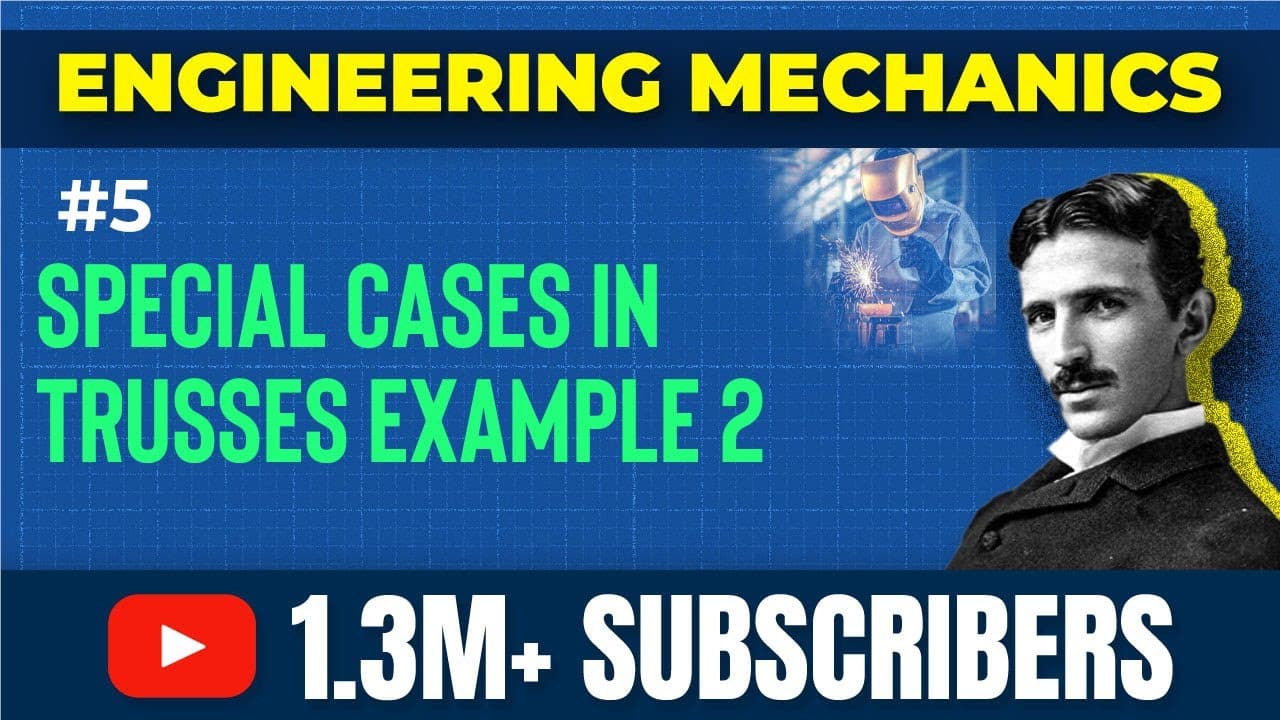
Special Cases in Trusses Example 2 - Truses - Engineering Mechanics
TL;DR
This video explains the step-by-step process for solving truss examples, including determining stability criteria, finding support reactions, and calculating forces in each member.
Transcript
okay students now this is the second example that we have for special cases in trusses now we are very much clear about how to go in solving the truss example the first step that we do is we find out the stability criteria then we move on to find out the support reactions and after that we do the calculations for each joint so that we can find out ... Read More
Key Insights
- #️⃣ The stability criteria formula, m = 2j - r, is used to determine if a truss is stable based on the number of members, joints, and reactions.
- 🎢 Support reactions in a truss are found by converting hinge and roller supports into vertical and horizontal reactions and applying conditions of equilibrium.
- ❓ The method of joints is a commonly used technique to determine the forces in each member of a truss by analyzing forces at individual joints.
- 👻 Special cases in truss analysis allow for direct determination of forces in members based on observed collinear forces at specific joints.
- ❓ Adjusting assumptions of reaction directions may be necessary during the calculation of support reactions to ensure equilibrium.
- 💨 The table method is a convenient way to summarize the forces in each member of a solved truss example.
- ❓ Truss analysis involves a systematic step-by-step approach to ensure accurate determination of stability, support reactions, and forces in members.
Install to Summarize YouTube Videos and Get Transcripts
Explore YouTube Video Summarizer or Get YouTube Transcript Extractor
Questions & Answers
Q: How do you determine if a truss is stable or not?
The truss stability is determined using the stability criteria formula: m = 2j - r, where m is the number of members, j is the number of joints, and r is the number of reactions. If the equation holds true, the truss is stable.
Q: How do you find support reactions in a truss?
Support reactions are found by converting hinge supports into two reactions (vertical and horizontal) and using conditions of equilibrium. The assumption of reaction directions may need to be adjusted based on the calculation results.
Q: What is the method of joints used for in truss analysis?
The method of joints is used to calculate the forces in each member of a truss. It involves analyzing the equilibrium of forces at each joint and applying the principle of forces acting in opposite directions along a member.
Q: How do you apply special cases in solving truss examples?
Special cases in truss analysis occur when forces in certain members can be directly determined through observation. For example, if a joint has collinear forces, the force in one member may be equal to the reaction force in the same direction.
Summary & Key Takeaways
-
The video provides guidance on solving truss examples by following three main steps: stability criteria, support reactions, and forces in members.
-
Stability criteria is determined using the equation m = 2j - r, where m is the number of members, j is the number of joints, and r is the number of reactions.
-
Support reactions are found by converting hinge supports into two reactions and applying conditions of equilibrium. The assumption of reaction directions may need to be adjusted based on the calculation results.
Read in Other Languages (beta)
Share This Summary 📚
Summarize YouTube Videos and Get Video Transcripts with 1-Click
Try YouTube Summary with ChatGPT & Claude or YouTube Transcript Generator
Explore More Summaries from Ekeeda 📚
Summarize YouTube Videos and Get Video Transcripts with 1-Click
Try YouTube Summary with ChatGPT & Claude or YouTube Transcript Generator