Humanities + Digital Tools: Geography of the Post
TL;DR
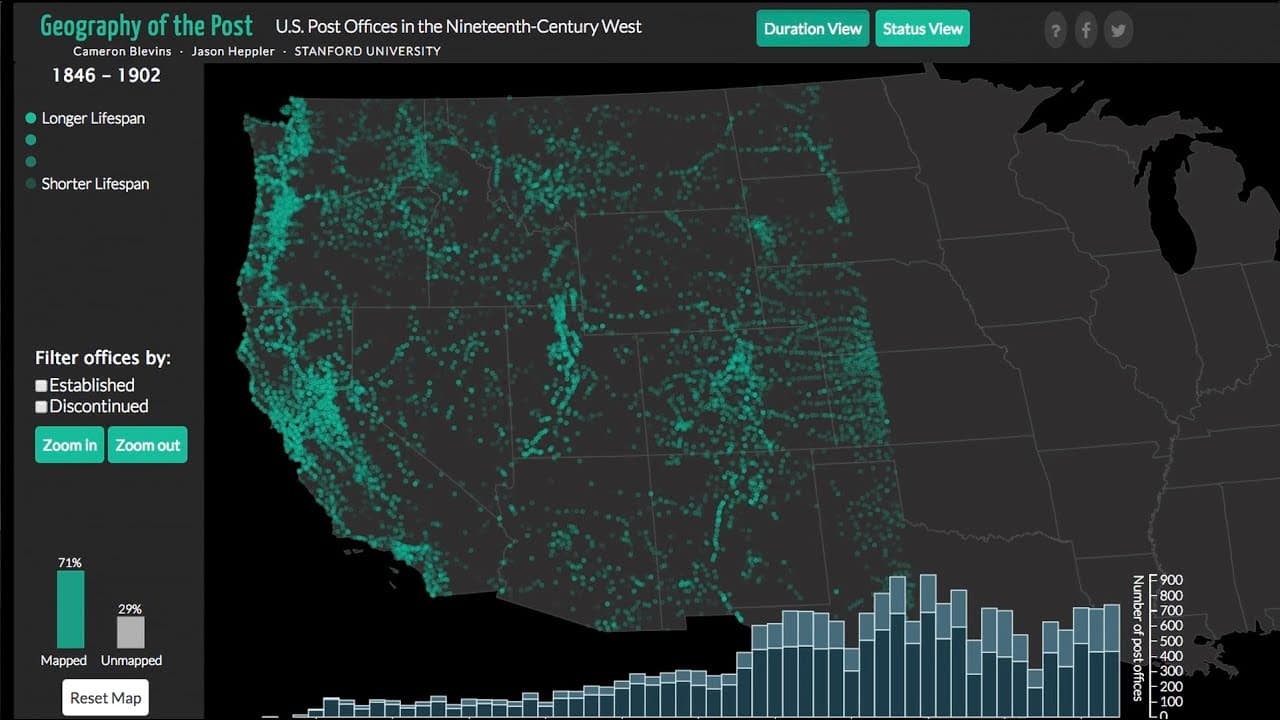
"The "Geography of the Post" project maps the post offices that existed in the American West between 1846 and 1902, revealing insights into the settlement and integration of the region."
Transcript
This program is brought to you by the Stanford Humanities Center. For more information, please visit us at shc.stanford.edu. The "Geography of the Post" is an approach to studying the integration of the American West. And it's the idea of trying to recapture how half of a continent got settled and integrated into the rest of the country in such a s... Read More
Key Insights
- 🏣 Mapping post offices helps researchers track the rise and decline of communities in the American West.
- 🤪 The project shows the spatial narrative of Western history, going beyond chronological accounts.
- 🏣 Post offices reveal the unique and distinct patterns of settlement and integration in the American West.
- 🏣 Examining post office lifespans provides insights into the boom and bust cycles of different regions.
- 📽️ The project challenges existing narratives by highlighting simultaneous events and their geographic proximity.
- 🦻 Visualization tools aid in making large amounts of historical data more accessible and understandable.
- 📽️ The "Geography of the Post" project encourages researchers to engage with the data and potentially challenge the project's conclusions.
Install to Summarize YouTube Videos and Get Transcripts
Explore YouTube Video Summarizer or Get YouTube Transcript Extractor
Questions & Answers
Q: How does the "Geography of the Post" project use post offices to study Western integration?
The project uses post offices as a way to track the presence of communities and how they changed over time. Post offices function as a proxy for understanding Western development and settlement patterns.
Q: What challenges did the project face in analyzing the data?
The project had to deal with the complexity and messiness of historical data. Transcribing and organizing data from microfilms and databases proved difficult due to the scale of information. However, visualization tools helped make the data more accessible and usable for historians.
Q: What is the most impressive aspect of the "Geography of the Post" project?
One impressive aspect is the Status view, which shows the different statuses of post offices over time. Being able to visualize the opening, closing, and lifespan of post offices provides a comprehensive understanding of Western development.
Q: How does the project challenge traditional narratives of Western history?
The project challenges traditional narratives by revealing the simultaneous occurrence of events like the Transcontinental Railroad construction and mineral strikes. By mapping these events, it becomes clear that they happened at the same time and in close proximity, offering a different perspective on Western history.
Summary & Key Takeaways
-
"Geography of the Post" visualizes and maps 14,000 post offices that were in operation between 1846 and 1902 in the American West.
-
Post offices serve as a proxy for communities, allowing researchers to understand the ephemeral and impermanent nature of Western development.
-
The project fills a gap in our understanding of the geography of Western history and provides a fine-grained view of settlement patterns.
Read in Other Languages (beta)
Share This Summary 📚
Summarize YouTube Videos and Get Video Transcripts with 1-Click
Try YouTube Summary with ChatGPT & Claude or YouTube Transcript Generator
Explore More Summaries from Stanford 📚






Summarize YouTube Videos and Get Video Transcripts with 1-Click
Try YouTube Summary with ChatGPT & Claude or YouTube Transcript Generator