Breaking down forces for free body diagrams | AP Physics 1 | Khan Academy
TL;DR
An explanation of forces and free-body diagrams, including how to break down vectors and understand net force.
Transcript
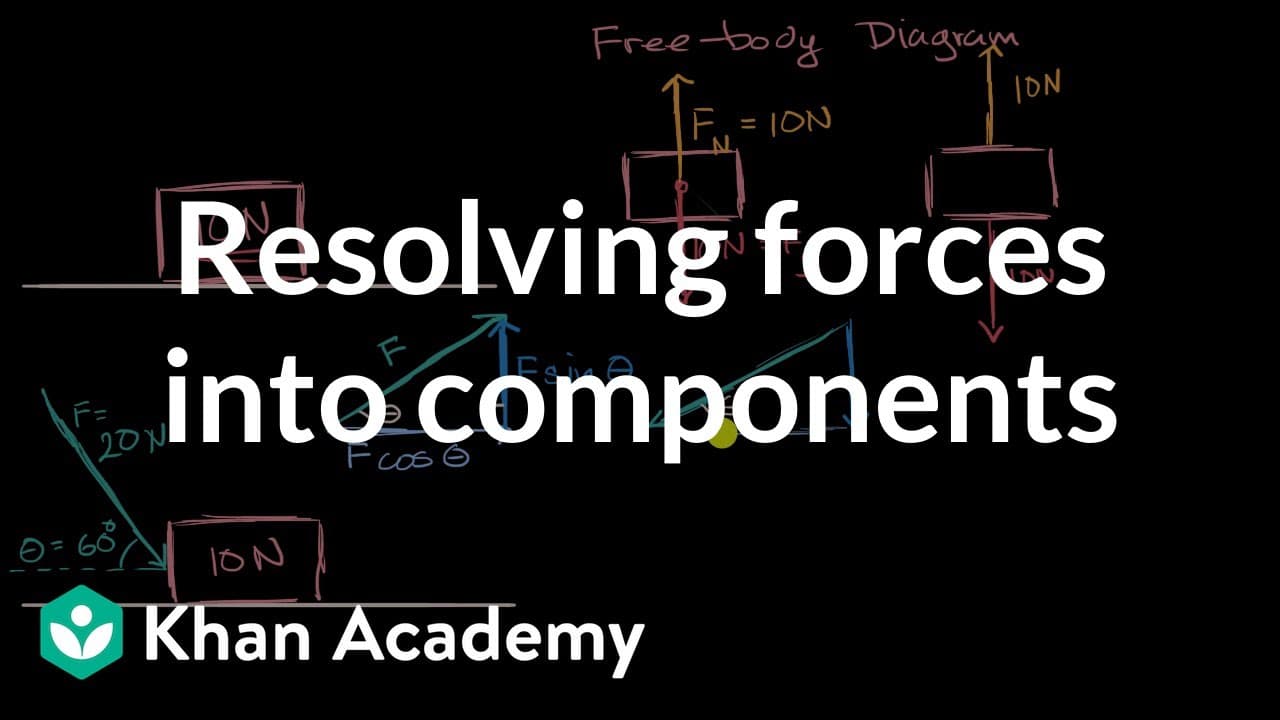
- [Instructor] Let's say we have some type of hard, flat, frictionless surface right over here. That's my drawing of a hard, flat, frictionless surface. And on that, I have a block, and that block is not accelerating in any direction. It is just sitting there. And let's say we know the weight of that block. It is a 10-newton block. So my question t... Read More
Key Insights
- 🥶 Free-body diagrams are essential for analyzing forces on an object and predicting its motion.
- 🍳 Vectors can be broken down into horizontal and vertical components using trigonometry.
- 📉 The normal force counteracts the force of gravity to prevent an object from accelerating downwards.
- 🪐 The net force determines whether an object will accelerate and in which direction.
- 🥶 Frictionless surfaces eliminate the need to consider frictional forces in free-body diagrams.
- 😣 A net force of zero indicates a state of equilibrium where the object remains at rest or moves with constant velocity.
- 👻 Breaking down angled force vectors into components allows for a more accurate analysis of forces in different directions.
Install to Summarize YouTube Videos and Get Transcripts
Explore YouTube Video Summarizer or Get YouTube Transcript Extractor
Questions & Answers
Q: What is a free-body diagram and why is it useful?
A free-body diagram is a visual representation that shows all the forces acting on an object. It is useful because it helps determine the net force and predict the object's motion.
Q: How do you calculate the horizontal and vertical components of a force?
To calculate the horizontal component, multiply the magnitude of the force by the cosine of the angle. To calculate the vertical component, multiply the magnitude of the force by the sine of the angle.
Q: What happens when the net force is zero?
When the net force is zero, the object remains at rest or moves with a constant velocity. This is because the forces acting on the object are balanced.
Q: How does the normal force counteract the force of gravity?
The normal force is the force exerted by a surface to support an object. It counteracts the force of gravity by pushing upward with an equal magnitude but in the opposite direction.
Summary & Key Takeaways
-
The content discusses the concept of forces acting on a block on a frictionless surface.
-
It explains how to draw a free-body diagram to visualize and analyze the forces acting on an object.
-
The video demonstrates how to break down an angled force vector into its horizontal and vertical components.
Read in Other Languages (beta)
Share This Summary 📚
Summarize YouTube Videos and Get Video Transcripts with 1-Click
Try YouTube Summary with ChatGPT & Claude or YouTube Transcript Generator
Explore More Summaries from Khan Academy 📚



Summarize YouTube Videos and Get Video Transcripts with 1-Click
Try YouTube Summary with ChatGPT & Claude or YouTube Transcript Generator