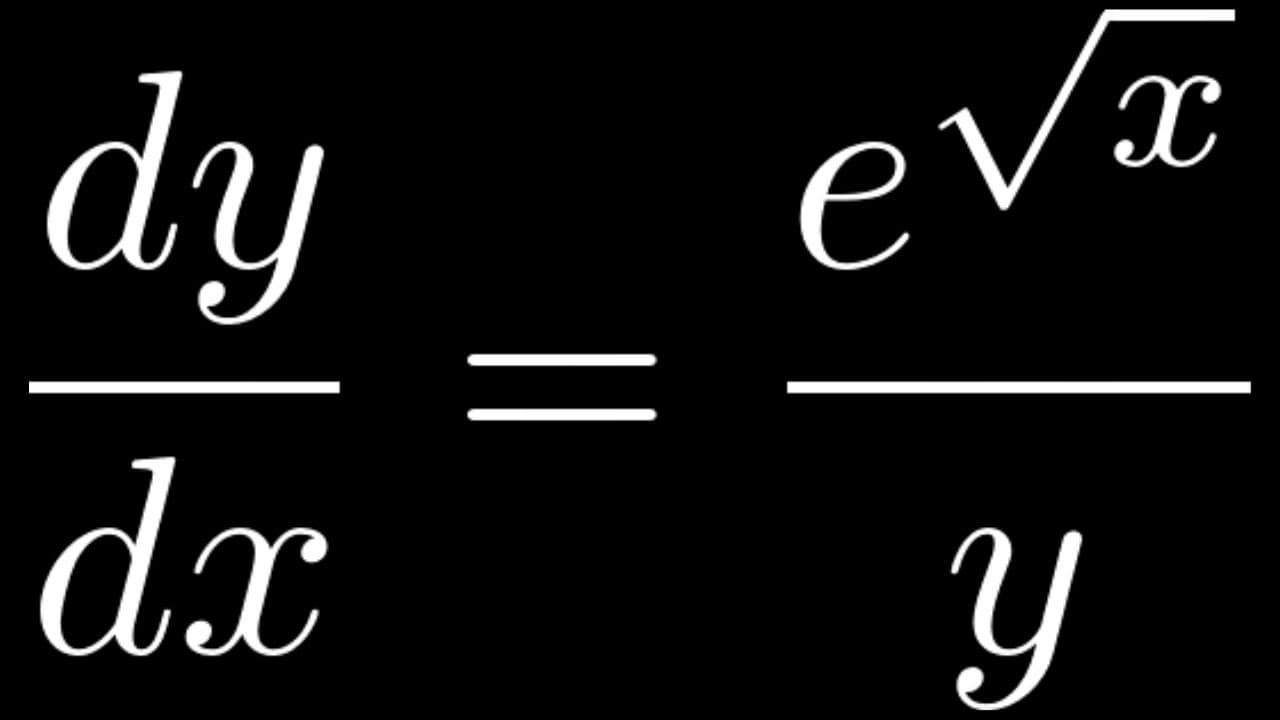
Separable Differential Equation Initial Value Problem dy/dx = e^(sqrt(x))/y with y(1) = 2
TL;DR
Learn a shortcut to integration with tabular method, avoiding integration by parts for simplification.
Transcript
I think we can separate it pretty easily right what type of multiplication can we use cross yeah we never get to use that very good I love I don't know why it's fun it's just alright so this times this and then this times I like cross multiplication because I remember when I learned that I understood it I know how to do that you just cross them and... Read More
Key Insights
- 😵 Cross multiplication aids in simplifying mathematical operations and understanding concepts effectively.
- ✊ The tabular method is a powerful shortcut for integration, especially suitable for functions involving specific components like powers, exponentials, and trigonometric functions.
- 🗯️ Choosing the right pieces to differentiate and integrate in the tabular method is crucial for achieving accurate integration results.
- ➕ The plus-minus-plus rule in tabular integration guides the sequential steps in differentiation and integration, streamlining the process for efficient solution.
- 🆘 Understanding the tabular method's application can help in solving integration problems quickly and accurately.
- ⌛ The tabular method offers a structured approach to integration, saving time and enhancing clarity in mathematical calculations.
- 🥳 Utilizing the tabular method as an alternative to integration by parts can be advantageous in simplifying complex integration problems.
Install to Summarize YouTube Videos and Get Transcripts
Explore YouTube Video Summarizer or Get YouTube Transcript Extractor
Questions & Answers
Q: What is the tabular method, and how does it differ from integration by parts?
The tabular method is a shortcut for integrating functions that involve a power of X, an exponential function, and other components, making it simpler and quicker than traditional integration by parts.
Q: Why is it essential to choose a piece that becomes eventually zero in the tabular method?
Selecting a part that becomes zero after repeated differentiation ensures proper calculation and simplification through the tabular method, leading to an accurate integration result.
Q: How does the tabular method's plus-minus-plus rule contribute to the integration process?
The plus-minus-plus rule in tabular integration governs the sequential differentiation and integration steps, providing a structured approach to solving integration problems efficiently and effectively.
Q: Can the tabular method be applied to various functions beyond the specific example shown in the content?
Yes, the tabular method is a versatile technique applicable to different functions involving powers, exponentials, and trigonometric functions, offering a convenient way to tackle complex integration scenarios.
Summary & Key Takeaways
-
Cross multiplication in mathematical operations is a useful technique for simplification and understanding.
-
The concept of using a tabular method for integration can be a time-saving shortcut in solving complex integration problems.
-
Demonstrating step-by-step solving of a calculus problem using the tabular method highlights its efficiency and clarity in approach.
Read in Other Languages (beta)
Share This Summary 📚
Summarize YouTube Videos and Get Video Transcripts with 1-Click
Try YouTube Summary with ChatGPT & Claude or YouTube Transcript Generator
Explore More Summaries from The Math Sorcerer 📚


Summarize YouTube Videos and Get Video Transcripts with 1-Click
Try YouTube Summary with ChatGPT & Claude or YouTube Transcript Generator