Wire Gauge - AWG, Amperage, Diameter Size, & Resistance Per Unit Length
TL;DR
Learn about wire size, resistance, and maximum current handling, and how they are all related.
Transcript
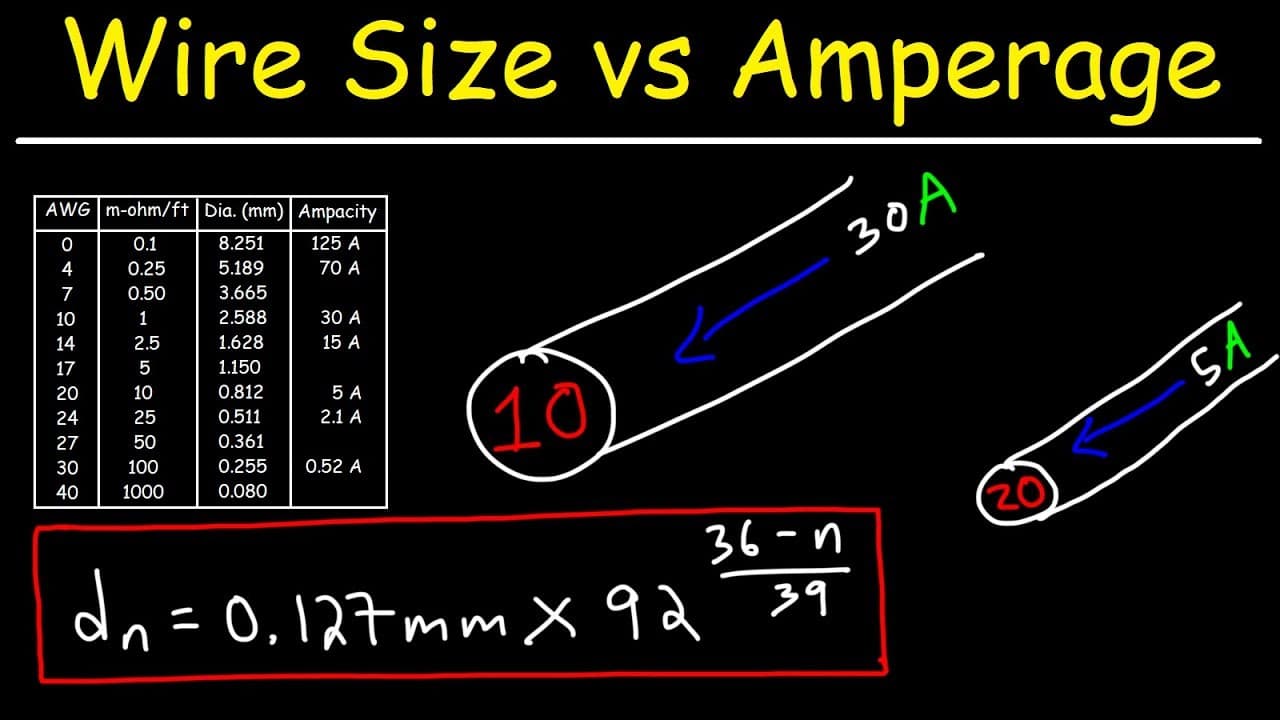
in this video we're going to talk about wire size wire gauge amperage diameter and other things related to this topic perhaps you've seen this abbreviation awg this stands for american wire gauge and it tells us the size of the wire and how much current it can safely handle so the picture on the left represents a wire gauge of 10. the one on the ri... Read More
Key Insights
- 🛜 AWG indicates wire size and current handling capacity.
- 🛜 Wire gauge and diameter have an inverse relationship.
- 🛜 Higher wire gauge numbers mean smaller wire diameter and lower current handling.
- 🛜 Resistance per unit length increases as wire gauge increases.
- 🧑🏭 Increasing wire gauge by 3 doubles the resistance, and by 10 increases it by a factor of 10.
- 🛜 Wire diameter can be calculated using a formula involving the wire gauge number.
- 🛀 The provided table shows the relationship between wire gauge, resistance, diameter, and maximum current handling.
Install to Summarize YouTube Videos and Get Transcripts
Explore YouTube Video Summarizer or Get YouTube Transcript Extractor
Questions & Answers
Q: What does AWG stand for, and what does it indicate?
AWG stands for American Wire Gauge. It indicates the size of a wire and its current handling capacity.
Q: How are wire gauge and wire diameter related?
Wire gauge and wire diameter are inversely related — as the gauge number increases, the diameter decreases.
Q: How does the wire gauge affect the current handling capacity?
Higher wire gauge numbers correspond to lower current handling capacities. For example, a gauge 10 wire can handle 30 amps, while a gauge 20 wire can handle only 5 amps.
Q: What is the relationship between wire gauge and resistance?
As the wire gauge increases, the resistance per unit length increases. Increasing the gauge by 3 doubles the resistance, and increasing it by 10 increases the resistance by a factor of 10.
Q: Can wire diameter be calculated from the wire gauge number?
Yes, there is a formula to calculate wire diameter from the wire gauge number: d_subn = 0.127 millimeters * 92^(36-n/39).
Q: What is the maximum voltage that a 14 gauge wire can handle at 60 degrees Celsius?
First, calculate the resistance of the wire using the resistance per unit length. For a 14 gauge wire, the resistance is 2.5 milliohms per foot. Multiply this by the length of the wire, in this case, 9000 feet, to get the resistance. Using Ohm's Law (V = IR), with a maximum current of 15 amps, we find that the maximum voltage is 337.5 volts.
Summary & Key Takeaways
-
American Wire Gauge (AWG) is used to indicate the size of a wire and its current handling capacity.
-
Wire gauge and wire diameter are inversely related — as the gauge number increases, the diameter decreases.
-
Higher wire gauge numbers correspond to lower current handling capacities.
-
The resistance per unit length increases as the wire gauge increases.
-
A table provides information on wire gauge, resistance, diameter size, and maximum current handling at 60 degrees Celsius.
-
Increasing the wire gauge by 3 doubles the resistance, while increasing it by 10 increases the resistance by a factor of 10.
-
A formula is provided to calculate wire diameter from the wire gauge number.
-
An example problem demonstrates calculating the maximum voltage a wire can handle.
Read in Other Languages (beta)
Share This Summary 📚
Summarize YouTube Videos and Get Video Transcripts with 1-Click
Try YouTube Summary with ChatGPT & Claude or YouTube Transcript Generator
Explore More Summaries from The Organic Chemistry Tutor 📚






Summarize YouTube Videos and Get Video Transcripts with 1-Click
Try YouTube Summary with ChatGPT & Claude or YouTube Transcript Generator