Animation basics: The art of timing and spacing - TED-Ed
TL;DR
Understanding timing and spacing in animation is key to creating realistic movements.
Transcript
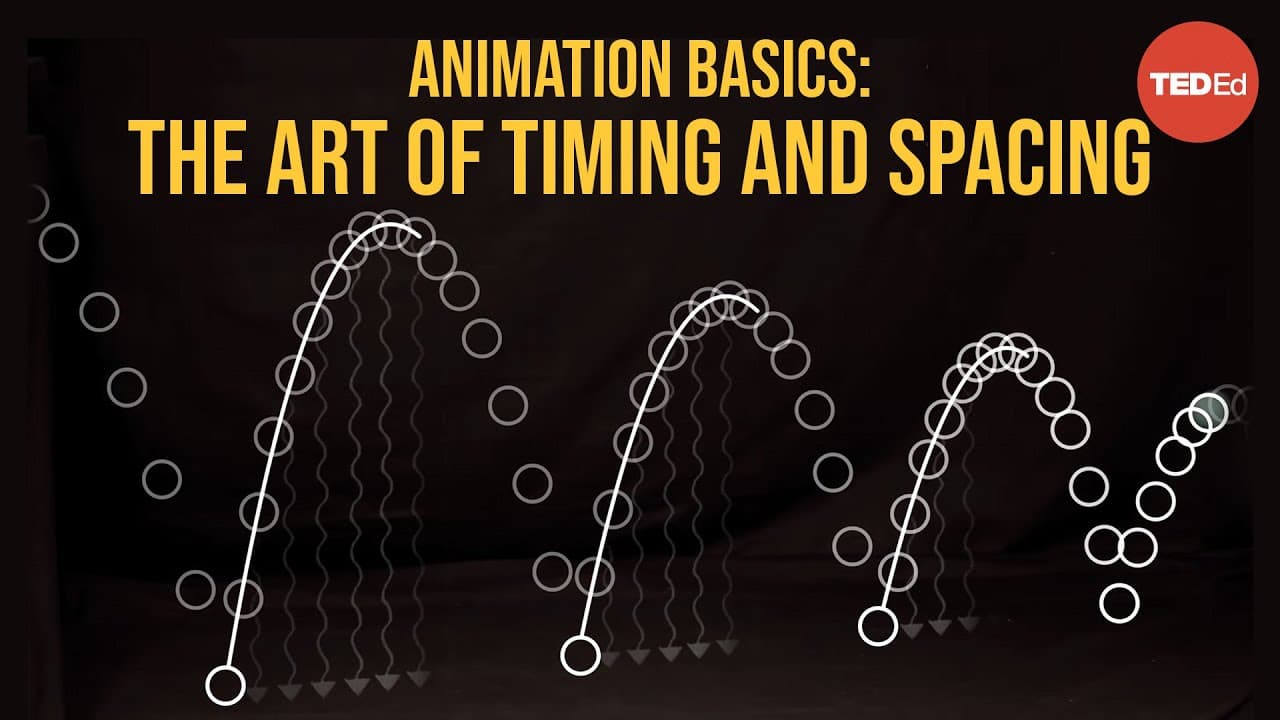
Norman McLaren, the great 20th century pioneer of animation technique, once said, "Animation is not the art of drawings that move, but the art of movements that are drawn. What happens between each frame is more important than what exists on each frame." What did he mean? Well, for an object to appear in motion, it necessarily has to change in posi... Read More
Key Insights
- 🐎 Timing and spacing are fundamental principles in animation, determining the speed and realism of motion.
- ❓ Physical properties of objects influence their visual representation and behavior in animation.
- 👾 Adjusting spacing in animation can convey forces like momentum and gravity realistically.
- 👻 Understanding timing and spacing allows animators to create lifelike movements for different objects and actions.
- 🧘 Animation relies on manipulating the passage of time and change in position to convey the illusion of life.
- ❓ Objects in motion convey more about themselves than their still appearance in animation.
- 👾 Mastering timing and spacing enables animators to emulate a wide range of actions and behaviors realistically.
Install to Summarize YouTube Videos and Get Transcripts
Explore YouTube Video Summarizer or Get YouTube Transcript Extractor
Questions & Answers
Q: What did Norman McLaren mean by saying animation is the art of movements drawn, not drawings that move?
McLaren emphasized that the essence of animation lies in capturing the changes in position over time to create the illusion of movement, emphasizing the significance of timing and spacing.
Q: How do timing and spacing play a role in animating a bouncing ball?
Timing determines the speed of the ball's motion, while spacing indicates the change in position between frames, allowing animators to showcase the forces of momentum and gravity realistically.
Q: Why is understanding the physical properties of an object important in animation?
An object's behavior in animation is influenced by its physical properties, leading to distinct visual rhythms based on its size, weight, and material.
Q: How can timing and spacing be applied to animate various actions beyond a bouncing ball?
Timing and spacing principles can be utilized to animate diverse actions like a yo-yo, punch, or even natural phenomena like the Sun's movement, providing a foundation for realistic animation.
Summary & Key Takeaways
-
Animation is about movements that are drawn, with timing and spacing being crucial principles.
-
Timing determines the speed of an action, while spacing dictates the change in position between frames.
-
By adjusting timing and spacing, animators can convey realistic motions in various scenarios.
Read in Other Languages (beta)
Share This Summary 📚
Summarize YouTube Videos and Get Video Transcripts with 1-Click
Try YouTube Summary with ChatGPT & Claude or YouTube Transcript Generator
Explore More Summaries from TED-Ed 📚


Summarize YouTube Videos and Get Video Transcripts with 1-Click
Try YouTube Summary with ChatGPT & Claude or YouTube Transcript Generator