The phony health craze that inspired hypnotism
TL;DR
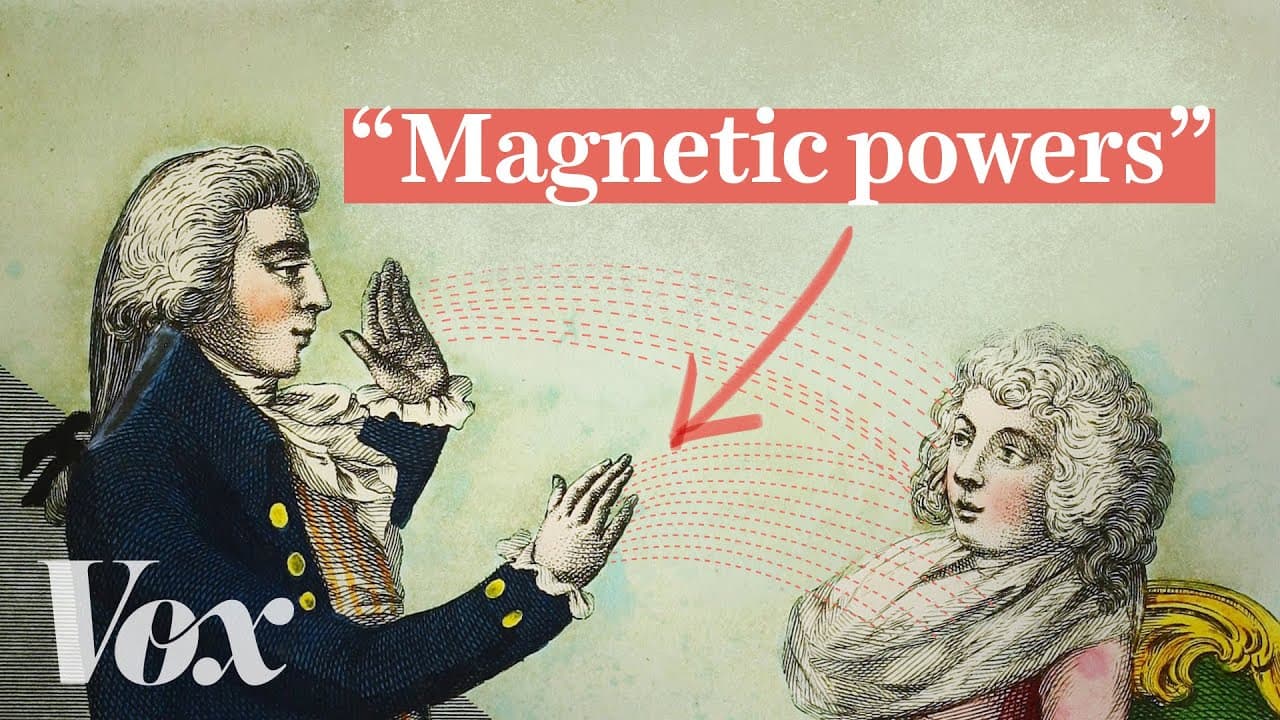
Mesmer's animal magnetism led to the discovery of hypnotism.
Transcript
In 1783, human beings left the ground for the first time. Lifted in the air by an invisible gas discovered only a few years earlier: hydrogen. Scientific progress in the 18th century in Europe, a period known as the “Age of Enlightenment” seemed like magic. Experiments in chemistry and physics were fundamentally altering how humans understood the u... Read More
Key Insights
- Franz Anton Mesmer introduced 'animal magnetism' as a healing practice, claiming an invisible magnetic fluid connected all living things, which he could manipulate to cure illnesses.
- Mesmer's methods gained widespread popularity in Paris, attracting patients from the nobility, including Queen Marie Antoinette, despite skepticism from the scientific community.
- Mesmer faced scrutiny when King Louis XVI commissioned a scientific investigation led by Benjamin Franklin, which ultimately debunked the existence of the magnetic fluid.
- The investigation employed one of the first known placebo-controlled blind trials, revealing that patients' reactions were due to imagination rather than magnetic fluid.
- The commission's findings discredited Mesmer, but acknowledged the psychological impact of his methods, laying the groundwork for understanding the placebo effect.
- Despite Mesmer's fall from grace, his ideas evolved into hypnotism, with James Braid coining the term and recognizing the mind's role in inducing trance-like states.
- Mesmer's practice highlighted the power of suggestion and imagination in healing, influencing the development of modern psychological therapies.
- The story of Mesmer and the Franklin Commission illustrates the transition from mystical healing practices to scientific inquiry in the Age of Enlightenment.
Install to Summarize YouTube Videos and Get Transcripts
Explore YouTube Video Summarizer or Get YouTube Transcript Extractor
Questions & Answers
Q: What was Franz Anton Mesmer's theory of healing?
Franz Anton Mesmer's theory of healing, known as 'animal magnetism,' posited that an invisible magnetic fluid connected all living things and that he could manipulate this fluid to cure diseases. Mesmer believed that blockages in the flow of this fluid within the body caused illnesses, and by 'magnetizing' patients, he could restore health.
Q: Why did Mesmer's methods become popular in Paris?
Mesmer's methods became popular in Paris due to their novelty and the charismatic nature of Mesmer himself. His claims of healing through 'animal magnetism' attracted attention, especially among the nobility, including Queen Marie Antoinette. The allure of a new, seemingly effective treatment, combined with the social aspect of his group sessions, contributed to his popularity.
Q: How did the scientific community respond to Mesmer's practices?
The scientific community was skeptical of Mesmer's practices, questioning the existence of the magnetic fluid he claimed to manipulate. In response, King Louis XVI commissioned an investigation led by Benjamin Franklin to examine Mesmer's methods. The investigation ultimately debunked the magnetic fluid theory, concluding that the effects were due to the power of suggestion and imagination.
Q: What was the significance of the investigation led by Benjamin Franklin?
The investigation led by Benjamin Franklin was significant because it employed one of the first placebo-controlled blind trials, setting a precedent for scientific inquiry into medical practices. The investigation debunked Mesmer's magnetic fluid theory, attributing the effects to imagination, and laid the groundwork for understanding the placebo effect, influencing future clinical trials and psychological therapies.
Q: What was the outcome for Mesmer after the investigation?
After the investigation, Mesmer's reputation was severely damaged, as the scientific commission concluded that his methods were based on imagination rather than any real magnetic influence. He was labeled a fraud and a charlatan, leading to his fall from grace. Despite this, the psychological impact of his methods was acknowledged, and his ideas eventually evolved into hypnotism.
Q: How did Mesmer's ideas influence modern psychological practices?
Mesmer's ideas influenced modern psychological practices by highlighting the power of suggestion and imagination in healing. Although his theory of animal magnetism was debunked, the psychological impact of his methods contributed to the understanding of the placebo effect. His practices evolved into hypnotism, with James Braid recognizing the mind's role in inducing trance-like states, influencing modern therapies.
Q: What role did James Braid play in the evolution of Mesmer's ideas?
James Braid played a crucial role in the evolution of Mesmer's ideas by coining the term 'hypnotism' in the 1840s. He was fascinated by animal magnetism and concluded that the phenomena observed in mesmerism could be produced by the mind alone, without any external influence. Braid's work helped transition Mesmer's ideas into a more scientifically grounded practice, influencing modern psychological therapies.
Q: What does the story of Mesmer and the Franklin Commission illustrate about the Age of Enlightenment?
The story of Mesmer and the Franklin Commission illustrates the transition from mystical healing practices to scientific inquiry during the Age of Enlightenment. It highlights the period's emphasis on reason, evidence-based investigation, and the demystification of the universe through scientific progress. Mesmer's downfall and the subsequent evolution of his ideas into hypnotism reflect the era's shift towards a more rational understanding of human health and psychology.
Summary & Key Takeaways
-
In the late 18th century, Franz Anton Mesmer introduced 'animal magnetism,' claiming he could heal diseases by manipulating an invisible magnetic fluid connecting all living things. His methods gained popularity in Paris, attracting many patients, including nobility, despite skepticism from the scientific community.
-
King Louis XVI commissioned a scientific investigation into Mesmer's methods, led by Benjamin Franklin. The investigation debunked the existence of the magnetic fluid using one of the first placebo-controlled blind trials, revealing that patients' reactions were due to imagination rather than any real magnetic influence.
-
Although Mesmer's reputation was ruined, the investigation acknowledged the psychological impact of his methods, contributing to the understanding of the placebo effect. Mesmer's ideas eventually evolved into hypnotism, with James Braid recognizing the mind's role in inducing trance-like states, influencing modern psychological therapies.
Read in Other Languages (beta)
Share This Summary 📚
Summarize YouTube Videos and Get Video Transcripts with 1-Click
Try YouTube Summary with ChatGPT & Claude or YouTube Transcript Generator
Explore More Summaries from Vox 📚



Summarize YouTube Videos and Get Video Transcripts with 1-Click
Try YouTube Summary with ChatGPT & Claude or YouTube Transcript Generator