Neural IR, part 3 | Stanford CS224U Natural Language Understanding | Spring 2021
TL;DR
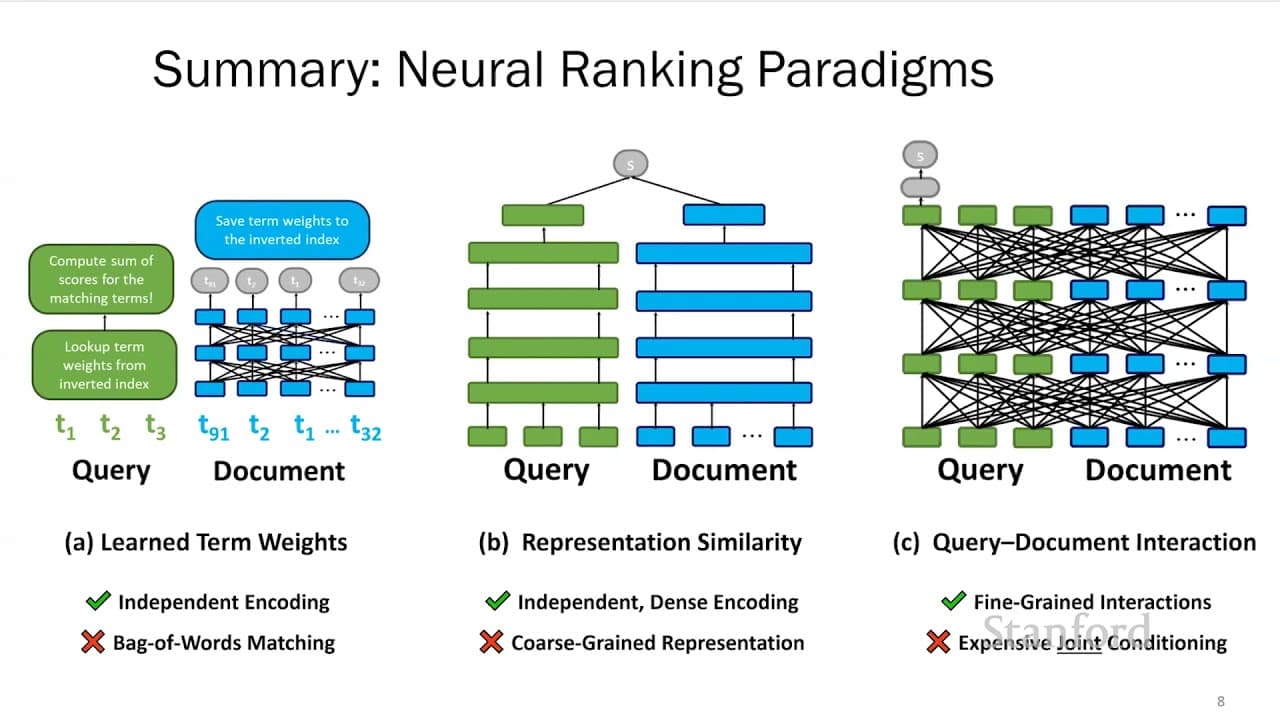
This content discusses the exploration of neural information retrieval (IR) models, focusing on the representation similarity paradigm and the late interaction paradigm, which aim to achieve high retrieval quality with low computational cost.
Transcript
hello everyone welcome to part 5 of our series on nlu and ir this screencast will be the third among three of our videos on neural ir in the previous screencast we discussed learning term weights as a paradigm for building neural ir models that are both efficient and effective we mentioned two such models from the ir literature deep ct and dr quiri... Read More
Key Insights
- 📜 The representation similarity paradigm in neural IR offers efficient retrieval by tokenizing queries and documents and encoding them separately using an encoder.
- 🌸 The Dense Passage Retriever (DPR) model is an example of a representation similarity model that achieves competitive performance through relevance scoring and classification loss optimization.
- 🖤 Representation similarity models lack fine-grained term level interactions, which can impact matching quality in IR tasks.
- 👻 The late interaction paradigm combines efficiency and term-level interactions, allowing for scalable end-to-end retrieval. COLBERT is an example of a late interaction model that achieves high quality with low computational cost.
- ✋ In the Beer benchmark, models with fine-grained interaction mechanisms, such as COLBERT, show robust performance in recall and achieve higher quality than single vector approaches.
- 🤩 Scalable fine-grained interaction is key to achieving high recall in various IR tasks.
Install to Summarize YouTube Videos and Get Transcripts
Explore YouTube Video Summarizer or Get YouTube Transcript Extractor
Questions & Answers
Q: What is the representation similarity paradigm in neural IR?
The representation similarity paradigm involves tokenizing queries and documents and encoding them separately using an encoder like BERT. Each query and document is represented by a vector, and relevance is calculated using a dot product between the two vectors.
Q: How does the Dense Passage Retriever (DPR) model work?
DPR encodes messages or documents as 768-dimensional vectors using BERT. During training, DPR calculates similarity scores between queries and positive/negative passages and optimizes a classification loss to select the positive passage. DPR achieves competitive performance in terms of Mean Reciprocal Rank (MRR) on IR tasks.
Q: What are the downsides of representation similarity models?
Representation similarity models have single vector representations for queries and documents, losing fine-grained term level interactions. They estimate relevance as a dot product between vectors, leading to a loss of term-level matching. They also require a re-ranking pipeline, tying recall to BM25 recall.
Q: How does the late interaction paradigm address the downsides of representation similarity models?
The late interaction paradigm enables fine-grained term level interactions while still benefiting from precomputation. It involves independently encoding queries and documents into matrix representations and using maximum similarity operators to compute relevance scores. Late interaction models, like COLBERT, maintain the efficiency of representation similarity models while retaining term-level interactions.
Summary & Key Takeaways
-
The content introduces the representation similarity paradigm, which involves tokenizing queries and documents and feeding them through an encoder (such as BERT) to produce vector representations for retrieval. This paradigm is efficient and allows for precomputation of document representations.
-
The content discusses the Dense Passage Retriever (DPR) model as an example of a representation similarity model. DPR encodes messages or documents as vectors and uses a classification loss to optimize relevance scores between queries and positive/negative passages.
-
The content highlights the downsides of representation similarity models, including single vector representations and the lack of fine-grained term level interactions. It introduces the late interaction paradigm as a solution to combine efficiency and term level interactions for IR tasks.
-
The content presents COLBERT (Contextualized Late Interaction over BERT), a late interaction model that achieves comparable quality to BERT at a fraction of the cost. COLBERT allows for end-to-end retrieval and scalable pruning with sub-second latencies.
Read in Other Languages (beta)
Share This Summary 📚
Summarize YouTube Videos and Get Video Transcripts with 1-Click
Try YouTube Summary with ChatGPT & Claude or YouTube Transcript Generator
Explore More Summaries from Stanford Online 📚

Summarize YouTube Videos and Get Video Transcripts with 1-Click
Try YouTube Summary with ChatGPT & Claude or YouTube Transcript Generator