Addressing treating differentials algebraically | AP Calculus AB | Khan Academy
TL;DR
Differentials are used in calculus to represent small changes in variables, allowing for algebraic manipulation in solving basic differential equations.
Transcript
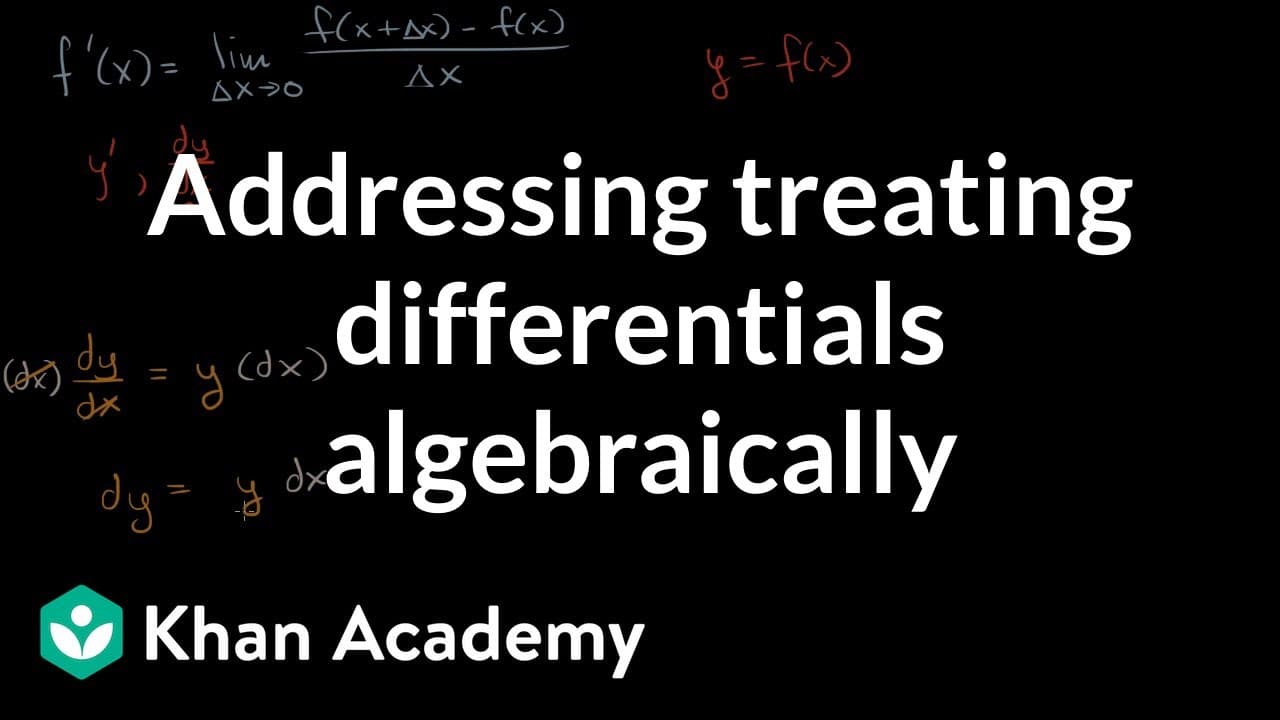
- [Instructor] So when you first learn calculus, you learn that the derivative of some function f, could be written as f prime of x is equal to the limit as, then there's multiple ways of doing this, the change in x approaches zero of f of x plus our change in x, minus f of x, over our change in x. And you learn multiple notations for this. For exa... Read More
Key Insights
- 🌤️ Differentials, represented as d-x or d-y, represent small changes in variables in response to infinitesimally small changes in other variables.
- 🙃 Treating differentials algebraically, such as multiplying or dividing both sides of an equation, is a commonly used technique in introductory calculus and differential equations.
- 😑 While not mathematically rigorous, treating differentials as algebraic expressions has proven to be a useful tool in finding solutions to basic differential equations.
- 😒 In more advanced mathematics, there are rigorous definitions of differentials that provide a better understanding of when and how to use them.
- 🏛️ Differentials are used in various fields of mathematics, including calculus, differential equations, and multi-variable classes.
- ❗ Different notations, such as f prime of x, y prime, and d-y/d-x, can be used to represent the derivative of a function.
- 🫥 The concept of differentials helps in understanding the limiting value of the slope as it transitions from a secant line to a tangent line.
Install to Summarize YouTube Videos and Get Transcripts
Explore YouTube Video Summarizer or Get YouTube Transcript Extractor
Questions & Answers
Q: What is the notation for the derivative of a function in calculus?
The derivative of a function f can be represented as f prime of x, y prime, or d-y/d-x, among other notations.
Q: How are differentials used in solving differential equations?
In solving differential equations, differentials are treated algebraically by multiplying both sides of an equation by d-x or dividing by d-y, allowing for integration and finding a general solution.
Q: How can you justify treating differentials as algebraic expressions?
Conceptually, differentials represent super small changes in variables due to infinitesimally small changes in another variable. This is supported by the definition of the limit as the change approaches zero.
Q: Is treating differentials as algebraic expressions mathematically rigorous?
No, treating differentials as algebraic expressions is not mathematically rigorous, and rigorous definitions of differentials exist in more advanced mathematics. However, for introductory students, it is a reasonable technique to explore and manipulate basic differential equations.
Summary & Key Takeaways
-
Differentials are denoted as d-x or d-y and represent small changes in x or y, respectively, in response to infinitesimally small changes in variables.
-
They are commonly used in introductory calculus, differential equations, and multi-variable classes.
-
While treating differentials as algebraic expressions is not mathematically rigorous, it has proven to be a useful technique in finding solutions.
Read in Other Languages (beta)
Share This Summary 📚
Summarize YouTube Videos and Get Video Transcripts with 1-Click
Try YouTube Summary with ChatGPT & Claude or YouTube Transcript Generator
Explore More Summaries from Khan Academy 📚



Summarize YouTube Videos and Get Video Transcripts with 1-Click
Try YouTube Summary with ChatGPT & Claude or YouTube Transcript Generator