Products
Features
YouTube Video Summarizer
Summarize YouTube videos
Web & PDF Highlighter
Highlight web pages & PDFs
Chat with PDF
Ask any PDF questions with AI
Ask AI Clone
Chat with your highlights & memories
Audio Transcriber
Transcribe audio files to text
Glasp Reader
Read and highlight articles
Kindle Highlight Export
Export your Kindle highlights
Idea Hatch
Hatch ideas from your highlights
Integrations
Obsidian Plugin
Notion Integration
Pocket Integration
Instapaper Integration
Medium Integration
Readwise Integration
Snipd Integration
Hypothesis Integration
Apps & Extensions
Chrome Extension
Safari Extension
Edge Add-ons
Firefox Add-ons
iOS App
Android App
Discover
Discover
Ideas
Discover new ideas and insights
Articles
Curated articles and insights
Books
Book recommendations by great minds
Posts
Essays and notes from readers
Quotes
Inspiring quotes collection
Videos
Curated videos and summaries
Explore Glasp
Glasp Newsletter
Weekly insights and updates
Glasp Talk
Interview series with great minds
Glasp Blog
Latest news and articles
Glasp Use Cases
Learn how others use Glasp
Build & Support
Glasp API
Access Glasp's API for developers
MCP Connector
Connect Glasp to Claude & ChatGPT
Community
Glasp Reddit Community
Students
Student discount and benefits
FAQs
Frequently Asked Questions
AboutPricing
DashboardLog inSign up

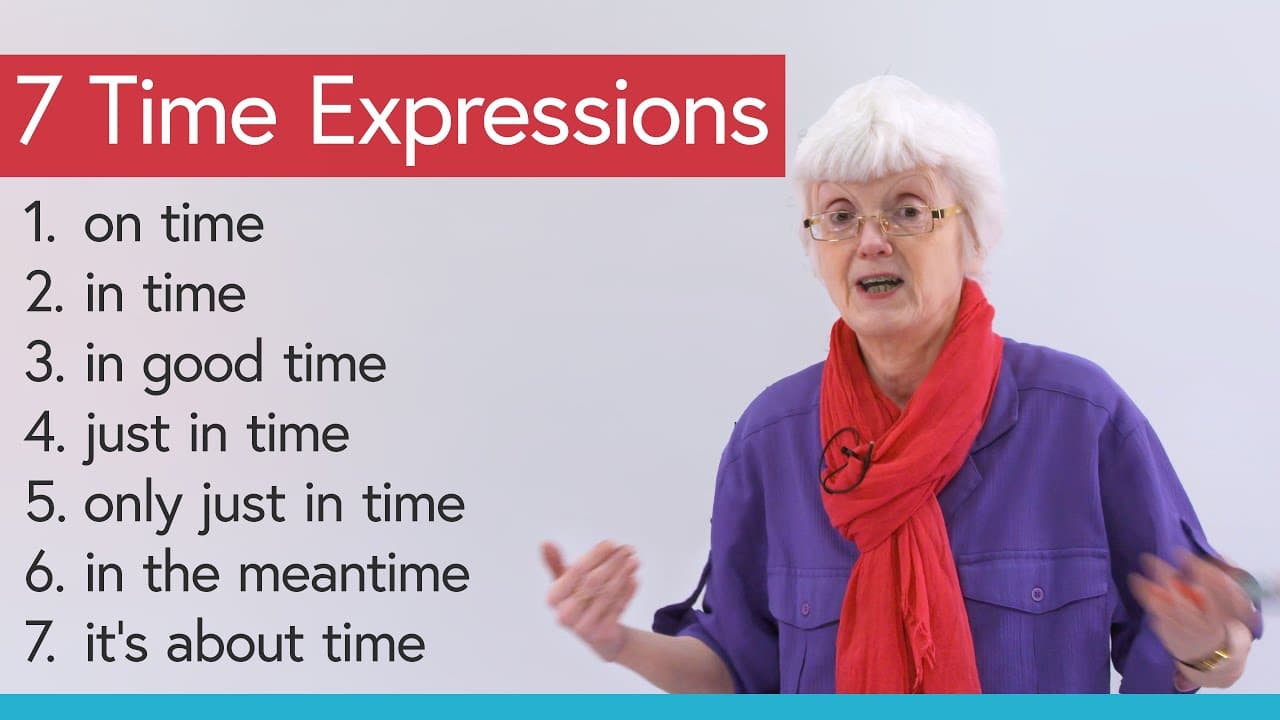
Learn 7 Time Expressions in English
3.1M views
β€’
August 11, 2020
by
Learn English with Gill Β· engVid
YouTube video player
Learn 7 Time Expressions in English

TL;DR

Learn seven time expressions used in different contexts.

Transcript

I'm Gill at www.engvid.com and today's lesson is on seven time expressions, okay? Seven different ways of using the word "time" with slightly different meanings, okay? So, let's have a look. So, the first one is "on time". If you're on time, that means you're exactly on - arriving at the time agreed. If you're coming for an 11:00 meeting, you arriv... Read More

Key Insights

  • πŸ˜‘ Different time expressions carry nuances on punctuality.
  • βŒ› "Just in time" and "only just in time" signify narrow escapes from being late.
  • πŸ‡°πŸ‡Ό "In the meantime" is used to describe activities during a wait period.
  • πŸ˜‘ Various time expressions offer subtle distinctions in timing precision.
  • βŒ› "In good time" suggests having excess time to spare before an event.
  • πŸ˜‘ Mastering time expressions enhances language precision and clarity.
  • πŸ˜‘ Contextual understanding of time expressions aids effective communication.

Install to Summarize YouTube Videos and Get Transcripts

Explore YouTube Video Summarizer or Get YouTube Transcript Extractor

Questions & Answers

Q: What does "on time" mean?

"On time" refers to arriving exactly when expected, neither early nor late, meeting the agreed-upon time.

Q: How is "in good time" different from "in time"?

"In good time" implies arriving with ample extra time to relax, compared to "in time," which means arriving slightly before an event.

Q: When would you say you arrived "just in time"?

"Just in time" denotes reaching a destination very close to the scheduled time, often with only moments to spare before being considered late.

Q: How is "in the meantime" used in a sentence?

"In the meantime" is employed to fill time before another event occurs, typically indicating a short period of waiting or downtime.

Summary & Key Takeaways

  • "On time" means arriving exactly at the agreed time, not before or after.

  • "In time" suggests arriving a few minutes before an event, ensuring no rush.

  • "In good time" signifies arriving with plenty of extra time to spare.

  • "Just in time" involves arriving very close to the scheduled time, almost late.


Read in Other Languages (beta)

English

Share This Summary πŸ“š

Summarize YouTube Videos and Get Video Transcripts with 1-Click

Download browser extensions on:

Try YouTube Summary with ChatGPT & Claude or YouTube Transcript Generator

Explore More Summaries from Learn English with Gill Β· engVid πŸ“š

Help a Charity, Save a Life thumbnail
Help a Charity, Save a Life
Learn English with Gill Β· engVid
Basic English – How and when to use LOOK, SEE, and WATCH thumbnail
Basic English – How and when to use LOOK, SEE, and WATCH
Learn English with Gill Β· engVid
Easy English Lesson: Should you use β€œA” or β€œAN”? thumbnail
Easy English Lesson: Should you use β€œA” or β€œAN”?
Learn English with Gill Β· engVid
English Grammar: Negative contractions of the verb "TO BE" thumbnail
English Grammar: Negative contractions of the verb "TO BE"
Learn English with Gill Β· engVid
Improve Your Vocabulary: 23 words for talking about feeling good or bad thumbnail
Improve Your Vocabulary: 23 words for talking about feeling good or bad
Learn English with Gill Β· engVid
The 12 Days of Christmas – Sing and Learn English! thumbnail
The 12 Days of Christmas – Sing and Learn English!
Learn English with Gill Β· engVid

Summarize YouTube Videos and Get Video Transcripts with 1-Click

Download browser extensions on:

Try YouTube Summary with ChatGPT & Claude or YouTube Transcript Generator

Apps & Extensions

  • Chrome Extension
  • Safari Extension
  • Edge Add-ons
  • Firefox Add-ons
  • iOS App
  • Android App

Key Features

  • YouTube Video Summarizer
  • Web & PDF Summarizer
  • Web & PDF Highlighter
  • Chat with PDF
  • Ask AI Clone
  • Audio Transcriber
  • Glasp Reader
  • Kindle Highlight Export
  • Idea Hatch

Integrations

  • Obsidian Plugin
  • Notion Integration
  • Pocket Integration
  • Instapaper Integration
  • Medium Integration
  • Readwise Integration
  • Snipd Integration
  • Hypothesis Integration

More Features

  • APIs
  • MCP Connector
  • Blog & Post
  • Embed Links
  • Image Highlight
  • Personality Test
  • Quote Shots

Company

  • About us
  • Blog
  • Community
  • FAQs
  • Job Board
  • Newsletter
  • Pricing
Terms

β€’

Privacy

β€’

Guidelines

Β© 2026 Glasp Inc. All rights reserved.