Introduction to Function Notation
TL;DR
Function notation defines relationships between inputs and outputs in mathematical functions.
Transcript
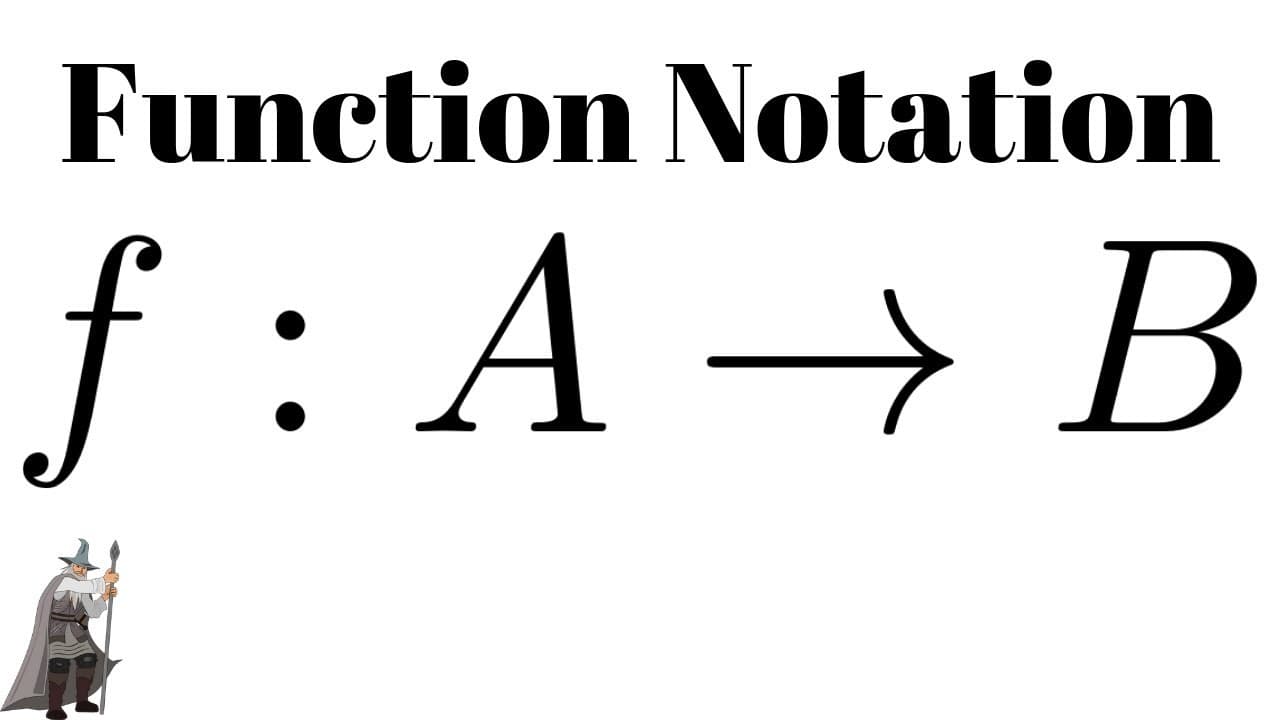
hi everyone in this video we're going to talk about function notation so we have a function which we'll call F from A to B and so the definition of a function is the following it says f is a function so f is a function if to each element so a here is a set so it's members or elements so to each element let's say little a and a F assigns one element... Read More
Key Insights
- 😫 Function notation defines relationships between elements in two sets where each element in the domain is mapped to a unique element in the codomain.
- 🔠 The domain represents all possible inputs, while the codomain includes all possible outputs of a function.
- ❓ Graphical representations of functions visually display how elements in the domain are associated with elements in the codomain.
- 🍁 Valid functions adhere to the rule that each element in the domain must map to one unique element in the codomain.
- 😫 The range of a function represents the set of all possible output values it can produce.
- 🔠 Understanding function notation is essential in mathematics to describe and analyze relationships between inputs and outputs.
- 💦 Examples like mapping real numbers to their squared values illustrate how function notation works in practical scenarios.
Install to Summarize YouTube Videos and Get Transcripts
Explore YouTube Video Summarizer or Get YouTube Transcript Extractor
Questions & Answers
Q: What is function notation and how does it define relationships between elements in sets?
Function notation describes how a function maps elements from a domain set to unique elements in a codomain set, ensuring each input has a single output.
Q: Why is it important for every element in the domain set to be assigned to an element in the codomain set for a function to be valid?
Assigning every element from the domain to a unique element in the codomain ensures that the function meets the criteria of a one-to-one relationship, essential in mathematical functions.
Q: Can a codomain be larger than the domain in function notation?
Yes, the codomain can contain more elements than the domain in function notation, as not every element in the domain needs to be mapped to an element in the codomain.
Q: How can function notation be visualized and represented graphically?
Function notation can be represented graphically with diagrams, showing how each element in the domain is mapped to an element in the codomain, often seen in graphs of mathematical functions.
Summary & Key Takeaways
-
Function notation defines a function from set A to set B, where each element in A maps to one unique element in B.
-
The domain (A) contains all inputs, while the codomain (B) contains all possible outputs of the function.
-
Examples illustrate how functions work, assigning specific elements from the domain to corresponding elements in the codomain.
Read in Other Languages (beta)
Share This Summary 📚
Summarize YouTube Videos and Get Video Transcripts with 1-Click
Try YouTube Summary with ChatGPT & Claude or YouTube Transcript Generator
Explore More Summaries from The Math Sorcerer 📚

Summarize YouTube Videos and Get Video Transcripts with 1-Click
Try YouTube Summary with ChatGPT & Claude or YouTube Transcript Generator