A robot that runs and swims like a salamander | Auke Ijspeert
TL;DR
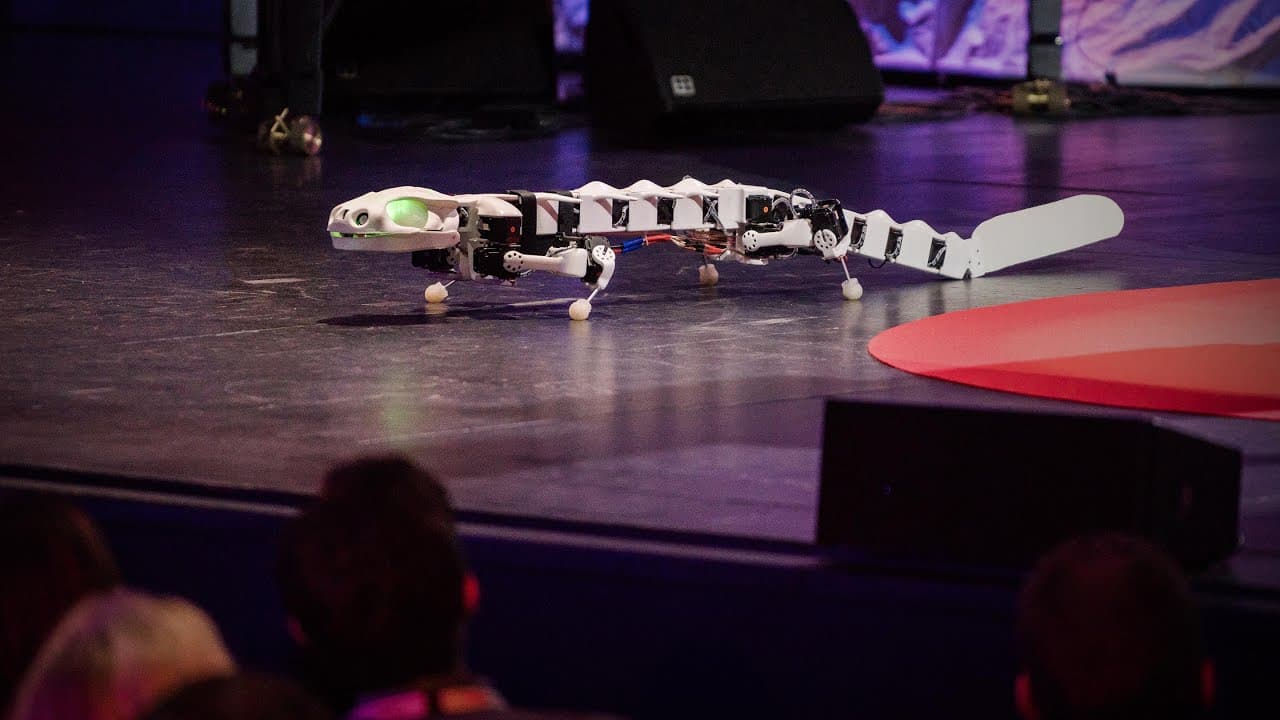
Pleurobot is a robot designed to mimic the movement of salamanders and serves as a scientific tool for neuroscience and understanding animal locomotion.
Transcript
This is Pleurobot. Pleurobot is a robot that we designed to closely mimic a salamander species called Pleurodeles waltl. Pleurobot can walk, as you can see here, and as you'll see later, it can also swim. So you might ask, why did we design this robot? And in fact, this robot has been designed as a scientific tool for neuroscience. Indeed, we desig... Read More
Key Insights
- 🤖 Pleurobot is a robot designed to mimic a salamander called Pleurodeles waltl for neuroscience research on animal locomotion.
- 🏃 Animal locomotion is impressive and highly complex, requiring coordination of around 200 muscles.
- 🧠 Animal locomotion involves four main components: body biomechanics, spinal cord reflexes, central pattern generators, and descending modulation from the brain.
- 💡 The spinal cord and body alone can solve a significant portion of the locomotion problem.
- ⚡ Recording spinal cord activity is challenging, but robots and mathematical models can help understand locomotion.
- 💼 Biorobotics is an active field of research that uses animals as inspiration to create outdoor robots.
- 🌊 Pleurobot successfully replicates the swimming and walking gaits of a salamander.
- 💪 Cat locomotion relies on lightweight limbs, pantograph-like structure, and elastic behavior, demonstrating the importance of biomechanics in locomotion.
- 🤖 By understanding animal locomotion, scientists can apply insights to human locomotion and the development of neuroprosthetics for spinal cord injuries.
Install to Summarize YouTube Videos and Get Transcripts
Explore YouTube Video Summarizer or Get YouTube Transcript Extractor
Questions & Answers
Q: What is the purpose of the Pleurobot robot?
The Pleurobot robot has been designed as a scientific tool for neuroscience, specifically to understand how animals move and how the spinal cord controls locomotion.
Q: What are the four main components behind animal locomotion?
The four main components behind animal locomotion are the body, the spinal cord, central pattern generators, and descending modulation from higher parts of the brain.
Q: Why is the spinal cord of animals a focus in understanding locomotion?
The spinal cord of animals is a focus in understanding locomotion because it already solves a significant part of the locomotion problem. Cutting the head off a chicken, for example, shows that the lower part, spinal cord and body, can still allow the chicken to run.
Q: How do biorobots like Pleurobot contribute to understanding locomotion?
Biorobots like Pleurobot, along with mathematical models, can help in understanding locomotion by providing a tool for testing and validating spinal cord models. They allow researchers to study the role of each component and observe the dynamic interaction between them, which would be difficult to determine in living animals.
Q: What are some of the goals of biorobotics?
Biorobotics aims to take inspiration from animals to develop robots that can handle complex terrains, such as stairs, mountains, and forests. It also serves as a scientific tool for various fields, including neuroscience, biomechanics, and hydrodynamics.
Q: Why is the salamander a key animal for studying locomotion?
The salamander is a key animal for studying locomotion because it is an amphibian that bridges the gap between swimming, as seen in eels or fish, and quadruped locomotion, as seen in mammals like cats and humans. It provides insights into the evolutionary history of locomotion in terrestrial vertebrates.
Q: How does the Pleurobot compare to the real salamander in terms of locomotion?
Pleurobot closely replicates the walking and swimming gaits of a real salamander. It achieves almost a one-to-one replay of the walking gait, and swimming gait is very close to the real animal. This demonstrates the success of replicating salamander locomotion using a robot.
Q: How do mechanics play a significant role in locomotion?
Mechanics play a significant role in locomotion because they can stabilize and simplify the movement. In the case of the Cheetah-Cub robot, even without complex feedback loops, purely relying on mechanics allows the robot to maintain stability and recover from small perturbations. This emphasizes the importance of good biomechanics in locomotion.
Q: What is the significance of studying cat and salamander locomotion for understanding human locomotion?
The nervous system, including the spinal cord, is similar between humans and other vertebrates. By studying cat and salamander locomotion, researchers can gain insights into the functioning of the spinal cord, its interaction with the body, and how the brain communicates with the spinal cord. This knowledge is crucial in developing neuroprosthetics and therapies for spinal cord injuries.
Summary & Key Takeaways
-
Pleurobot is a robot designed to mimic the locomotion of the salamander species Pleurodeles waltl, and it can walk and swim.
-
The purpose of designing Pleurobot is to understand how animals move and how the spinal cord controls locomotion, in collaboration with neurobiologists.
-
Biorobots like Pleurobot and mathematical models can help to understand the complexities of animal locomotion and validate spinal cord models.
Read in Other Languages (beta)
Share This Summary 📚
Summarize YouTube Videos and Get Video Transcripts with 1-Click
Try YouTube Summary with ChatGPT & Claude or YouTube Transcript Generator
Explore More Summaries from TED 📚




Summarize YouTube Videos and Get Video Transcripts with 1-Click
Try YouTube Summary with ChatGPT & Claude or YouTube Transcript Generator