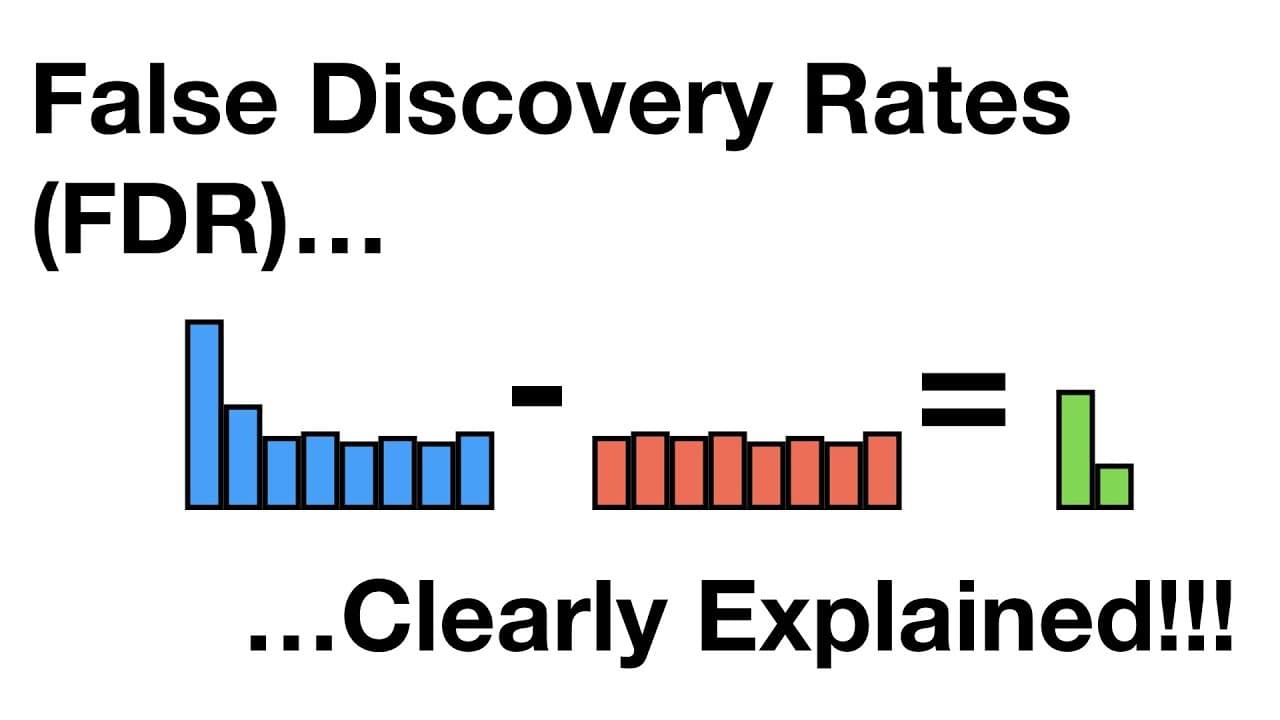
False Discovery Rates, FDR, clearly explained
TL;DR
False discovery rates (FDR) are a tool to identify and control for false positives in statistical analysis, and the Benjamine Hochberg method is a mathematical formula used to adjust p-values and reduce false positives.
Transcript
holy frickin smokes it's time for stat quest hello and welcome to stat quest stat quest is brought to you by the friendly folks in the genetics department at the University of North Carolina at Chapel Hill today we're going to be talking about false discovery rates or FDR if you've ever seen or done anything with high-throughput sequencing chances ... Read More
Key Insights
- 🚀 False discovery rates (FDR) are a tool to identify and eliminate misleading data in high-throughput sequencing experiments. FDR helps separate true positives from false positives.
- 🔍 RNA sequencing measurements for a gene called gene X can vary, resulting in a bell-shaped curve distribution. Most measurements fall close to the mean, with rare outliers.
- 🔬 Comparing two sets of samples using statistical tests can determine if they come from the same distribution. If they overlap significantly, the p-value will be greater than 0.05. If not, it will be less than 0.05, indicating a false positive.
- 🧪 When testing thousands of genes, a small percentage (5%) will result in false positives due to chance. This emphasizes the need for controlling false positives in research.
- 💡 The false discovery rate (FDR) methodology, specifically the Benjamini-Hochberg method, helps control the number of false positives reported as significant. It adjusts p-values to limit false positives.
- 📊 FDR correction can change p-values, altering their significance level. A p-value of 0.04 may be significant before correction, but after FDR correction, it may increase to 0.06, no longer significant.
- 📚 The Benjamini-Hochberg method ranks and adjusts p-values based on their values, considering the total number of p-values and their ranks. It helps separate true positives from false positives.
- 📈 The Benjamini-Hochberg method can effectively identify true positives by adjusting p-values. However, not all true positive genes will have adjusted p-values below the significance cutoff, as some may have larger p-values.
Install to Summarize YouTube Videos and Get Transcripts
Explore YouTube Video Summarizer or Get YouTube Transcript Extractor
Questions & Answers
Q: What is the purpose of false discovery rates (FDR) in statistical analysis?
False discovery rates (FDR) are used to identify and control for false positives, which helps to eliminate misleading results and ensure the accuracy of statistical analysis. FDR measures the proportion of false positives among the significant findings, and adjusting p-values based on FDR can reduce the number of false positives reported.
Q: How does the Benjamine Hochberg method adjust p-values to control for false positives?
The Benjamine Hochberg method ranks p-values and adjusts them based on a predetermined cutoff and the number of total p-values and their rank. It compares each p-value to the cutoff and adjusts it by multiplying it with the total number of p-values divided by its rank. The method selects the smaller value between the adjusted p-value and the previously adjusted p-value and repeats this process until all p-values are adjusted.
Q: How does the Benjamine Hochberg method help in identifying true positive results?
The Benjamine Hochberg method adjusts p-values, allowing researchers to determine which findings are statistically significant and likely to be true positives. By comparing adjusted p-values to a predetermined cutoff, researchers can identify the results that are unlikely to be false positives and consider them as potential true positives.
Q: How do false positives impact statistical analysis and scientific research?
False positives can lead to incorrect conclusions and misleading findings in statistical analysis and scientific research. They can waste resources, time, and effort on pursuing lines of research that are not actually valid. By using techniques like false discovery rates and adjusting p-values, researchers can minimize the occurrence of false positives and ensure the reliability of their results.
Q: How can the Benjamine Hochberg method be applied to other fields of research?
While the Benjamine Hochberg method is commonly used in statistical genetics and high-throughput sequencing, it can be applied to various other fields of research where statistical analysis is conducted. Any research area that involves multiple statistical tests and seeks to control for false positives can benefit from using the Benjamine Hochberg method or similar approaches to adjust p-values and identify true positives.
Summary & Key Takeaways
-
False discovery rates (FDR) are used to identify and eliminate false positives in statistical analysis.
-
The Benjamine Hochberg method is a mathematical formula that adjusts p-values to control for false positives.
-
The method ranks p-values, compares them to a cutoff, and adjusts them based on the number of total p-values and their rank.
Read in Other Languages (beta)
Share This Summary 📚
Summarize YouTube Videos and Get Video Transcripts with 1-Click
Try YouTube Summary with ChatGPT & Claude or YouTube Transcript Generator
Explore More Summaries from StatQuest with Josh Starmer 📚



Summarize YouTube Videos and Get Video Transcripts with 1-Click
Try YouTube Summary with ChatGPT & Claude or YouTube Transcript Generator