Worked example: Analyzing the purity of a mixture | AP Chemistry | Khan Academy
TL;DR
Analyzing the percent chlorine by mass in a solid compound can determine if it is pure sodium chloride or if other compounds, such as sodium iodide, potassium chloride, or lithium chloride, are present.
Transcript
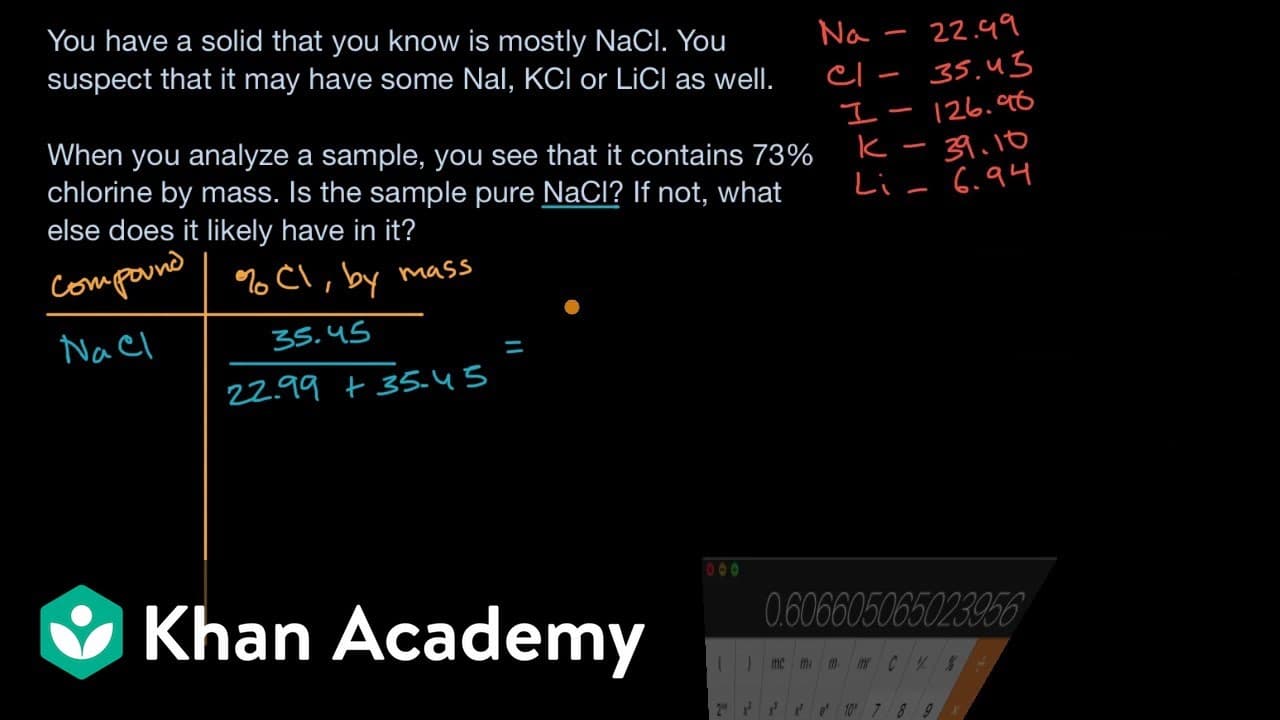
- [Instructor] We're told, you have a solid that you know is mostly sodium chloride, you suspect that it might have or it may have some sodium iodide, potassium chloride or lithium chloride as well. When you analyze a sample you see that it contains 73% chlorine by mass. Is the sample pure sodium chloride? If not, what else does it likely have in i... Read More
Key Insights
- 💆 Analyzing the percent chlorine by mass is useful for identifying the composition of a solid compound.
- 😘 The calculated percent chlorine by mass can indicate the presence of other compounds with a higher or lower chlorine content.
- 💆 Comparison of the observed percent chlorine by mass with expected values for different compounds helps determine if the sample is pure or a mixture.
Install to Summarize YouTube Videos and Get Transcripts
Explore YouTube Video Summarizer or Get YouTube Transcript Extractor
Questions & Answers
Q: How can the percent chlorine by mass be calculated for different compounds?
The percent chlorine by mass for a compound can be calculated by dividing the molar mass of chlorine by the molar mass of the entire compound, multiplied by 100. This ratio provides the percentage of chlorine in the compound.
Q: Is the sample pure sodium chloride?
No, the sample is not pure sodium chloride because its observed percent chlorine by mass of 73% is significantly different from the expected value of approximately 61% for pure sodium chloride.
Q: What other compounds could be present in the sample?
The sample could contain compounds with a higher percent chlorine by mass than sodium chloride, such as sodium iodide, potassium chloride, or lithium chloride.
Q: How does the percent chlorine by mass calculation help determine if other compounds are present?
By comparing the calculated percent chlorine by mass for different compounds with the observed 73% chlorine by mass, it is possible to identify which compound(s) could be present in the sample based on whether the calculated value is higher or lower.
Summary & Key Takeaways
-
The content discusses the analysis of a solid compound to determine its chlorine content and identify if it is pure sodium chloride or a mixture of other compounds.
-
By calculating the percent chlorine by mass for different compounds, such as sodium chloride, sodium iodide, potassium chloride, and lithium chloride, it is possible to determine the composition of the sample.
-
Comparison of the calculated percent chlorine by mass with the observed 73% chlorine can help identify the presence of additional compounds in the sample.
Read in Other Languages (beta)
Share This Summary 📚
Summarize YouTube Videos and Get Video Transcripts with 1-Click
Try YouTube Summary with ChatGPT & Claude or YouTube Transcript Generator
Explore More Summaries from Khan Academy 📚



Summarize YouTube Videos and Get Video Transcripts with 1-Click
Try YouTube Summary with ChatGPT & Claude or YouTube Transcript Generator