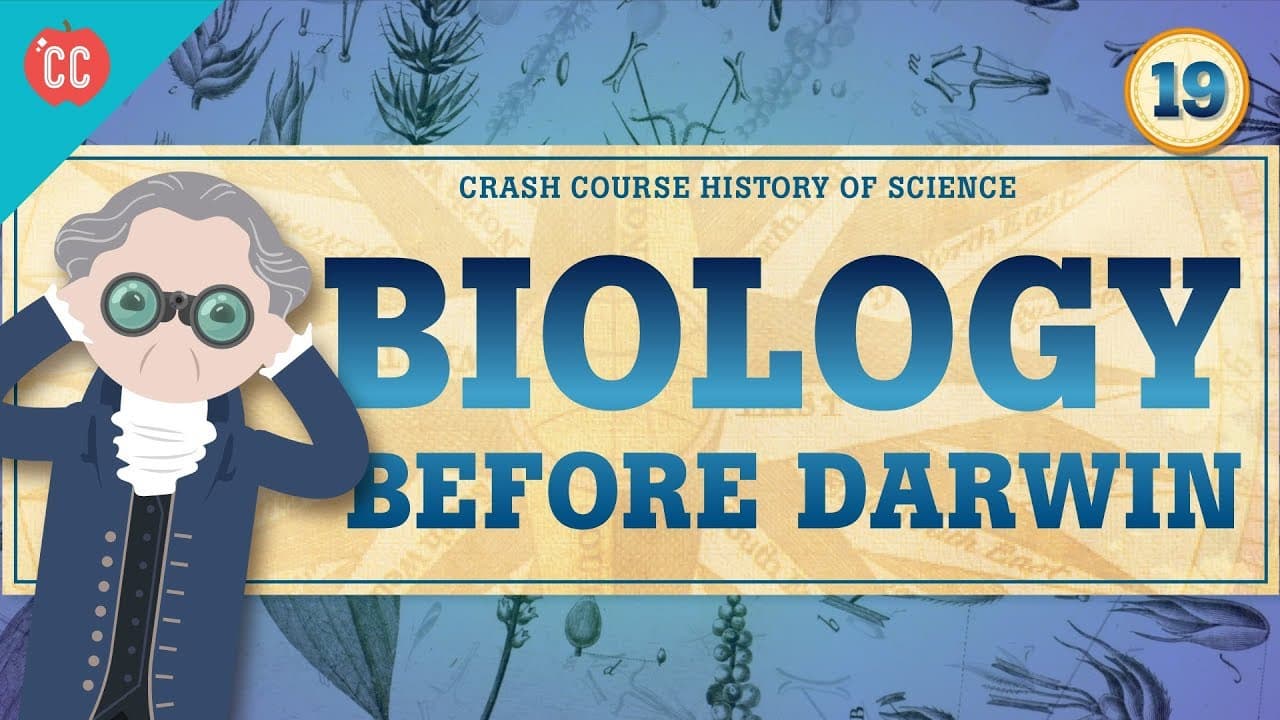
Biology Before Darwin: Crash Course History of Science #19
TL;DR
Explores pre-Darwinian ideas on life and biological classification.
Transcript
In physics, questions about astronomy led to revolutionaries such as Kepler and Newton, who provided a new theoretical framework that replaced the old Aristotelian one. But when it came to the study of living things, this shift didn’t happen until a little later, in the 1800s. You’ve probably heard of Charles Darwin, but before we get to him, and I... Read More
Key Insights
- The term 'biology' was not used until 1799; prior studies were termed 'natural history,' based on Aristotle's work.
- Joannes Baptista van Helmont's willow tree experiment was the first quantitative biology experiment, showing plants grow by water, not soil.
- Maria Sibylla Merian, a leading entomologist, significantly contributed to understanding insect metamorphosis and published influential works.
- Carl Linnaeus developed the binomial classification system, a foundational framework for categorizing living organisms still in use today.
- Joseph Banks utilized the British Empire's resources to expand botanical knowledge, enhancing the Royal Botanic Gardens at Kew.
- French thinkers Buffon, Lamarck, and Cuvier introduced transformative ideas about species change, challenging static views of life.
- Lamarck's 'transformisme' suggested species evolve through acquired traits, a precursor to epigenetics, though later disproven.
- Cuvier's catastrophism theory proposed species change through catastrophic events, integrating fossil evidence with divine creation beliefs.
Install to Summarize YouTube Videos and Get Transcripts
Explore YouTube Video Summarizer or Get YouTube Transcript Extractor
Questions & Answers
Q: What was the significance of van Helmont's willow tree experiment?
Van Helmont's willow tree experiment was significant because it was the first quantitative experiment in biology. Conducted in the 1600s, it demonstrated that plants grow by absorbing water rather than consuming soil. This marked a pivotal shift in understanding plant growth, moving away from purely observational studies to empirical, data-driven research.
Q: How did Maria Sibylla Merian contribute to natural history?
Maria Sibylla Merian was a pioneering entomologist and scientific illustrator who significantly contributed to the understanding of insect metamorphosis. Her detailed observations and illustrations of the butterfly life cycle set a benchmark for natural historians. Her work, particularly her publication 'Metamorphosis Insectorum Surinamensium,' combined art and science, influencing both fields profoundly.
Q: What was Carl Linnaeus's contribution to biology?
Carl Linnaeus developed the binomial nomenclature system, revolutionizing the classification of living organisms. His system provided a standardized method for naming species, using a two-part Latin name consisting of genus and species. Introduced in 'Systema Naturæ,' this classification framework remains a cornerstone of biological taxonomy, facilitating global scientific communication and research.
Q: How did Joseph Banks influence botanical studies?
Joseph Banks played a crucial role in advancing botanical studies by leveraging the British Empire's resources to gather plant specimens globally. As a prominent naturalist, he expanded the Royal Botanic Gardens at Kew into a world-renowned botanical center. His efforts in classification and collection significantly enriched botanical knowledge and supported Linnaean taxonomy.
Q: What were Buffon's views on species change?
Buffon, a prominent French naturalist, proposed that species were degenerating from their original divine design, introducing the idea of species change. Although he later recanted his views, Buffon's ideas opened the door to discussions on species transformation and evolution, influencing later thinkers like Lamarck and contributing to the shift in understanding biological diversity.
Q: What was Lamarck's theory of 'transformisme'?
Lamarck's theory of 'transformisme' suggested that species evolve through the inheritance of acquired traits. He believed that organisms adapt to their environment by changing certain body parts during their lifetime, passing these changes to their offspring. Although later disproven, Lamarck's ideas foreshadowed concepts in epigenetics and marked an early attempt to explain species change scientifically.
Q: How did Cuvier's ideas differ from Lamarck's?
Cuvier, a contemporary of Lamarck, opposed evolutionary theories, advocating for catastrophism instead. He believed species were perfectly adapted to their environments and major changes resulted from catastrophic events. Cuvier's focus on fossil evidence and anatomical studies highlighted extinction as a natural process, contrasting with Lamarck's progressive evolution theory, which emphasized gradual change.
Q: Why is the period before Darwin important in the history of science?
The period before Darwin is crucial because it set the foundation for modern biology by challenging traditional views and introducing new ways of thinking about life and species. Key figures developed classification systems, conducted empirical experiments, and proposed early evolutionary theories, paving the way for Darwin's groundbreaking work on natural selection and the broader acceptance of evolutionary biology.
Summary & Key Takeaways
-
The video explores the evolution of biological thought before Darwin, focusing on key figures like Aristotle, van Helmont, and Linnaeus. It highlights how the concept of life was debated and studied through natural history, leading to foundational classification systems and early evolutionary theories.
-
Prominent figures such as Maria Sibylla Merian and Joseph Banks expanded the understanding of life through meticulous observation and the exploitation of colonial resources. Their contributions laid the groundwork for modern biological classification and the global collection of botanical specimens.
-
French thinkers Buffon, Lamarck, and Cuvier introduced revolutionary ideas about species change, challenging the static view of life. While Lamarck's theories were eventually disproven, they paved the way for future evolutionary thought, setting the stage for Darwin's later work on natural selection.
Read in Other Languages (beta)
Share This Summary 📚
Summarize YouTube Videos and Get Video Transcripts with 1-Click
Try YouTube Summary with ChatGPT & Claude or YouTube Transcript Generator
Explore More Summaries from CrashCourse 📚


Summarize YouTube Videos and Get Video Transcripts with 1-Click
Try YouTube Summary with ChatGPT & Claude or YouTube Transcript Generator