Defining a Factorial Function
TL;DR
Learn how to define and use functions in Python to avoid rewriting code and make calculations more efficient.
Transcript
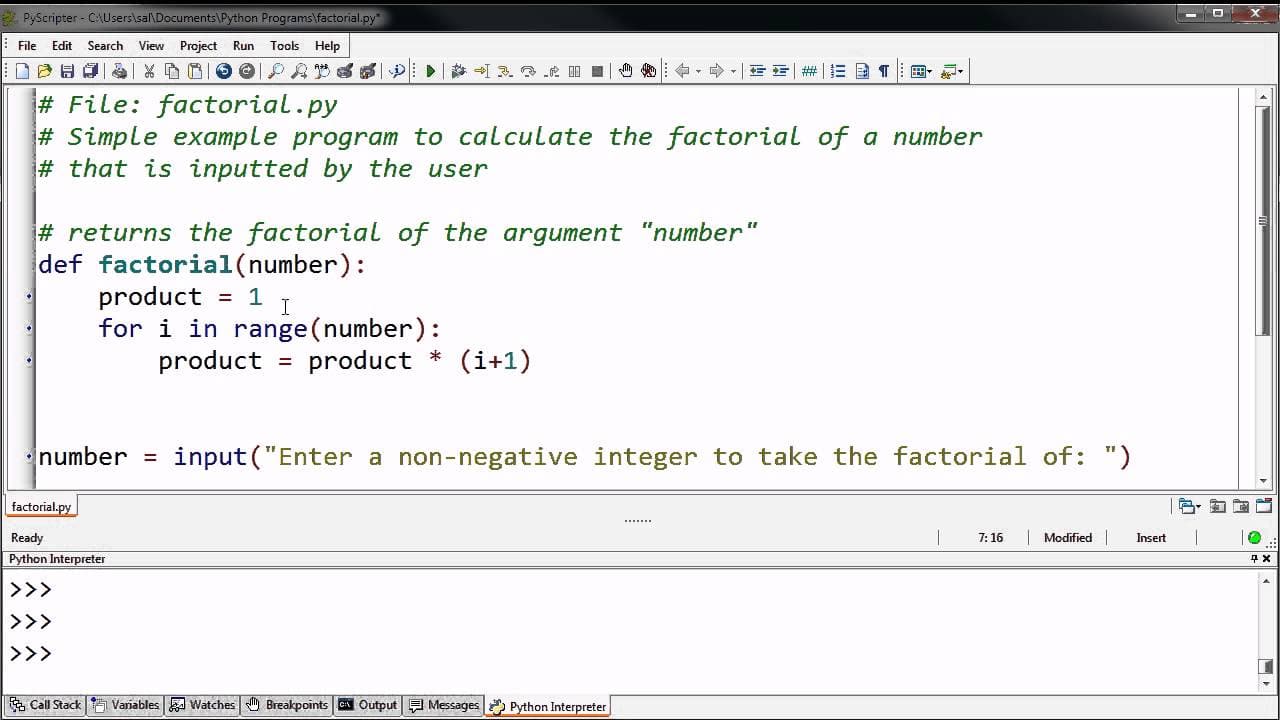
In the last few videos, we wrote a nice little program here that asks the user for some type of an input, and then computes the factorial of that number, and then prints it out. And that's nice. But you could imagine a world where you would want to calculate the factorial multiple places, or in multiple different programs, or in the same program, y... Read More
Key Insights
- 👨💻 Functions in Python help avoid code repetition by allowing the definition of reusable blocks of code.
- 👨💻 Properly naming functions is essential for code readability and understanding.
- ❓ Functions can take arguments, providing flexibility and customization.
- 📲 The return statement is used to send a value back to the calling program.
- 👻 Using functions in different programs allows for easy code sharing and modification.
- 👨💻 Functions improve code organization and efficiency.
- 💄 Python interprets functions quickly, making them efficient for repetitive calculations.
Install to Summarize YouTube Videos and Get Transcripts
Explore YouTube Video Summarizer or Get YouTube Transcript Extractor
Questions & Answers
Q: Why would you want to use functions in Python?
Functions in Python allow for code reuse, making it easier to write and maintain programs without repeating the same code multiple times.
Q: How do you define a function in Python?
To define a function in Python, you use the keyword "def" followed by the function name, parameters (if any), and a colon. The function's code block is indented beneath the definition.
Q: What are arguments in Python functions?
Arguments are the values passed to a function when it is called. They provide input to the function and can be used within the function to perform specific tasks.
Q: How do you return a value from a Python function?
To return a value from a Python function, you use the "return" keyword followed by the value or expression you want to return. The returned value can then be used in the calling program.
Summary & Key Takeaways
-
Functions in Python allow for the reuse of code by defining a set of instructions that can be called whenever needed.
-
When defining a function, it is important to choose a name that accurately describes its purpose.
-
Functions can take arguments, which are values passed to the function when it is called, and can return a result back to the calling program.
Read in Other Languages (beta)
Share This Summary 📚
Summarize YouTube Videos and Get Video Transcripts with 1-Click
Try YouTube Summary with ChatGPT & Claude or YouTube Transcript Generator
Explore More Summaries from Khan Academy 📚



Summarize YouTube Videos and Get Video Transcripts with 1-Click
Try YouTube Summary with ChatGPT & Claude or YouTube Transcript Generator