Medium or Heavy Commercial Vehicles
TL;DR
Learn about medium and heavy commercial vehicles, including their specifications, engine types, and weight classifications.
Transcript
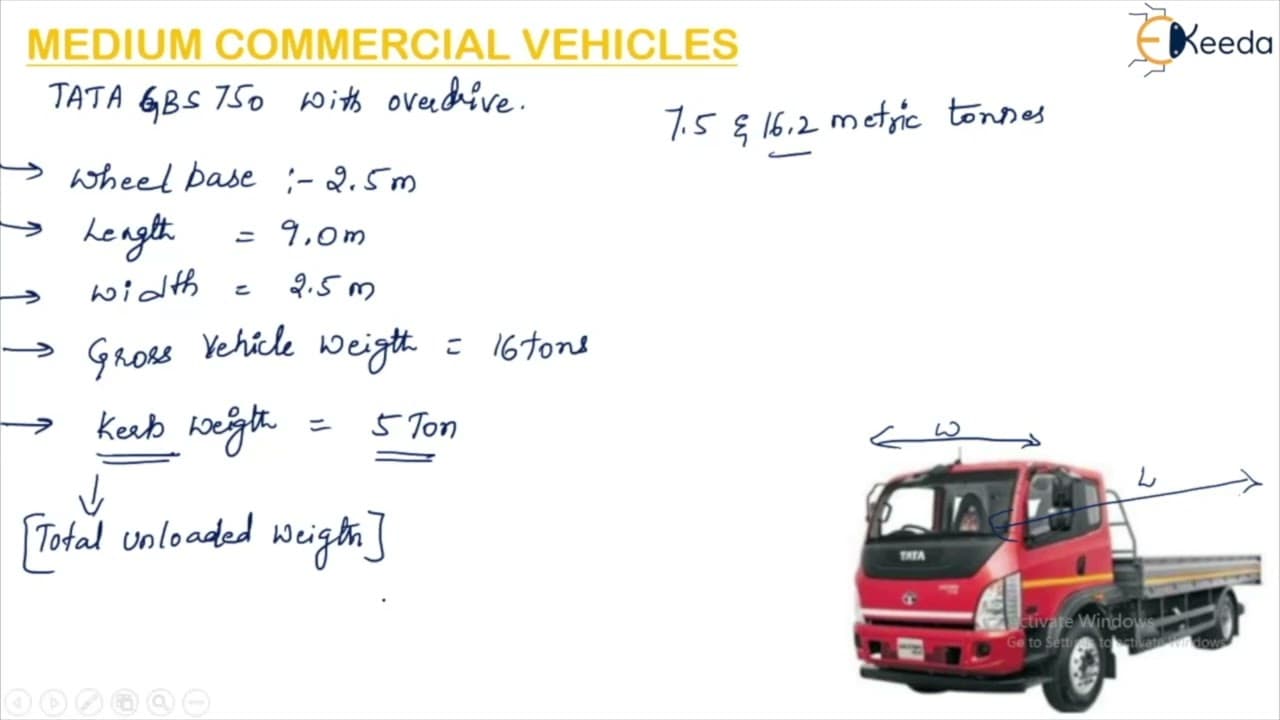
hello students today we will learn about medium commercial vehicles so medium commercial vehicles are nothing but medium trucks and passenger buses so these are medium trucks and passenger buses so here the gross weight of these vehicles will be between 7.5 and 16.2 meters so cross weight of these vehicles is so as i have already told you no commer... Read More
Key Insights
- 😋 Medium commercial vehicles have a weight range between 7.5 and 16.2 metric tons and are commonly used for transporting goods or passengers.
- ❣️ Turbocharged engines are a popular choice in both medium and heavy commercial vehicles due to their power and efficiency.
- 🖐️ The lubricating system, usually wet-sump, plays a vital role in maintaining engine performance and longevity.
- 🚙 The wheelbase of commercial vehicles varies depending on their weight classification, with heavy vehicles having a longer wheelbase for stability.
- ❣️ Heavy commercial vehicles, such as the Ashok Leyland truck, have a gross weight exceeding 16.2 metric tons, making them suitable for heavy-duty transportation.
- 🏋️ The length and width of commercial vehicles remain relatively consistent across different weight classifications.
- 🥳 The compression ratio, engine power, and gearbox specifications can differ between specific vehicle models within the medium and heavy categories.
Install to Summarize YouTube Videos and Get Transcripts
Explore YouTube Video Summarizer or Get YouTube Transcript Extractor
Questions & Answers
Q: What is the difference between medium and heavy commercial vehicles?
The main distinction lies in their weight classifications. Medium commercial vehicles have a gross weight between 7.5 and 16.2 metric tons, while heavy commercial vehicles weigh more than 16.2 metric tons.
Q: What engine types are commonly found in medium and heavy commercial vehicles?
Both medium and heavy commercial vehicles are often equipped with turbocharged engines. The example medium truck, Tata 1518, has a turbocharged six-cylinder engine, while the heavy truck, Ashok Leyland, features a six-cylinder turbocharged engine.
Q: What is the role of the lubricating system in these commercial vehicles?
The lubricating system, commonly a wet-sump system, ensures proper lubrication and cooling of the engine's moving parts. It helps reduce friction and wear, prolonging the life of the vehicle.
Q: How does the weight classification affect the specifications of commercial vehicles?
The weight classification affects various specifications, such as the wheelbase. Medium commercial vehicles typically have a wheelbase of 2.5 meters, while heavy commercial vehicles, like the Ashok Leyland truck, have a longer wheelbase of 5.5 meters.
Summary & Key Takeaways
-
Medium commercial vehicles refer to trucks and passenger buses with a gross weight between 7.5 and 16.2 metric tons.
-
The example medium truck mentioned is the Tata 1518, equipped with a turbocharged six-cylinder engine, water-cooled cooling system, and a cylinder capacity of 6000 cubic centimeters.
-
Heavy commercial vehicles, like the Ashok Leyland truck mentioned, have a gross weight exceeding 16.2 metric tons, with varying specifications such as a six-cylinder turbocharged engine, wet-sump lubricating system, and a wheelbase of 5.5 meters.
Read in Other Languages (beta)
Share This Summary 📚
Summarize YouTube Videos and Get Video Transcripts with 1-Click
Try YouTube Summary with ChatGPT & Claude or YouTube Transcript Generator
Explore More Summaries from Ekeeda 📚





Summarize YouTube Videos and Get Video Transcripts with 1-Click
Try YouTube Summary with ChatGPT & Claude or YouTube Transcript Generator