Desktop Metal’s 3D printer makes metal manufacturing less messy
TL;DR
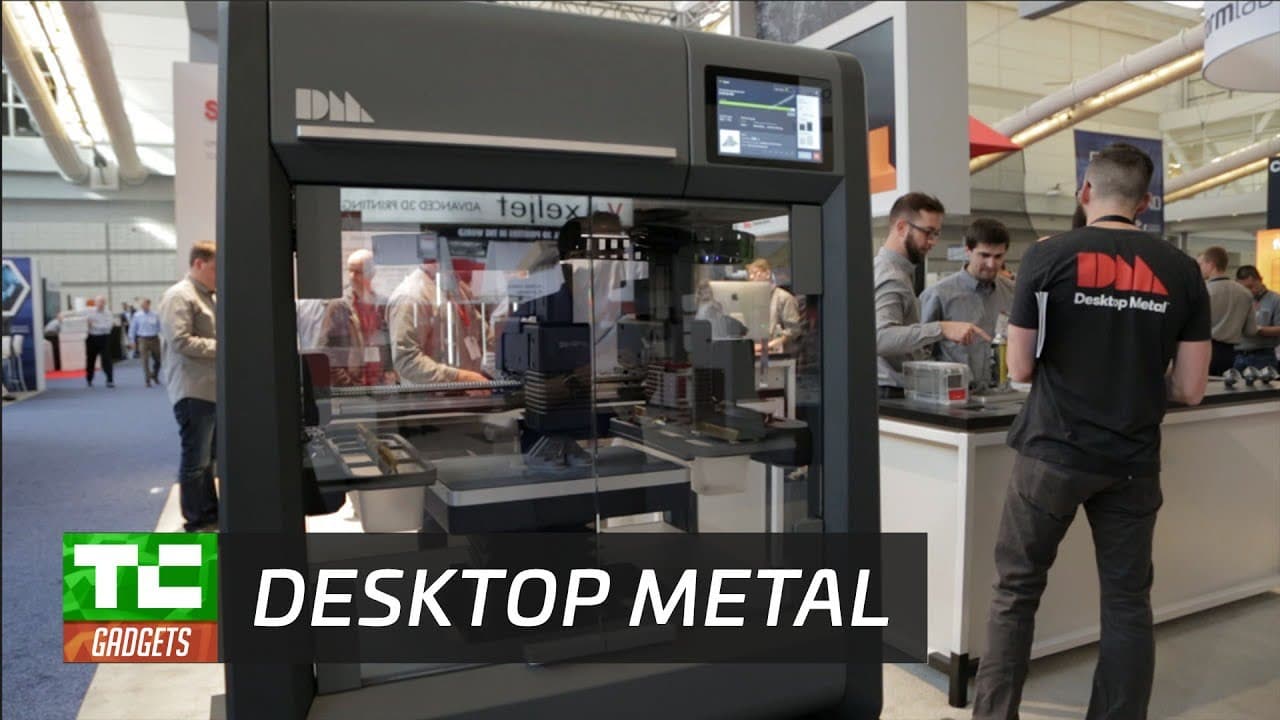
Desktop Metal has developed a metal 3D printer that is safe, accessible, and capable of producing functional metal parts in your office, using a unique extrusion technique.
Transcript
- My name is Jordan Myerberg, I'm a co-founder and CTO of Desktop Metal. And what we've done is developed and launched here a 3D printer, for metal, that is safe and capable of printing metal parts in your office. (synthesizer music) A lot of the state of the art metal 3D printers use a powder bed, powder bed fusion technique. Problem with powder b... Read More
Key Insights
- 🤘 Desktop Metal's metal 3D printer offers a safer and more accessible method for producing metal parts in-office, eliminating the need for powder bed fusion techniques.
- 🤘 The extrusion technique used by Desktop Metal ensures easy operation and removes the complexities and safety concerns associated with traditional metal 3D printing.
- 😶🌫️ The software and cloud connectivity optimize the printing process and facilitate accurate production by providing precise instructions to the printer and furnace.
- 🔊 The Desktop Metal production system is designed for mass production, competing with high-volume manufacturing processes used in industries like consumer electronics and automotive.
- 🤘 The consolidation process in Desktop Metal's furnace ensures the creation of solid metal parts, using the same materials employed in metal injection molding.
- 😒 Design flexibility is a significant advantage of Desktop Metal's metal 3D printing, as it allows customers to use the same alloys and systems without any modifications.
- 🚄 The speed and efficiency of Desktop Metal's production system make it a viable alternative to metal injection molding for high-volume manufacturing.
Install to Summarize YouTube Videos and Get Transcripts
Explore YouTube Video Summarizer or Get YouTube Transcript Extractor
Questions & Answers
Q: How does Desktop Metal's metal 3D printer differ from other existing metal 3D printers?
Unlike traditional powder bed fusion printers, Desktop Metal's printer uses an extrusion technique that eliminates the messiness, safety concerns, and complexity associated with powder handling. This makes it safer and more accessible to operate.
Q: How does the software contribute to the printing process?
The software, designed from the ground up, includes a slicer that optimizes the printing process and supports the part layer by layer. It ensures the operator knows the best way to build each part and transfers this information to the printer and furnace for accurate production.
Q: What are the advantages of Desktop Metal's metal 3D printing process for mass production?
The Desktop Metal production system is 100 times faster than their studio system, allowing for high-volume manufacturing. It competes with processes like metal injection molding, utilizing the same materials and offering design flexibility without the need for changing alloys or systems.
Q: How does the consolidation process work after printing?
After printing, the parts are placed in a furnace, similar to metal injection molding. The parts, nested on layers of kiln furniture, undergo consolidation to create solid metal parts using the same materials as metal injection molding. This ensures the printed parts are functional and ready for use.
Summary & Key Takeaways
-
Desktop Metal's 3D printer offers a safe and accessible alternative to traditional powder bed fusion techniques for metal printing.
-
The printer uses an extrusion technique to bind metal powder into a polymer matrix, which is then consolidated in a furnace.
-
The software and cloud connectivity enable efficient printing and post-processing of the metal parts.
Read in Other Languages (beta)
Share This Summary 📚
Summarize YouTube Videos and Get Video Transcripts with 1-Click
Try YouTube Summary with ChatGPT & Claude or YouTube Transcript Generator
Explore More Summaries from TechCrunch 📚




Summarize YouTube Videos and Get Video Transcripts with 1-Click
Try YouTube Summary with ChatGPT & Claude or YouTube Transcript Generator