Introduction to Binary Search Tree
TL;DR
This video explains the properties and operations of a binary search tree, including insertion, deletion, counting nodes, and searching for values.
Transcript
click the bell icon to get latest videos from akira hello friends today we will look at binary search tree binary search tree is a kind of a binary tree in which all the nodes has to follow the following two properties let us discuss these properties first property the left subtree of all the nodes should have the values lesser than or equal to its... Read More
Key Insights
- 👪 A binary search tree follows two important properties: left subtree values are lesser than or equal to the parent, and right subtree values are greater than or equal to the parent.
- 🔍 The implementation of a binary search tree involves using a BSTNode class that stores references to the left and right child nodes.
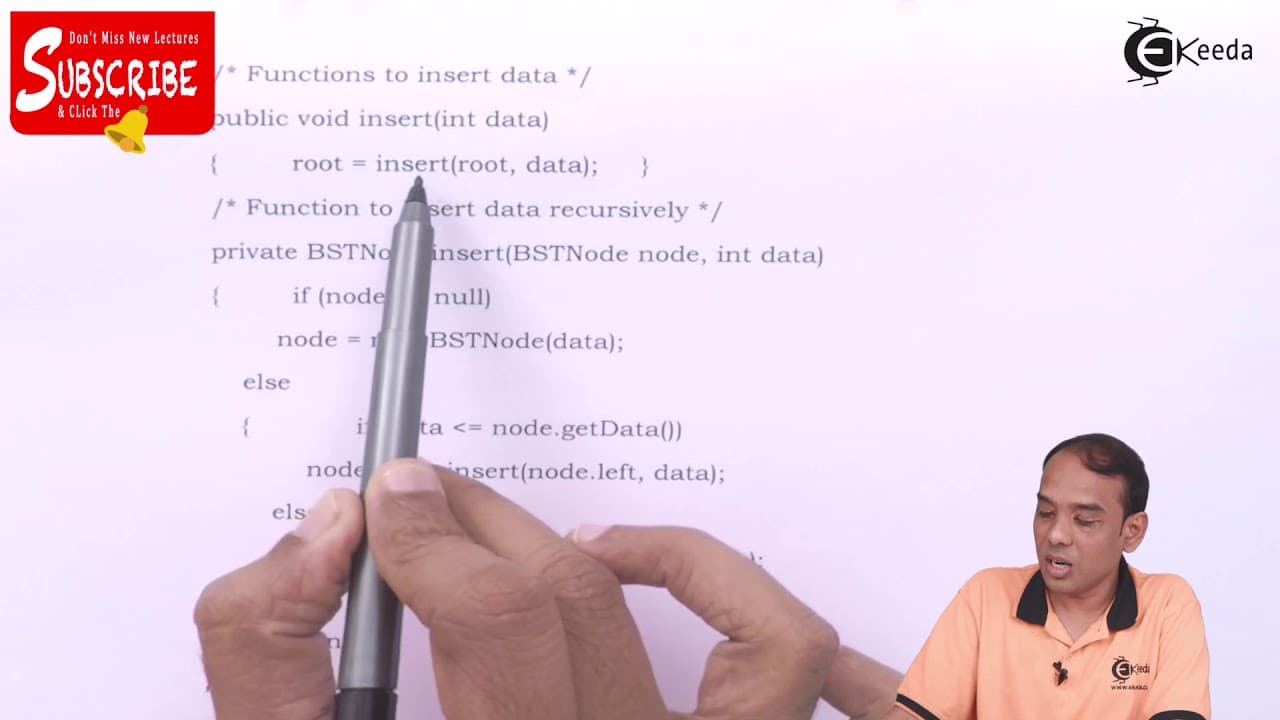
- 🔍 Insertion into a binary search tree involves comparing values and moving either to the left or right subtree until a suitable position is found.
- 🌲 Deletion in a binary search tree requires finding the node, determining its type, and performing the appropriate deletion operation to maintain the tree's properties.
- 🌲 Counting the number of nodes in a binary search tree can be done recursively by traversing the tree and incrementing a counter variable.
Install to Summarize YouTube Videos and Get Transcripts
Explore YouTube Video Summarizer or Get YouTube Transcript Extractor
Questions & Answers
Q: What are the two properties that a binary search tree must follow?
The left subtree of each node should have values less than or equal to the parent node, and the right subtree should have values greater than or equal to the parent node.
Q: How is a binary search tree implemented using a BSTNode class?
The BSTNode class has variables for left and right child nodes, as well as a data variable. It includes constructors for creating nodes with or without initial values and getter and setter methods for manipulating the nodes.
Q: How is a value inserted into a binary search tree?
When inserting a value, the algorithm checks if the value is less than or equal to the current node. If so, it moves to the left subtree; otherwise, it moves to the right subtree. This process continues until a suitable position is found, and a new node is inserted.
Q: How does the deletion process work in a binary search tree?
To delete a value, the algorithm first searches for the value in the tree. If found, it determines the type of node (leaf, one child, or two children) and performs a suitable deletion operation. The tree is then adjusted to maintain the binary search tree properties.
Summary & Key Takeaways
-
A binary search tree (BST) is a type of binary tree that follows two properties: the left subtree of each node has values less than or equal to the parent node, and the right subtree has values greater than or equal to the parent node.
-
The video explains the implementation of a BST using a BSTNode class and includes constructors, setters, getters, and operations like insertion and deletion.
-
Other operations covered include counting the number of nodes in the tree and searching for a specific value.
Read in Other Languages (beta)
Share This Summary 📚
Summarize YouTube Videos and Get Video Transcripts with 1-Click
Try YouTube Summary with ChatGPT & Claude or YouTube Transcript Generator
Explore More Summaries from Ekeeda 📚






Summarize YouTube Videos and Get Video Transcripts with 1-Click
Try YouTube Summary with ChatGPT & Claude or YouTube Transcript Generator