Recursive Function to Convert Decimal to Hexadecimal | Data Structure Using C
TL;DR
This video explains how to use a recursive function to convert a decimal number to a hexadecimal number.
Transcript
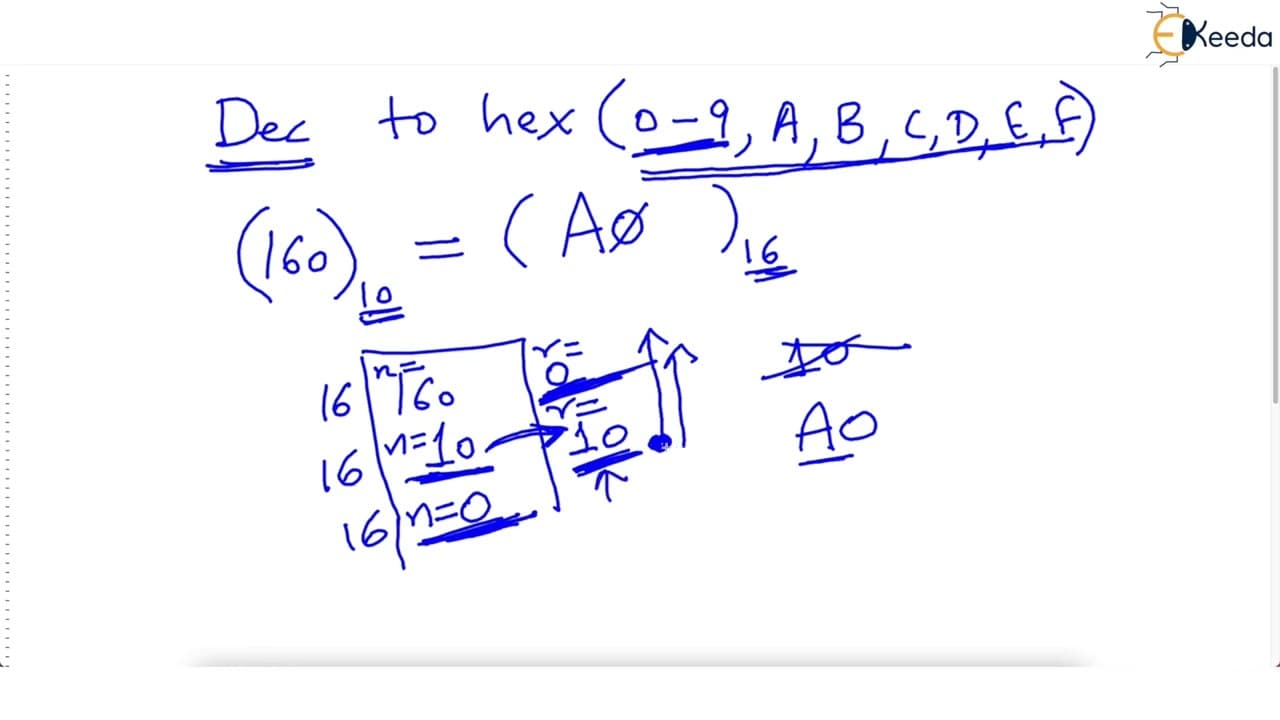
hello dear students let's see a recursive function to convert a decimal number to hexadecimal number now as you see in the previous video we saw how to convert a decimal number to binary number so what is the procedure of converting decimal to hex i have already written a function here as you see a recursive function which is named as deck to hex d... Read More
Key Insights
- 🎮 The video emphasizes the importance of understanding the concept of dividing a decimal number by 16 to obtain remainders in the conversion process.
- 🔨 Recursive functions can be a useful tool for iterative processes in programming, simplifying complex algorithms.
- 😒 The use of a switch statement in the recursive function allows for easy conversion of remainders greater than 9 to their hexadecimal equivalents.
Install to Summarize YouTube Videos and Get Transcripts
Explore YouTube Video Summarizer or Get YouTube Transcript Extractor
Questions & Answers
Q: What is the purpose of using a recursive function for decimal to hexadecimal conversion?
The recursive function allows for an iterative process of dividing the decimal number by 16 and obtaining remainders until the number converges to 0. This approach simplifies the conversion process.
Q: How are remainders represented in hexadecimal format?
If a remainder is greater than 9, it is represented by a letter instead of a number. For example, remainder 10 is represented as 'A', 11 as 'B', and so on.
Q: How does the recursive function handle cases where the quotient cannot be further divided?
When the quotient becomes 0, the recursive function stops, and the remainders obtained are printed in reverse order to obtain the hexadecimal equivalent of the decimal number.
Q: Can the recursive function handle decimal numbers larger than 160?
Yes, the recursive function can handle any decimal number. It repeatedly divides the number by 16 until the quotient becomes 0, regardless of the initial value of the decimal number.
Summary & Key Takeaways
-
The video discusses the process of converting a decimal number to a hexadecimal number using a recursive function.
-
It explains the difference between decimal and hexadecimal number systems, highlighting that hexadecimal has 16 digits (0-9 and A-F).
-
The video provides step-by-step instructions on how to convert a decimal number to hexadecimal, including dividing the number by 16, obtaining remainders, and printing the results.
Read in Other Languages (beta)
Share This Summary 📚
Summarize YouTube Videos and Get Video Transcripts with 1-Click
Try YouTube Summary with ChatGPT & Claude or YouTube Transcript Generator
Explore More Summaries from Ekeeda 📚






Summarize YouTube Videos and Get Video Transcripts with 1-Click
Try YouTube Summary with ChatGPT & Claude or YouTube Transcript Generator