Organized Structure of the Body | Biology
TL;DR
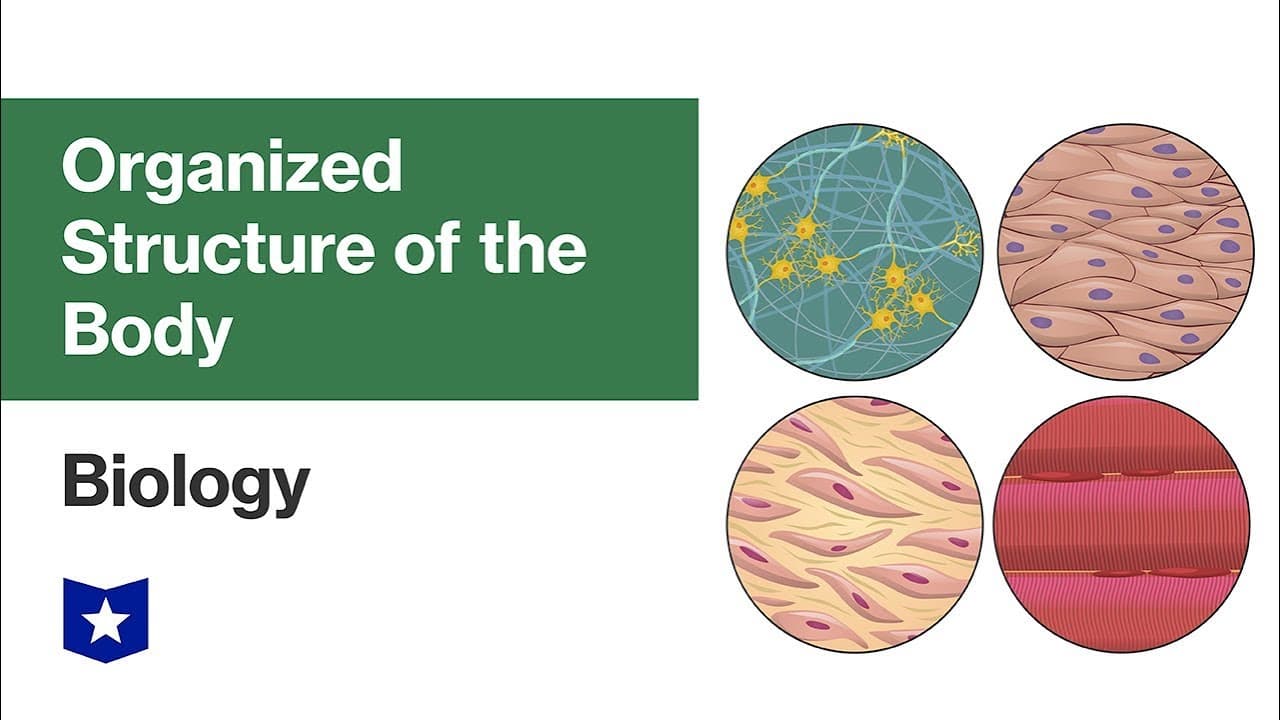
The body contains muscle, nervous, epithelial, and connective tissues that serve unique functions.
Transcript
the body of a multicellular organism is a complex and organized system made up of specialized cells cells are the same function come together to form tissues of which there are four main categories muscle nervous epithelial and connective tissues let's take a closer look at each one of these in turn muscle tissue is responsible for body movement as... Read More
Key Insights
- 💪 Muscle tissue enables body movement and substance transport.
- 😟 Nervous tissue transmits information and forms the nervous system.
- 🧑🏭 Epithelial tissue acts as a protective barrier for organs.
- ❓ Connective tissue provides structure and support for the body.
- 💪 Smooth muscle is involuntary, while skeletal muscle is voluntary.
- 🥰 Cardiac muscle aids in heart function.
- 😟 Nervous tissue facilitates response to stimuli.
Install to Summarize YouTube Videos and Get Transcripts
Explore YouTube Video Summarizer or Get YouTube Transcript Extractor
Questions & Answers
Q: What are the main categories of tissues in a multicellular organism's body?
The main categories are muscle, nervous, epithelial, and connective tissues.
Q: What is the difference between smooth and skeletal muscle tissues?
Smooth muscle tissues are involuntary and found in organ linings, while skeletal muscle tissues are voluntary and attached to bones for movement.
Q: How does nervous tissue function in the body?
Nervous tissue is responsible for transmitting information throughout the body, forming the nervous system and enabling responses to external stimuli.
Q: What role does epithelial tissue play in the body?
Epithelial tissue covers body surfaces and internal organs, providing a protective barrier between organs and their environment.
Summary & Key Takeaways
-
The body consists of specialized cells that come together to form muscle, nervous, epithelial, and connective tissues.
-
Muscle tissue enables body movements, with smooth, skeletal, and cardiac muscle types each serving specific functions.
-
Nervous tissue receives and transmits information, while epithelial tissue acts as a protective barrier, and connective tissue provides structure and support.
Read in Other Languages (beta)
Share This Summary 📚
Summarize YouTube Videos and Get Video Transcripts with 1-Click
Try YouTube Summary with ChatGPT & Claude or YouTube Transcript Generator
Explore More Summaries from Course Hero 📚




Summarize YouTube Videos and Get Video Transcripts with 1-Click
Try YouTube Summary with ChatGPT & Claude or YouTube Transcript Generator