Black holes | Stars, black holes and galaxies | Cosmology & Astronomy | Khan Academy
TL;DR
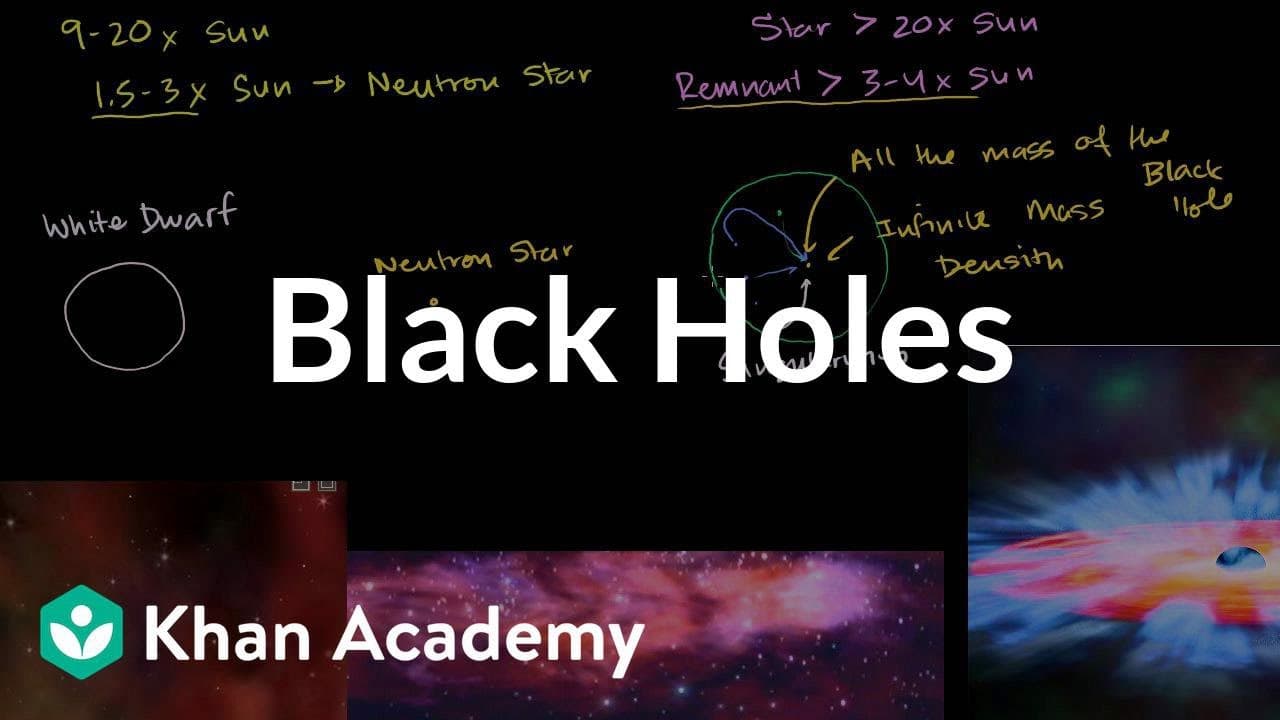
Stars with a mass more than 20 times that of the Sun collapse into black holes, where all the mass is contained in an infinitely small point called a singularity.
Transcript
In the last video, we saw that if we started with a massive star about nine to 20 times the mass of the Sun, and when it finally matures the remnant of the star is roughly, or that remnant core of the star is roughly 1 and 1/2 to 3 times the solar mass or the mass of the Sun, then this remnant right here-- and let me just be clear, this nine to 20 ... Read More
Key Insights
- ✴️ Massive stars with a mass more than 20 times that of the Sun collapse into black holes.
- 💯 Black holes have a singularity at their core, which is an infinitely small and infinitely dense point.
- 🖤 The event horizon is the boundary around the singularity where anything within cannot escape the black hole's gravitational pull.
- 🖤 Our understanding of black holes and singularities is still incomplete, as they challenge our current laws of physics.
- 🖤 Black holes cannot emit any radiation or light, making them appear completely black.
- 😚 Matter that gets too close to a black hole can be ripped apart and pulled into it, creating an accretion disk.
- 🖤 Theories such as Hawking radiation suggest that black holes can emit radiation due to quantum effects near the event horizon, though it is not directly from the black hole itself.
Install to Summarize YouTube Videos and Get Transcripts
Explore YouTube Video Summarizer or Get YouTube Transcript Extractor
Questions & Answers
Q: What happens to a star with a mass more than 20 times that of the Sun when it reaches old age?
The star collapses into a white dwarf, then into a neutron star, and eventually into a black hole due to its massive size and density.
Q: What is a singularity in the context of black holes?
A singularity is a point of infinite mass density at the core of a black hole, where the laws of physics break down and our current understanding is incomplete.
Q: How does the event horizon relate to black holes?
The event horizon is the boundary around the singularity where nothing, not even light or electromagnetic radiation, can escape the gravitational influence of the black hole.
Q: Can we observe black holes directly?
Currently, we can only observe indirect evidence of black holes through their effects on surrounding matter and their strong gravitational pull.
Summary & Key Takeaways
-
When large stars with a mass of 9 to 20 times that of the Sun mature and shed outer material, the supernova explosion condenses into a neutron star.
-
Stars with a mass more than 20 times that of the Sun collapse into white dwarfs, then into neutron stars, and eventually into black holes.
-
Black holes have a singularity at their core, which is an infinitely small point of infinite mass and density that pulls in all surrounding matter.
Read in Other Languages (beta)
Share This Summary 📚
Summarize YouTube Videos and Get Video Transcripts with 1-Click
Try YouTube Summary with ChatGPT & Claude or YouTube Transcript Generator
Explore More Summaries from Khan Academy 📚



Summarize YouTube Videos and Get Video Transcripts with 1-Click
Try YouTube Summary with ChatGPT & Claude or YouTube Transcript Generator