Fields | Forces at a distance | Middle school physics | Khan Academy
TL;DR
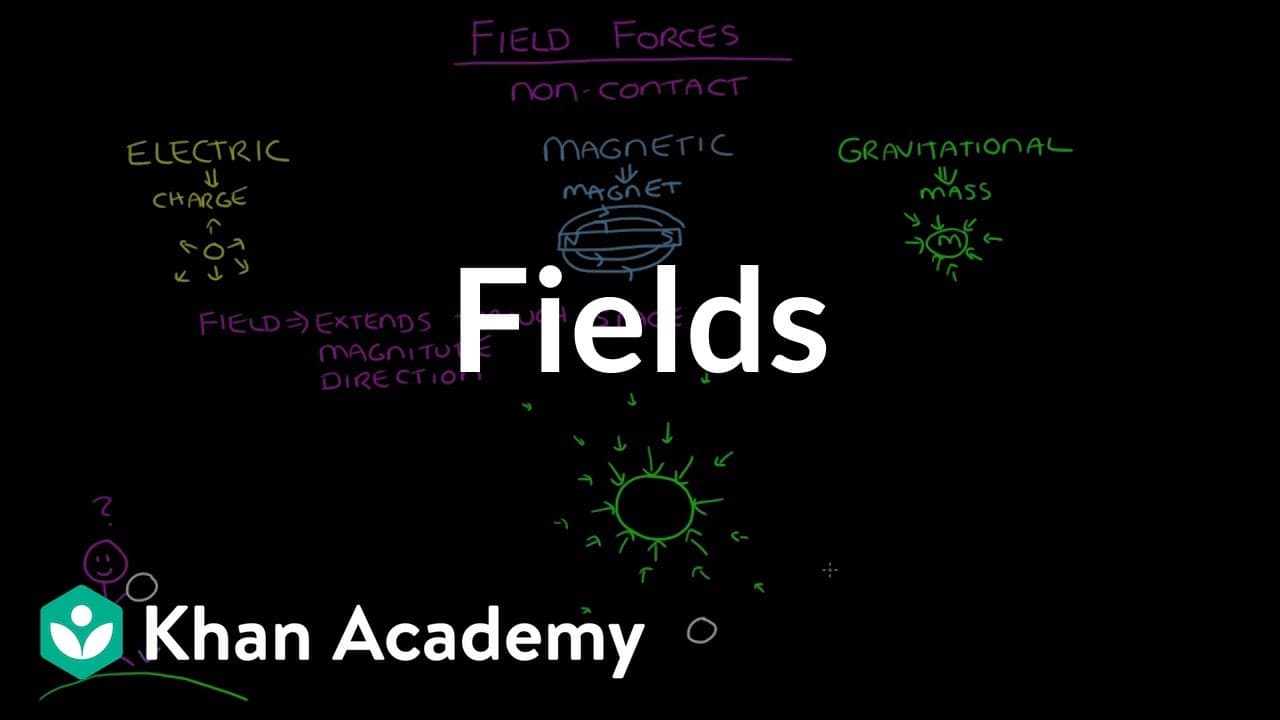
Non-contact forces, such as gravity, electric, and magnetic forces, exert a force on objects without physically touching them, acting over a region called a field.
Transcript
- If you hold a ball up in the air and let it go, you know it's going to fall, but why? Nothing is touching it once you let it go. How can there be a force on it? Well, this is because Earth's gravitational force is pulling the ball and gravity is a non-contact force. Non-contact forces don't have to touch an object to exert a force on it. Instead,... Read More
Key Insights
- 🤙 Non-contact forces, like gravity, electric, and magnetic forces, act over a region called a field.
- 👾 Fields extend through space from objects with specific physical properties, such as mass for gravitation, charge for electric forces, and magnetic properties for magnetic forces.
- 🏑 The strength and direction of a field determine the forces experienced by objects within the field.
- 😚 The closer an object is to the source of the field, the stronger the force it experiences.
- 🏑 Gravitational, electric, and magnetic forces are examples of field forces.
- 🏑 Field lines represent the direction and strength of a field.
- 🚱 Non-contact forces can affect objects without physical contact, exerting a force over a distance.
Install to Summarize YouTube Videos and Get Transcripts
Explore YouTube Video Summarizer or Get YouTube Transcript Extractor
Questions & Answers
Q: How do non-contact forces exert a force on objects that they aren't touching?
Non-contact forces, like gravity, electric, and magnetic forces, act over a region called a field. This field surrounds objects with specific physical properties, and if an object is within that region, it will be affected by the force exerted by the field.
Q: What is a field and what physical properties determine its presence?
A field is a region that extends through space surrounding an object with specific physical properties. Gravitational forces are associated with mass, electric forces with charge, and magnetic forces with magnetic properties. Any object possessing these properties will have a field surrounding it.
Q: How do fields help in predicting the behavior of objects experiencing non-contact forces?
By studying the strength and direction of a field, scientists can predict the forces experienced by objects within the field. As an object gets closer to the source of the field, the force becomes stronger, and field lines represent the direction and strength of the field.
Q: What are some examples of non-contact forces?
Non-contact forces include gravitational forces, electric forces, and magnetic forces. These forces can influence the behavior of objects without physical contact, exerting a force over a distance.
Summary & Key Takeaways
-
Non-contact forces, like gravity, electric, and magnetic forces, can affect objects without physical contact due to the presence of a field.
-
Fields extend through space from objects with specific physical properties, such as mass for gravitational forces, charge for electric forces, and magnetic properties for magnetic forces.
-
The strength and direction of a field determine the forces experienced by objects within the field, with the force becoming stronger as an object gets closer to the source of the field.
Read in Other Languages (beta)
Share This Summary 📚
Summarize YouTube Videos and Get Video Transcripts with 1-Click
Try YouTube Summary with ChatGPT & Claude or YouTube Transcript Generator
Explore More Summaries from Khan Academy 📚



Summarize YouTube Videos and Get Video Transcripts with 1-Click
Try YouTube Summary with ChatGPT & Claude or YouTube Transcript Generator