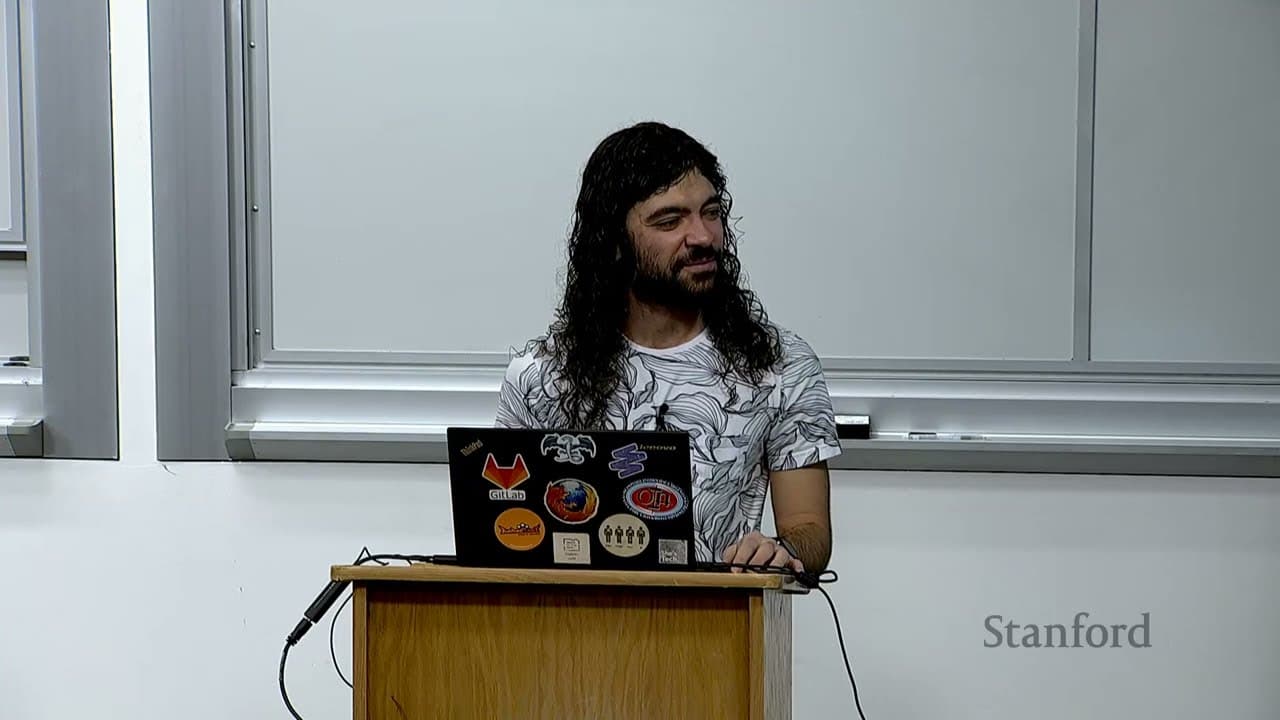
Stanford CS224N NLP with Deep Learning | 2023 | Lecture 15 - Code Generation
TL;DR
Models like Codex and Alpha Code have shown promising results in generating code for programming tasks, but they still have limitations. The use of sampling, testing, and filtering can improve the performance of code generation models. However, challenges like maintaining composability and debugging code generated by AI models remain.
Transcript
so this is lecture 15. and today we'll be talking about code generation so a little bit unusual since it's a we'll be generating unnatural languages this time but it'll connect in a number of ways to natural language Generation Um so before I start just a few announcements the project Milestone is due this Thursday you are certainly aware of that u... Read More
Key Insights
- 👨💻 Code generation models show promise in generating code for programming tasks but have limitations.
- 👨💻 Strategies such as sampling, testing, and filtering can improve the performance of code generation models.
- 👨💻 Maintaining composability and debugging code generated by AI models are challenges that need to be addressed.
- 👨💻 Code generation using natural language descriptions as specifications requires handling ambiguity and understanding human preferences.
Install to Summarize YouTube Videos and Get Transcripts
Explore YouTube Video Summarizer or Get YouTube Transcript Extractor
Questions & Answers
Q: How can program synthesizers ensure the correctness of the output program based on the given specification?
Program synthesizers typically validate the correctness of the output program by testing it against the given specification. Input-output examples can be used to verify that the program produces the expected outputs for a given set of inputs.
Q: What are the challenges of code generation using natural language descriptions as specifications?
Code generation from natural language descriptions is challenging due to the ambiguity in human languages. Understanding the context, resolving ambiguity, and capturing human preferences can be difficult for program synthesizers when generating code based on natural language specifications.
Q: How can the performance of code generation models be improved?
Performance can be improved by sampling more programs, testing them against the given specification, and filtering out incorrect solutions. Reranking the generated programs based on log probabilities can also help in selecting the most likely correct solutions.
Q: What are some limitations of code generation models like Codex and Alpha Code?
Limitations include the need for large-scale training and computational resources, difficulty in maintaining composability of code, challenges in debugging code generated by AI models, and the necessity of human understanding and intervention in the code generation process.
Summary & Key Takeaways
-
Code generation involves the use of program synthesis to write programs that satisfy a given specification.
-
Logical specifications, input-output examples, and natural language descriptions can be used as specifications for program synthesis.
-
Models like Codex and Alpha Code have achieved non-trivial performance in generating code for programming tasks through strategies such as sampling, testing, and filtering.
Read in Other Languages (beta)
Share This Summary 📚
Summarize YouTube Videos and Get Video Transcripts with 1-Click
Try YouTube Summary with ChatGPT & Claude or YouTube Transcript Generator
Explore More Summaries from Stanford Online 📚
Summarize YouTube Videos and Get Video Transcripts with 1-Click
Try YouTube Summary with ChatGPT & Claude or YouTube Transcript Generator