How to Use Practice Variability to Prevent Injuries
TL;DR
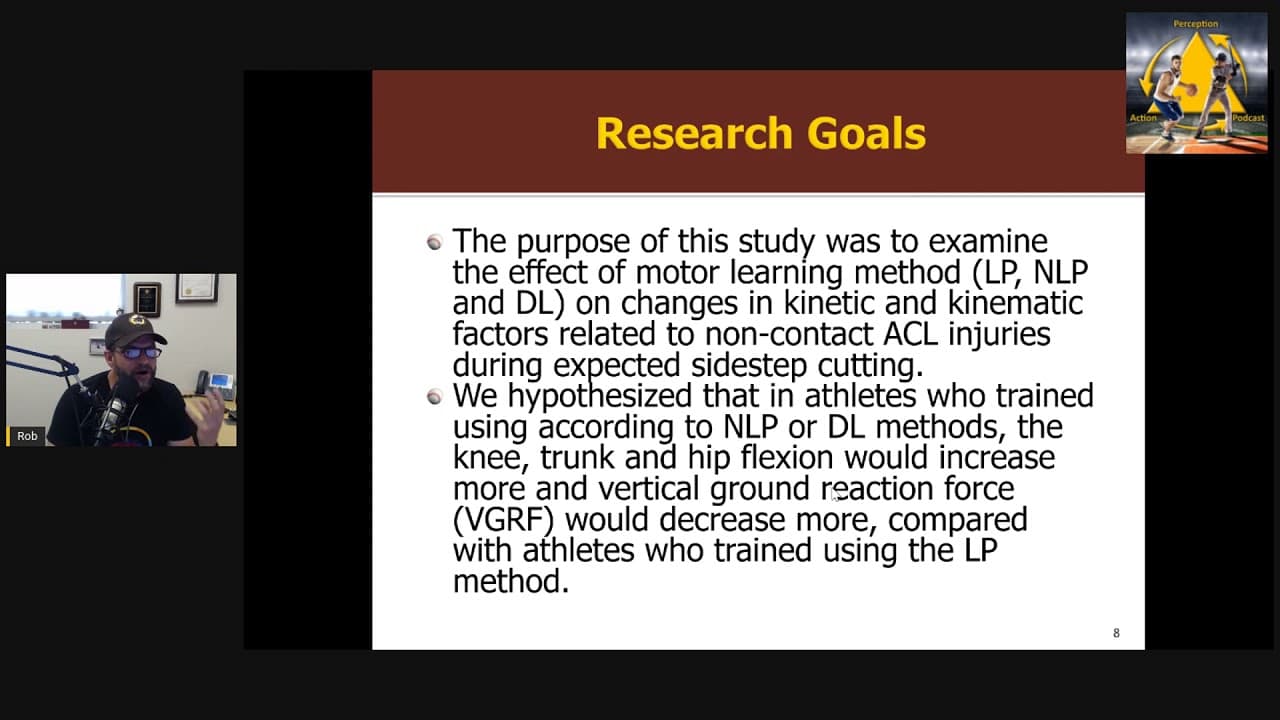
Training with high variability can reduce injury risk by encouraging adaptive movement solutions. By varying practice conditions, athletes can distribute forces more evenly, potentially lowering the risk of injuries like ACL tears. The study suggests that both constraints-led and differential learning approaches, which promote variability, are effective in minimizing injury risk factors.
Transcript
hi everyone it's rob gray from asu in the perception action podcast back with another article review in this article i want to look at the issue of variability of practice and prevention of injury as i discussed back in episode number 324 when looking at kind of the ecological approach to in injury and recovery and adaptation to injury one of the m... Read More
Key Insights
- Variability of practice is a critical factor in injury prevention, offering a third dimension to traditional load and frequency considerations.
- The variability overuse hypothesis suggests that low variability in repetitive movements increases injury risk.
- ACL injuries are prevalent in sports involving sidestepping, and certain knee angles and forces are indicators of injury risk.
- Training with higher variability encourages adaptive movement solutions, distributing forces more evenly across the body.
- Constraints-led and differential learning approaches both promote movement variability, reducing injury risk factors.
- Constraints-led approach introduces structured variability, guiding athletes towards alternative movement solutions.
- Differential learning adds random variability, encouraging exploration of a wide range of movement possibilities.
- Study findings support that both variability-promoting methods are more effective than linear prescriptive instruction in reducing injury risk factors.
Install to Summarize YouTube Videos and Get Transcripts
Explore YouTube Video Summarizer or Get YouTube Transcript Extractor
Questions & Answers
Q: How does practice variability prevent injuries?
Practice variability prevents injuries by encouraging athletes to adapt to different movement solutions, which helps distribute forces more evenly across the body. This adaptation reduces the likelihood of repetitive stress injuries, such as ACL tears, by minimizing the impact of repetitive movements performed in the same way.
Q: What is the variability overuse hypothesis?
The variability overuse hypothesis suggests that low variability in repetitive movements increases the risk of injury. Traditional injury considerations focus on excessive load and frequency, but this hypothesis adds a third dimension, emphasizing that performing the same movement repeatedly without variation can lead to overuse injuries.
Q: What are the key factors in ACL injury risk?
Key factors in ACL injury risk include certain knee angles and forces during movements, particularly in sports involving sidestepping or cutting. The study identifies that specific kinematic and kinetic factors, such as knee flexion angles and ground reaction forces, are associated with a higher likelihood of ACL injuries.
Q: How do constraints-led and differential learning approaches differ?
Constraints-led approach introduces structured variability, guiding athletes towards alternative movement solutions by manipulating practice constraints. Differential learning, on the other hand, adds random variability, encouraging athletes to explore a wide range of movement possibilities without specific guidance, promoting adaptability and exploration.
Q: What were the study's findings on practice methods?
The study found that both constraints-led and differential learning approaches, which promote movement variability, resulted in more positive outcomes in reducing injury risk factors compared to linear prescriptive instruction. These methods effectively improved kinematic and kinetic variables like knee angles and ground reaction forces, associated with lower injury risks.
Q: Why might the constraints-led approach be more effective?
The constraints-led approach may be more effective because it introduces purposeful, structured variability, guiding athletes towards specific alternative movement solutions. This structured approach helps destabilize existing movement patterns and encourages exploration of new, adaptive solutions, potentially leading to better injury prevention outcomes.
Q: What are some limitations of the study?
One limitation of the study is the potential straw man argument against linear prescriptive instruction, as it assumes no variability is allowed in traditional coaching. Additionally, there is circularity in defining risk factors and then measuring them as outcomes. A comparison with prescriptive instruction incorporating variability could provide more comprehensive insights.
Q: How can variability be added to prescriptive instruction?
Variability can be added to prescriptive instruction through contextual interference, using random practice sequences. For example, alternating between different types of drills like corner kicks, passes, and shots can introduce variability within a prescriptive framework. This method allows for variability while maintaining some level of structured guidance, potentially reducing injury risk.
Summary & Key Takeaways
-
Training with high variability can significantly reduce the risk of injuries like ACL tears by promoting adaptive movement solutions. By varying practice conditions, athletes can distribute forces more evenly, minimizing injury risks. The study highlights the effectiveness of both constraints-led and differential learning approaches in achieving these outcomes.
-
The variability overuse hypothesis introduces a new dimension to injury prevention, emphasizing the role of movement variability. Traditional injury risk factors include excessive load and frequency, but low variability in repetitive movements also contributes. By increasing variability, athletes can reduce injury risk through more adaptive and varied movement patterns.
-
Constraints-led and differential learning approaches both encourage movement variability, with the former using structured variability and the latter promoting random exploration. The study shows that these methods are more effective than linear prescriptive instruction in reducing kinematic and kinetic risk factors for injuries, such as knee angles and ground reaction forces.
Read in Other Languages (beta)
Share This Summary 📚
Summarize YouTube Videos and Get Video Transcripts with 1-Click
Try YouTube Summary with ChatGPT & Claude or YouTube Transcript Generator
Explore More Summaries from Rob Gray 📚

Summarize YouTube Videos and Get Video Transcripts with 1-Click
Try YouTube Summary with ChatGPT & Claude or YouTube Transcript Generator