Abstract Algebra | First Isomorphism Theorem for Groups
TL;DR
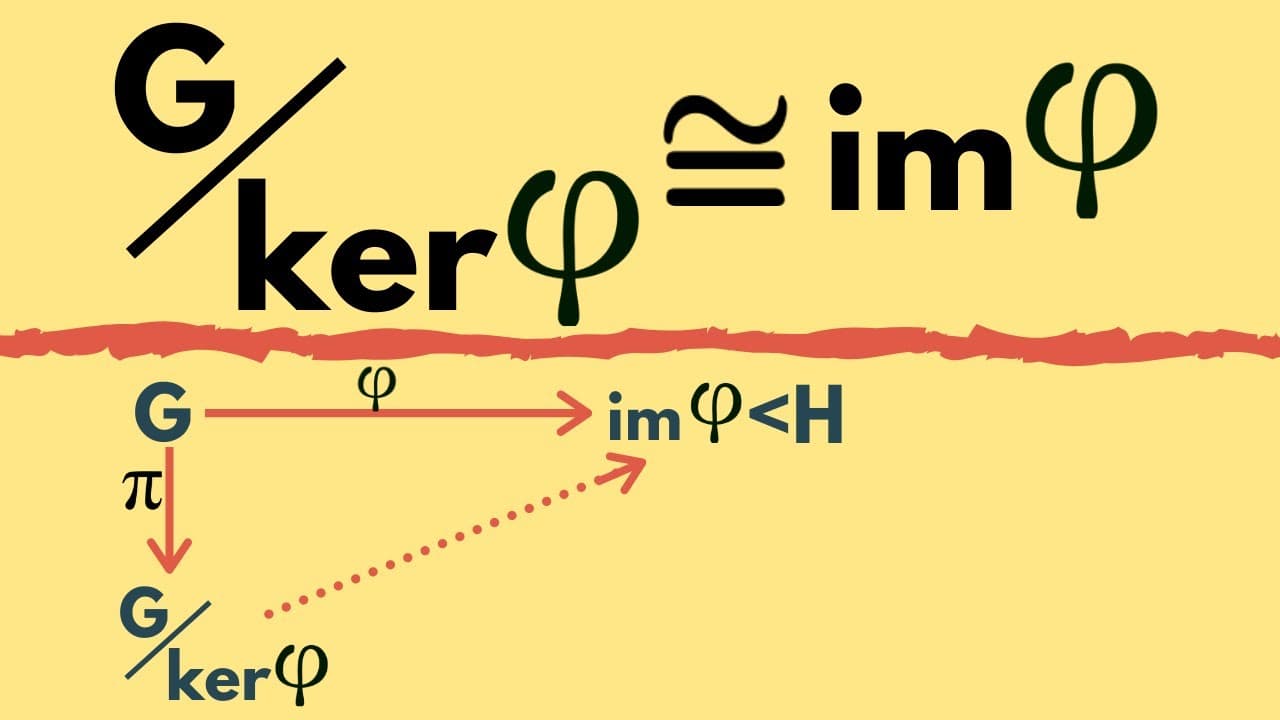
The First Isomorphism Theorem for groups states that if there is a homomorphism between two groups, there exists a unique isomorphism between the quotient group and the image of the homomorphism.
Transcript
okay in this video we're gonna look at a super important result known as the first isomorphism theorem for groups so there exists these kind of isomorphism theorems for all algebraic structures but in this video we'll just focus on groups so let's look at some background so let's say G 1 and G 2 are groups and we have a map fee from G 1 2 G 2 we sa... Read More
Key Insights
- 🧩 The first isomorphism theorem for groups is a significant result that applies to algebraic structures and specifically focuses on groups.
- 🤝 A homomorphism between two groups G1 and G2 is defined as a map fee that satisfies the condition C(X, Y) = V(X) * V(Y), where C denotes multiplication in G1 and V denotes multiplication in G2.
- 🧪 The kernel of fee is identified as the set of all elements X in G1 that map to the identity element in G2.
- 🔬 Previous proofs have established that the kernel of fee is a normal subgroup of G1.
- ️ The first isomorphism theorem for groups deals with the quotient group of G1 with the kernel.
- ⚖️ The theorem states that for a homomorphism from G1 to H, there exists a unique isomorphism pi from G mod kernel to the image of V, which is a subgroup of H.
- 🔄 The composition of psy and pi is equal to fee, representing the interaction between the homomorphisms involved in the theorem.
- 🧩 The proof of the theorem involves defining the map psy and demonstrating its well-defined nature, homomorphism, injectivity, and surjectivity. Additionally, uniqueness and the fulfillment of the composition rule are confirmed.
Install to Summarize YouTube Videos and Get Transcripts
Explore YouTube Video Summarizer or Get YouTube Transcript Extractor
Questions & Answers
Q: How is a homomorphism defined in group theory?
In group theory, a homomorphism is a map between two groups that preserves the group operation. For all elements x and y in the first group, the homomorphism satisfies f(x * y) = f(x) * f(y), where * denotes the group operation in both groups.
Q: What is the kernel of a homomorphism?
The kernel of a homomorphism is the set of all elements in the domain group that get mapped to the identity element in the codomain group. It is a normal subgroup of the domain group.
Q: How is the quotient group related to the kernel of a homomorphism?
The quotient group is formed by partitioning the elements of the domain group into cosets based on the kernel of the homomorphism. It represents the factor group where the elements in the kernel are identified as the identity element.
Q: What is the significance of the image of a homomorphism in the first isomorphism theorem?
The image of a homomorphism represents a subgroup of the codomain group that captures the essential structure of the domain group. The first isomorphism theorem establishes a one-to-one correspondence between the quotient group and the image, proving their intimate relationship.
Q: How does the first isomorphism theorem help in understanding the structure of groups?
The first isomorphism theorem allows us to dissect a given group into its quotient group and the image of a homomorphism, providing insights into their respective structures. It helps in analyzing the relationship between different groups and their substructures.
Q: What conditions must a homomorphism meet for the first isomorphism theorem to be applicable?
The homomorphism should be both surjective and defined over the entire domain group. The surjectivity ensures that the image of the homomorphism covers the entirety of the codomain group, establishing the correspondence with the quotient group.
Q: What does the uniqueness of the isomorphism in the first isomorphism theorem imply?
The uniqueness of the isomorphism means that there is only one way to map the elements of the quotient group onto the image of the homomorphism. It highlights the inherent connection between the quotient group and the image and ensures a consistent mapping between them.
Summary & Key Takeaways
-
The first isomorphism theorem for groups explains the relationship between a homomorphism and an isomorphism in group theory.
-
It states that if there is a homomorphism between two groups, there exists a unique isomorphism between the quotient group and the image of the homomorphism.
-
The theorem provides a way to understand the structure of groups and how they relate to each other.
Read in Other Languages (beta)
Share This Summary 📚
Summarize YouTube Videos and Get Video Transcripts with 1-Click
Try YouTube Summary with ChatGPT & Claude or YouTube Transcript Generator
Explore More Summaries from Michael Penn 📚
Summarize YouTube Videos and Get Video Transcripts with 1-Click
Try YouTube Summary with ChatGPT & Claude or YouTube Transcript Generator