is this trickier than it seems?
TL;DR
Explores octagon weight distribution and a tricky limit problem.
Transcript
so today I want to look at two kind of unrelated problems from the math magazine and the first one has to do with placing weights on an octagon well let's look at all the details so let's Place eight weights with rational masses given by the Numbers M1 M2 up to M8 on the vertices of a regular octagon and then let's also assu... Read More
Key Insights
- The first problem involves distributing weights on a regular octagon such that the center of mass is at the centroid, requiring specific mass equalities across the octagon's vertices.
- The octagon is inscribed in a unit circle, and its vertices are positioned using Cartesian coordinates, facilitating the calculation of the center of mass.
- Trigonometry plays a crucial role in determining the positions of the octagon's vertices, especially those at 45-degree angles from the axes.
- The rationality of the weights leads to a system of equations, ultimately proving that opposite masses in the octagon are equal.
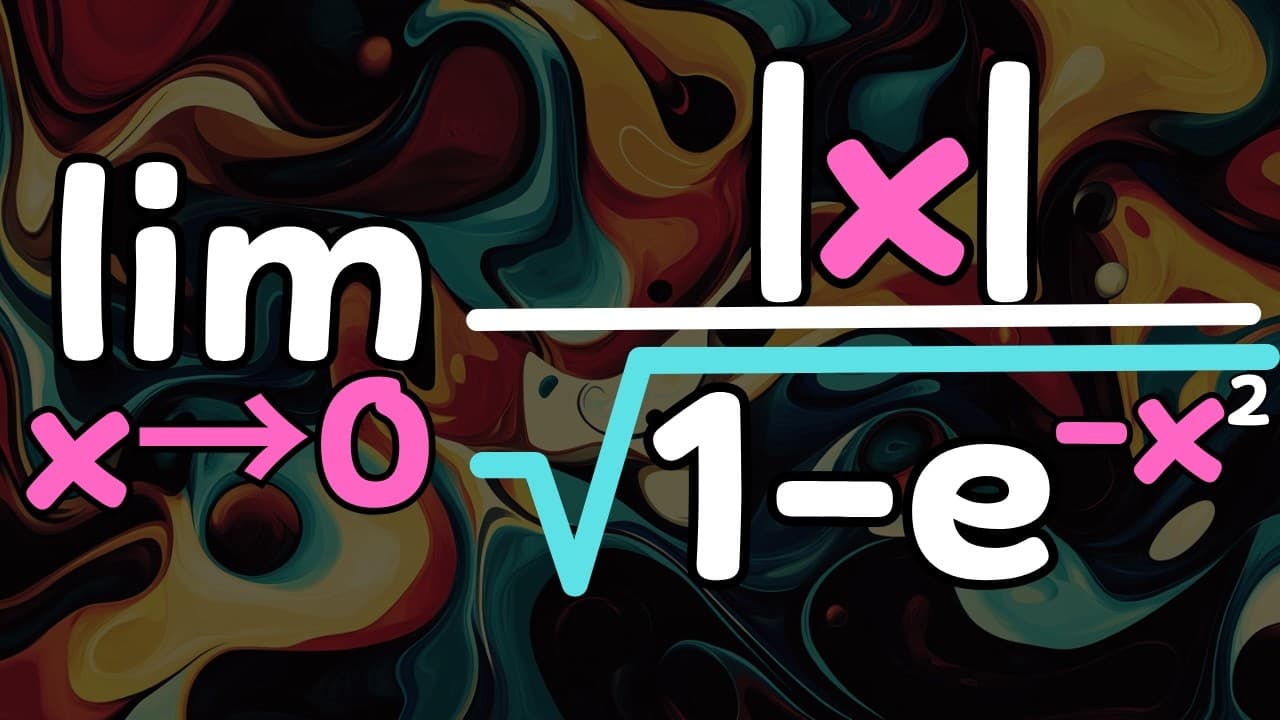
- The second problem involves evaluating a limit that initially presents an indeterminate form, requiring a strategic approach rather than straightforward application of L'Hôpital's rule.
- Squaring the limit expression simplifies the problem, allowing for the successful application of L'Hôpital's rule to find the limit.
- The limit problem demonstrates the importance of exploring alternative methods when direct approaches complicate the expression further.
- The solution to the limit problem confirms that the limit equals one, emphasizing the necessity of considering the positivity of the limit throughout the process.
Install to Summarize YouTube Videos and Get Transcripts
Explore YouTube Video Summarizer or Get YouTube Transcript Extractor
Questions & Answers
Q: What is the main goal of the octagon weight distribution problem?
The main goal of the octagon weight distribution problem is to place weights on the vertices of a regular octagon such that the center of mass, or centroid, is located at the center of the octagon. This requires proving that the masses across the octagon are equal, ensuring balance and symmetry.
Q: How is the octagon positioned in the problem?
The octagon is positioned by inscribing it in a unit circle, with its vertices placed using Cartesian coordinates. This setup allows for a systematic approach to determining the positions of the weights and facilitates the calculation of the center of mass. The vertices at 45-degree angles from the axes are particularly significant in this arrangement.
Q: What role does trigonometry play in the octagon problem?
Trigonometry is crucial for determining the positions of the octagon's vertices, especially those at 45-degree angles from the major axes. By using known trigonometric values, the coordinates of these vertices can be calculated accurately, enabling the formulation of equations necessary to prove the equality of opposite masses.
Q: Why is the rationality of the weights important in the octagon problem?
The rationality of the weights is important because it leads to a system of equations that can be solved to prove the equality of opposite masses. The presence of irrational numbers, such as the square root of two, in the equations allows for the separation of rational and irrational components, ultimately simplifying the problem and proving the required equalities.
Q: What challenge does the limit problem initially present?
The limit problem initially presents the challenge of an indeterminate form of type 0/0, which complicates direct application of L'Hôpital's rule. Instead of simplifying the expression, applying the rule directly makes it more complex, necessitating a different approach to evaluate the limit effectively.
Q: How is the limit problem simplified for evaluation?
The limit problem is simplified by squaring the limit expression, which removes the square root in the denominator and results in a more manageable form. This allows for the successful application of L'Hôpital's rule, leading to the evaluation of the limit. The process demonstrates the importance of considering alternative methods when direct approaches fail.
Q: What conclusion is reached about the limit in the second problem?
The conclusion reached about the limit in the second problem is that it equals one. This conclusion is based on the squared limit expression, which simplifies to a form that can be evaluated using L'Hôpital's rule. The positivity of the limit throughout the process supports this conclusion, confirming the value of the limit.
Q: What does the solution to the limit problem emphasize?
The solution to the limit problem emphasizes the importance of exploring alternative methods when direct approaches complicate the expression further. By considering the positivity of the limit and employing a strategic approach, the problem is simplified, and the limit is successfully evaluated. This highlights the necessity of flexibility and creativity in problem-solving.
Summary & Key Takeaways
-
The video explores two mathematical problems: one involving the distribution of weights on an octagon to achieve a balanced centroid, and another evaluating a complex limit. The octagon problem requires understanding of geometry and algebra, while the limit problem necessitates strategic thinking beyond L'Hôpital's rule.
-
In the octagon problem, weights are placed at the vertices of a regular octagon inscribed in a unit circle, with the goal of ensuring the center of mass is at the centroid. This leads to a system of equations proving that opposite masses are equal.
-
The limit problem involves a tricky indeterminate form that complicates with direct application of L'Hôpital's rule. By squaring the expression, the problem simplifies, allowing for successful evaluation of the limit, which is determined to be one.
Read in Other Languages (beta)
Share This Summary 📚
Summarize YouTube Videos and Get Video Transcripts with 1-Click
Try YouTube Summary with ChatGPT & Claude or YouTube Transcript Generator
Explore More Summaries from Michael Penn 📚
Summarize YouTube Videos and Get Video Transcripts with 1-Click
Try YouTube Summary with ChatGPT & Claude or YouTube Transcript Generator