Matched or Paired Samples T-Test - Hypothesis Testing
TL;DR
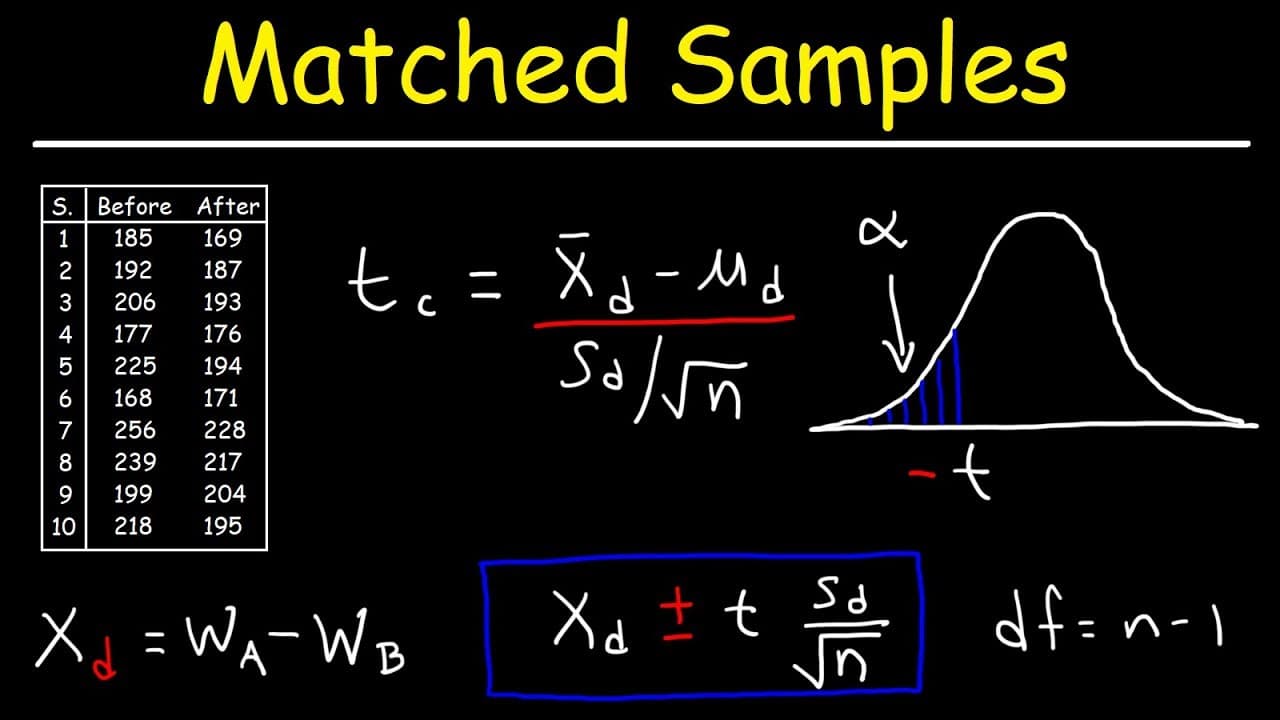
A weight loss study was conducted using paired samples to determine the effectiveness of a weight loss program.
Transcript
in this video we're going to talk about how to solve problems when you have a matched or paired sample a natural paired sample occurs when you're measuring two things with the same group of people in this case it could be the before and after weight of a weight loss program which is the problem that we're about to do so let's get right into it a st... Read More
Key Insights
- 👥 Paired sample designs are effective for assessing the impact of interventions on a specific group.
- 🆘 Calculating the mean and standard deviation of the differences helps evaluate the effectiveness of a program.
- 🉑 The critical t-value is used to determine whether to reject or accept the null hypothesis.
- 🧡 Confidence intervals provide a range in which the population mean difference is likely to fall.
- 🏋️ In this study, the weight loss program showed a statistically significant decrease in weight based on the obtained results.
- 🎚️ The margin of error helps determine the level of precision in estimating the mean difference.
- 🏋️ The rejection of the null hypothesis suggests that the weight loss program is effective.
Install to Summarize YouTube Videos and Get Transcripts
Explore YouTube Video Summarizer or Get YouTube Transcript Extractor
Questions & Answers
Q: How was the weight loss program evaluated?
The program was evaluated by measuring the before and after weights of 10 subjects in a paired sample design.
Q: What are the null and alternative hypotheses?
The null hypothesis states that the mean difference in weight is equal to or greater than zero, while the alternative hypothesis suggests that the mean difference is less than zero.
Q: How was the sample mean of the differences calculated?
The sample mean was obtained by taking the average of the differences in weight for the 10 subjects.
Q: How was the standard deviation of the differences calculated?
The standard deviation was calculated using either the formula or Excel, by subtracting each difference from the mean difference, squaring the result, summing up these squared differences, dividing by (n-1), and taking the square root.
Summary & Key Takeaways
-
A weight loss program was evaluated using paired samples of before and after weights of 10 subjects.
-
The differences between the before and after weights were calculated.
-
The null and alternative hypotheses were stated, and the sample mean, standard deviation, and critical t-value were calculated.
Read in Other Languages (beta)
Share This Summary 📚
Summarize YouTube Videos and Get Video Transcripts with 1-Click
Try YouTube Summary with ChatGPT & Claude or YouTube Transcript Generator
Explore More Summaries from The Organic Chemistry Tutor 📚



Summarize YouTube Videos and Get Video Transcripts with 1-Click
Try YouTube Summary with ChatGPT & Claude or YouTube Transcript Generator