Carbon as a building block of life | Properties of carbon | Biology | Khan Academy
TL;DR
Carbon is essential for life and forms the backbone of molecules that make life possible.
Transcript
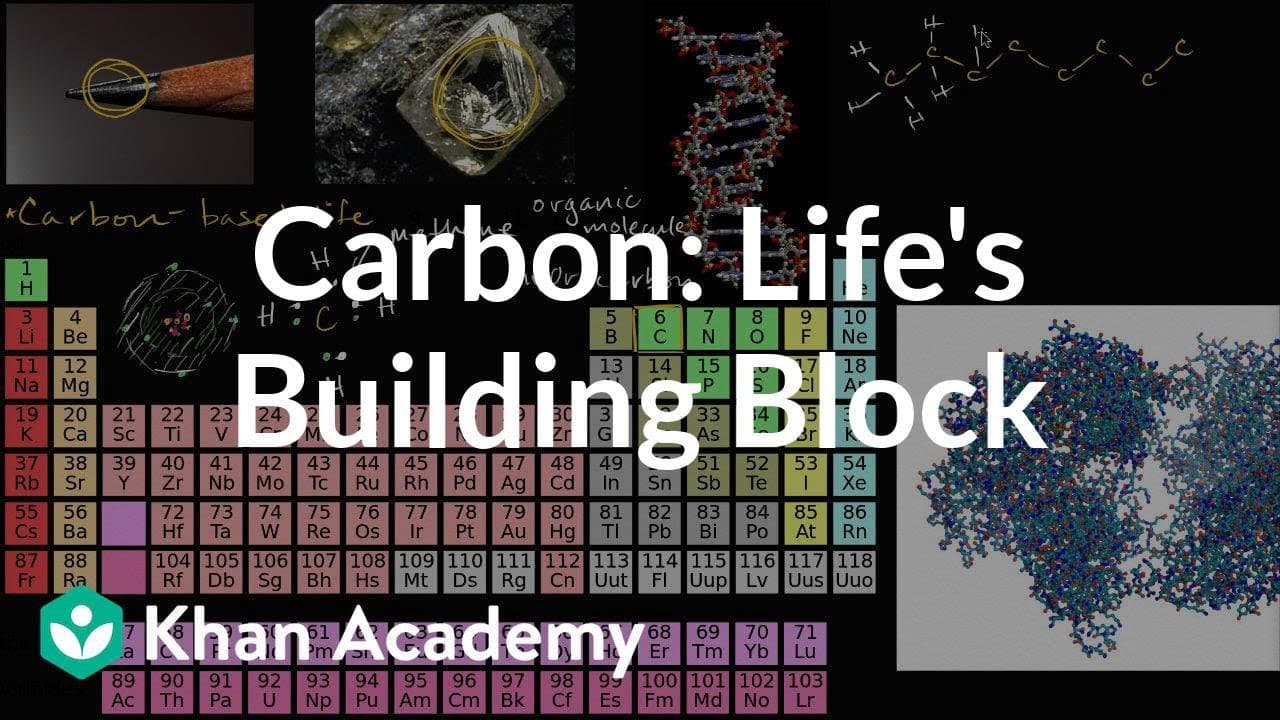
You're probably already familiar with some forms of carbon. For example this graph I write over here, this is one form carbon takes. Very important when you're writing with a pencil, otherwise you would not see any writing. If you didn't have the graphite scraping onto your, scraping onto your paper, which you and your paper is also. It's not pure... Read More
Key Insights
- 💁 Carbon is essential for life as we know it, forming the backbone of molecules like DNA and proteins.
- 💁 The versatility of carbon in forming covalent bonds enables the creation of complex molecular structures.
- 🖐️ Carbon-based compounds, such as hydrocarbons, play a significant role in various industries, including energy production.
- 💆 The majority of the human body's mass is carbon, highlighting its importance in biological systems.
- 💁 Carbon's ability to form different structures, such as chains, cycles, and lattice structures, contributes to its usefulness as a building block.
- 🍂 The study of organic molecules, which contain carbon, falls under the field of Organic Chemistry.
- 🫀 Valence electrons are crucial for carbon's ability to form bonds with other atoms and participate in chemical reactions.
Install to Summarize YouTube Videos and Get Transcripts
Explore YouTube Video Summarizer or Get YouTube Transcript Extractor
Questions & Answers
Q: Why is carbon essential for life?
Carbon forms the backbone of molecules that make up living organisms, such as DNA and proteins. It can form multiple bonds, allowing for the creation of complex molecular structures necessary for life.
Q: What is the most common isotope of carbon on Earth?
The most common isotope of carbon on Earth is carbon-12, which has six protons and six neutrons in its nucleus.
Q: What are valence electrons, and why are they important for carbon?
Valence electrons are the outermost electrons in an atom's electron shell. Carbon has four valence electrons, which are involved in chemical reactions and bonding with other atoms.
Q: What is the difference between organic molecules and hydrocarbons?
Organic molecules are compounds that contain carbon, while hydrocarbons are organic molecules only consisting of carbon and hydrogen. Hydrocarbons, such as methane, gasoline, and octane, are often used as fuels.
Summary & Key Takeaways
-
Carbon is a versatile element that can exist in various forms, such as graphite and diamonds.
-
Life as we know it is carbon-based, and signs of carbon-based life are sought on other planets.
-
Carbon's position in the periodic table and its ability to form multiple bonds make it valuable for life.
Read in Other Languages (beta)
Share This Summary 📚
Summarize YouTube Videos and Get Video Transcripts with 1-Click
Try YouTube Summary with ChatGPT & Claude or YouTube Transcript Generator
Explore More Summaries from Khan Academy 📚



Summarize YouTube Videos and Get Video Transcripts with 1-Click
Try YouTube Summary with ChatGPT & Claude or YouTube Transcript Generator