What Are Electromagnetic Waves and How Do They Work?
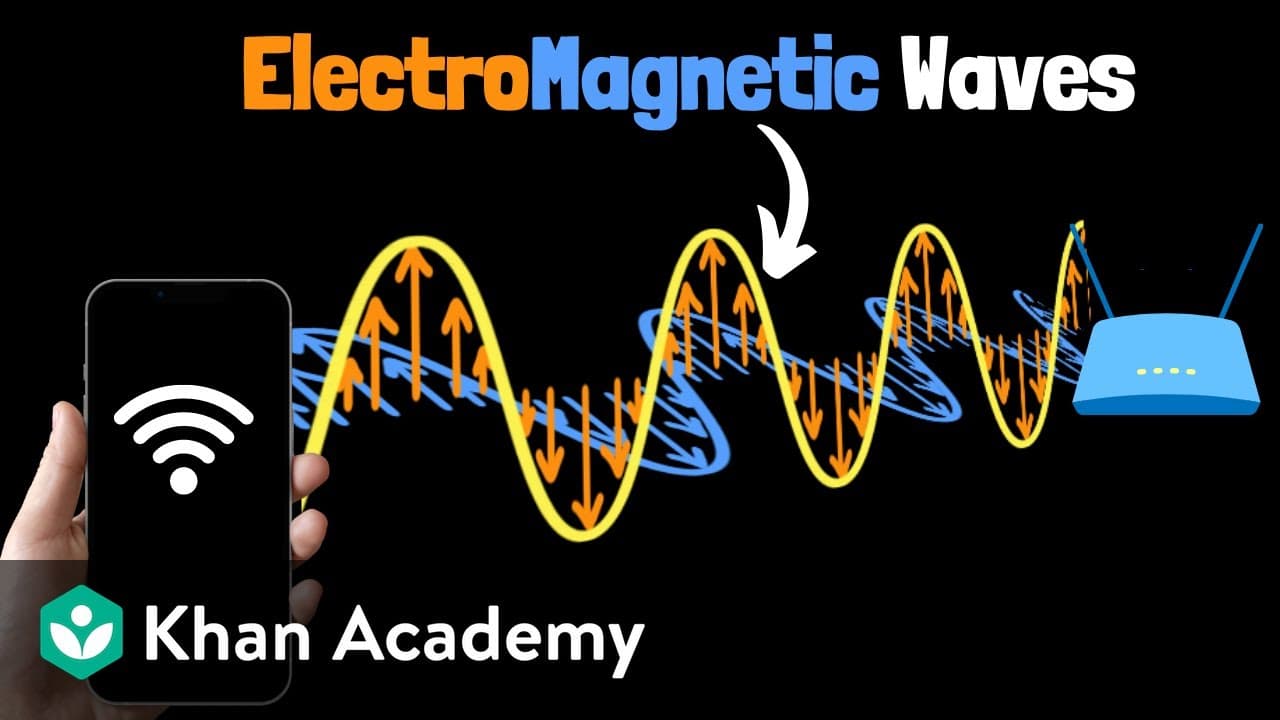
TL;DR
Electromagnetic waves are produced by accelerating charges and consist of oscillating electric and magnetic fields. They enable energy transfer without a medium and vary in type based on their frequency, influencing applications in wireless communication via modulation techniques like analog and digital. Understanding their properties, such as amplitude and wavelength, is crucial for harnessing their power in technology.
Transcript
- [Narrator] What's common between a wifi router, our bodies, and an incandescent bulb? We all give out electromagnetic waves. But why do we do that? And why are they, why are they all so different? And how do we use some of them for wireless communications? Let's answer all of them. Let's start by asking ourselves what exactly are electromagnetic ... Read More
Key Insights
- 👋 Electromagnetic waves consist of oscillating electric and magnetic fields, enabling energy transfer without a medium.
- 👋 The frequency of oscillation determines the type of electromagnetic wave, resulting in a wide spectrum from radio waves to gamma rays.
- 👋 Amplitude, phase, wavelength, and frequency are critical properties that describe electromagnetic waves and influence their behavior.
- 🙂 The speed of light is a fundamental constant for electromagnetic waves in a vacuum, illustrating the relationship between frequency and wavelength.
- 👻 Modulation is essential for the transmission of information via electromagnetic waves, allowing for both analog and digital communication.
- 👋 Different devices, like antennas, utilize electromagnetic waves by both transmitting and receiving energy through the oscillation of charges.
- 👋 The versatility of electromagnetic waves makes them integral to modern wireless communication technologies, including smartphones and satellite communications.
Install to Summarize YouTube Videos and Get Transcripts
Explore YouTube Video Summarizer or Get YouTube Transcript Extractor
Questions & Answers
Q: What are electromagnetic waves, and how are they generated?
Electromagnetic waves are oscillations of electric and magnetic fields. They are generated when charges, such as electrons, are accelerated. For example, by wiggling an electron up and down, energy is radiated away in the form of electromagnetic waves. This process can occur in different contexts, like in Wi-Fi antennas or incandescent bulbs, as the electrons inside oscillate and produce various types of electromagnetic radiation.
Q: How do the properties of electromagnetic waves differ, specifically amplitude, phase, wavelength, and frequency?
The amplitude of a wave refers to the height of its electric or magnetic field and indicates its strength. Phase describes the synchronization of wave points, determining if they are oscillating together (in phase) or not (out of phase). Wavelength is the distance between successive peaks, while frequency measures the number of wavelengths passing a point per second, typically measured in hertz. Together, these properties help characterize different types of electromagnetic waves.
Q: Why do we experience different types of electromagnetic waves, like radio waves and visible light?
The variation in electromagnetic waves can be attributed to the oscillation frequencies of charges. For instance, charges in Wi-Fi antennas oscillate at lower frequencies, producing radio waves, while charges in incandescent bulbs oscillate at higher frequencies, resulting in visible light. This relationship between oscillation frequency and the type of wave helps us differentiate among them.
Q: What is the significance of the speed of light concerning electromagnetic waves?
In a vacuum, all electromagnetic waves travel at the constant speed of light, approximately three times ten to the power of eight meters per second. This speed is independent of frequency and wavelength, meaning higher frequency waves possess shorter wavelengths, and vice versa. Understanding this relationship is crucial for grasping how electromagnetic waves function in various applications.
Q: How does modulation play a role in wireless communication?
Modulation is the method by which information is transmitted using electromagnetic waves. For example, amplitude modulation (AM) adjusts the wave's amplitude to encode an audio signal. In contrast, Wi-Fi employs digital modulation, sending bits represented as high and low signals. This enables the transmission of complex data, like music or internet traffic, through various modulation techniques.
Summary & Key Takeaways
-
Electromagnetic waves are generated by accelerating charges and consist of oscillating electric and magnetic fields, propagating energy without requiring a medium, as seen in phenomena like visible light and radio waves.
-
The properties of electromagnetic waves include amplitude, phase, wavelength, and frequency. These characteristics influence how different waves, like radio and infrared, are characterized and utilized in technology.
-
Wireless communication, such as Wi-Fi, relies on the modulation of electromagnetic waves to transmit information. This modulation can be analog or digital, allowing for the transfer of signals like music and data efficiently.
Read in Other Languages (beta)
Share This Summary 📚
Summarize YouTube Videos and Get Video Transcripts with 1-Click
Try YouTube Summary with ChatGPT & Claude or YouTube Transcript Generator
Explore More Summaries from Khan Academy 📚



Summarize YouTube Videos and Get Video Transcripts with 1-Click
Try YouTube Summary with ChatGPT & Claude or YouTube Transcript Generator