Analyzing structure with linear inequalities: fruits | High School Math | Khan Academy
TL;DR
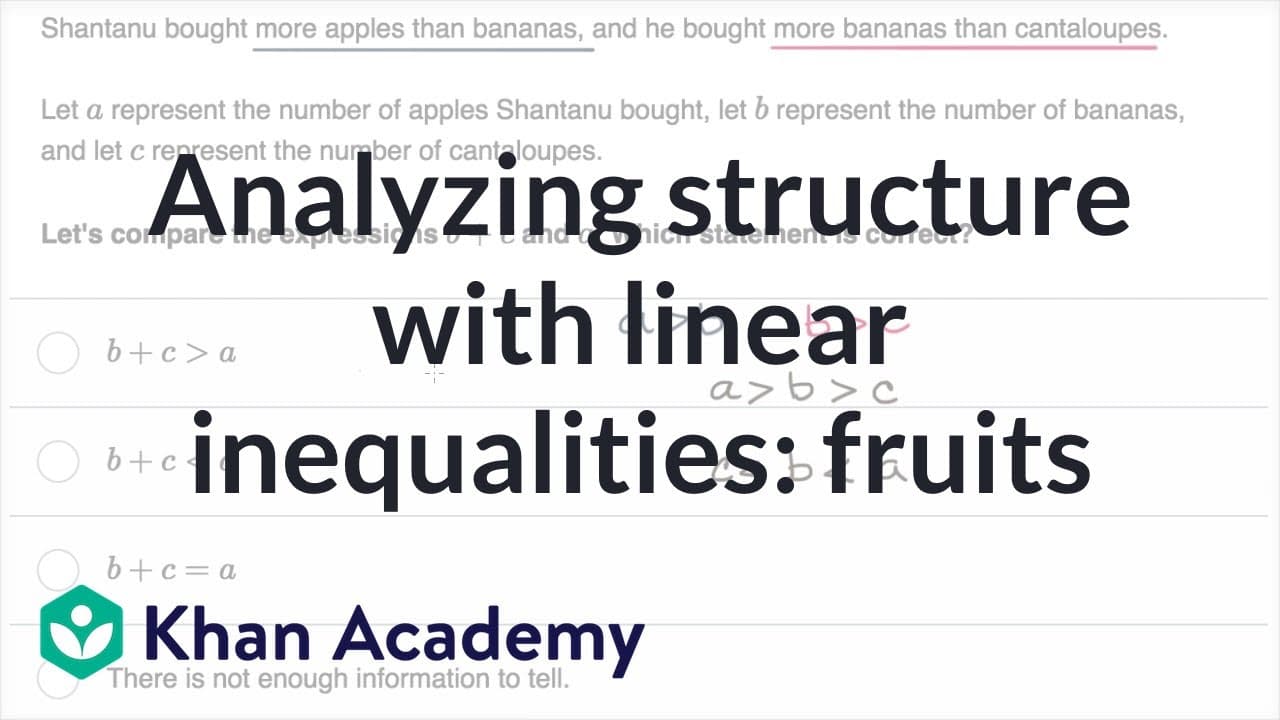
Shantanu bought more apples than bananas and more bananas than cantaloupes, and there is not enough information to determine whether B plus C is greater than A, less than A, or equal to A.
Transcript
- [Instructor] Shantanu bought more apples than bananas and he bought more bananas than cantaloupes. Let A represent the number of apples Shantanu bought, let B represent the number of bananas, and let C represent the number of cantaloupes. Let's compare the expressions B plus C and A. Which statement is correct? So is B plus C greater than A? Is i... Read More
Key Insights
- 😃 The given information indicates a sequence of quantities: A > B > C.
- 🔙 Plugging in different values for A, B, and C reveals that B plus C can be greater than A, less than A, or equal to A.
- 😃 Therefore, there is not enough information to determine the relationship between B plus C and A.
- ❓ This highlights the importance of considering different scenarios and not relying solely on abstract quantities.
- 🤝 It is essential to analyze the information given and explore various possibilities when dealing with abstract quantities.
- 🔌 The strategy of plugging in values helps determine if the given constraints consistently fit into one of the answer choices.
- 💼 In this case, any combination of values that adheres to A > B > C can result in B plus C being greater than, less than, or equal to A.
Install to Summarize YouTube Videos and Get Transcripts
Explore YouTube Video Summarizer or Get YouTube Transcript Extractor
Questions & Answers
Q: What do A, B, and C represent in this scenario?
A represents the number of apples, B represents the number of bananas, and C represents the number of cantaloupes that Shantanu bought.
Q: How is the relationship between A, B, and C determined?
It is given that A is greater than B and that B is greater than C, indicating a sequence of quantities: A > B > C.
Q: What is the purpose of comparing the expressions B plus C and A?
The purpose is to determine whether B plus C is greater than A, less than A, or equal to A.
Q: How is the comparison between B plus C and A carried out?
By plugging in different values for A, B, and C and calculating B plus C, it is possible to see if B plus C is consistently greater than A, less than A, or equal to A.
Summary & Key Takeaways
-
Shantanu bought more apples (A) than bananas (B) and more bananas than cantaloupes (C).
-
The expressions B plus C and A are compared to determine the relationship between them.
-
By plugging in different values for A, B, and C, it is determined that there is not enough information to tell if B plus C is greater than A, less than A, or equal to A.
Read in Other Languages (beta)
Share This Summary 📚
Summarize YouTube Videos and Get Video Transcripts with 1-Click
Try YouTube Summary with ChatGPT & Claude or YouTube Transcript Generator
Explore More Summaries from Khan Academy 📚



Summarize YouTube Videos and Get Video Transcripts with 1-Click
Try YouTube Summary with ChatGPT & Claude or YouTube Transcript Generator