Problems Solving on Entropy 3
TL;DR
This video solves a problem involving the calculation of net heat flow and overall change in entropy in a reversible heating and cooling process at constant pressure and volume.
Transcript
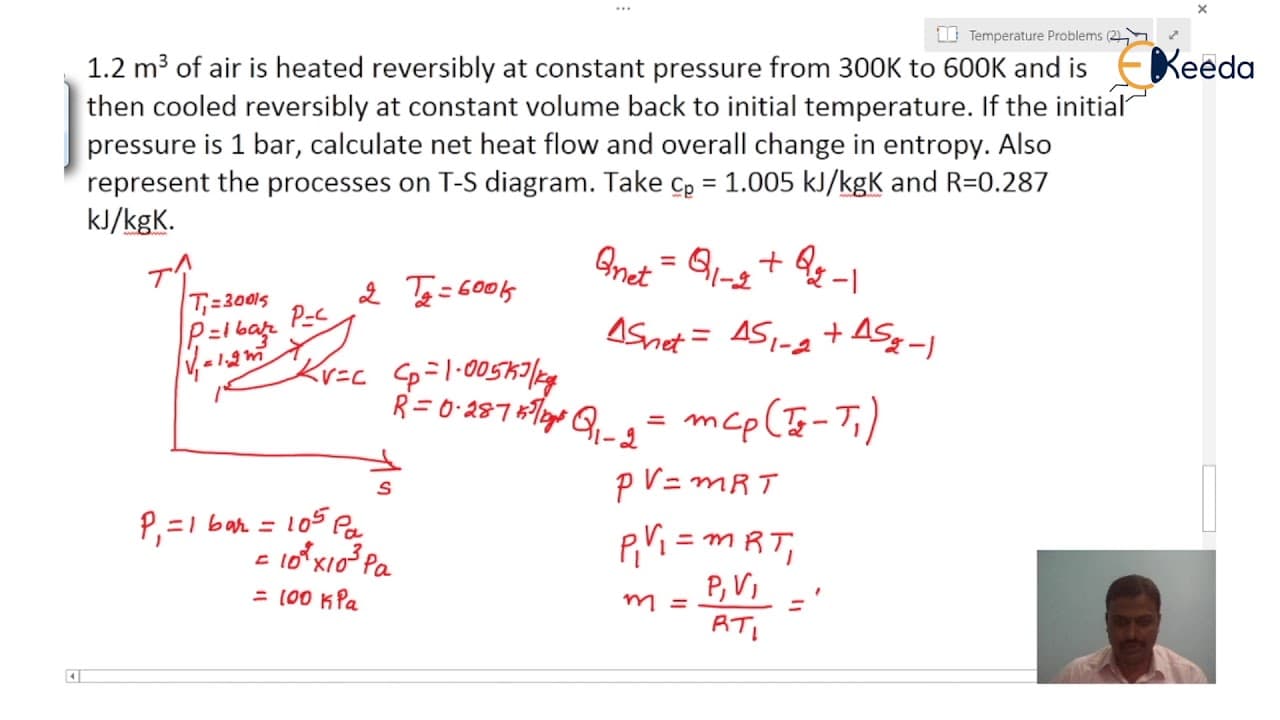
hello friends so in this video i'm solving a problem on entropy so in this problem 1.2 meter cube of air is heated reversibly at constant pressure from 300 kelvin to 600 kelvin and is then cooled reversibly at constant volume back to initial temperature if the initial pressure is 1 bar calculate net heat flow and overall change in entropy also repr... Read More
Key Insights
- 😎 The problem involves a reversible heating and cooling process of air at constant pressure and volume.
- 🥵 The net heat flow is calculated by adding the heat transferred in the heating process and subtracting the heat transferred in the cooling process.
- 🫢 The mass of air in the system is determined using the ideal gas equation.
- 💱 The reversible heating process contributes positively to the change in entropy, while the reversible cooling process contributes negatively.
- 💱 The overall change in entropy is calculated by summing the entropy changes in the heating and cooling processes.
- 🤩 The specific heat at constant pressure and volume play a key role in the calculations.
- 🥵 The specific heat at constant volume is used to calculate the heat transferred in the cooling process.
Install to Summarize YouTube Videos and Get Transcripts
Explore YouTube Video Summarizer or Get YouTube Transcript Extractor
Questions & Answers
Q: How is the net heat transfer calculated in the problem?
The net heat transfer is obtained by adding the heat transferred during the reversible heating process and subtracting the heat transferred during the reversible cooling process.
Q: How is the mass of air in the system calculated?
The mass of air can be determined using the ideal gas equation, where the initial pressure, volume, and temperature are known. By substituting the values, the mass can be calculated as pressure multiplied by volume divided by the universal gas constant times the initial temperature.
Q: What is the formula for calculating the heat transferred in the reversible heating process?
The heat transferred in the reversible heating process is determined by multiplying the mass of air, specific heat of air at constant pressure, and the temperature change (final temperature minus initial temperature).
Q: How is the overall change in entropy calculated?
The overall change in entropy is calculated by summing the entropy changes in the reversible heating and cooling processes. Each entropy change is determined using the mass of air, specific heat at constant pressure or volume, and the natural logarithm of the ratio of final and initial temperatures.
Summary & Key Takeaways
-
The problem involves heating 1.2 m^3 of air reversibly at constant pressure from 300 K to 600 K and cooling it reversibly at constant volume back to the initial temperature.
-
The net heat flow is calculated by adding the heat transferred in the heating process and subtracting the heat transferred in the cooling process.
-
The overall change in entropy is determined by summing the entropy changes in the heating and cooling processes.
Read in Other Languages (beta)
Share This Summary 📚
Summarize YouTube Videos and Get Video Transcripts with 1-Click
Try YouTube Summary with ChatGPT & Claude or YouTube Transcript Generator
Explore More Summaries from Ekeeda 📚





Summarize YouTube Videos and Get Video Transcripts with 1-Click
Try YouTube Summary with ChatGPT & Claude or YouTube Transcript Generator