How Does the Second Fundamental Theorem of Calculus Work?
TL;DR
The second fundamental theorem of calculus states that if a function is continuous over a specific interval, the definite integral can be evaluated using its antiderivative. This allows for calculating the area under the curve efficiently by subtracting the values of the antiderivative at the bounds of the interval.
Transcript
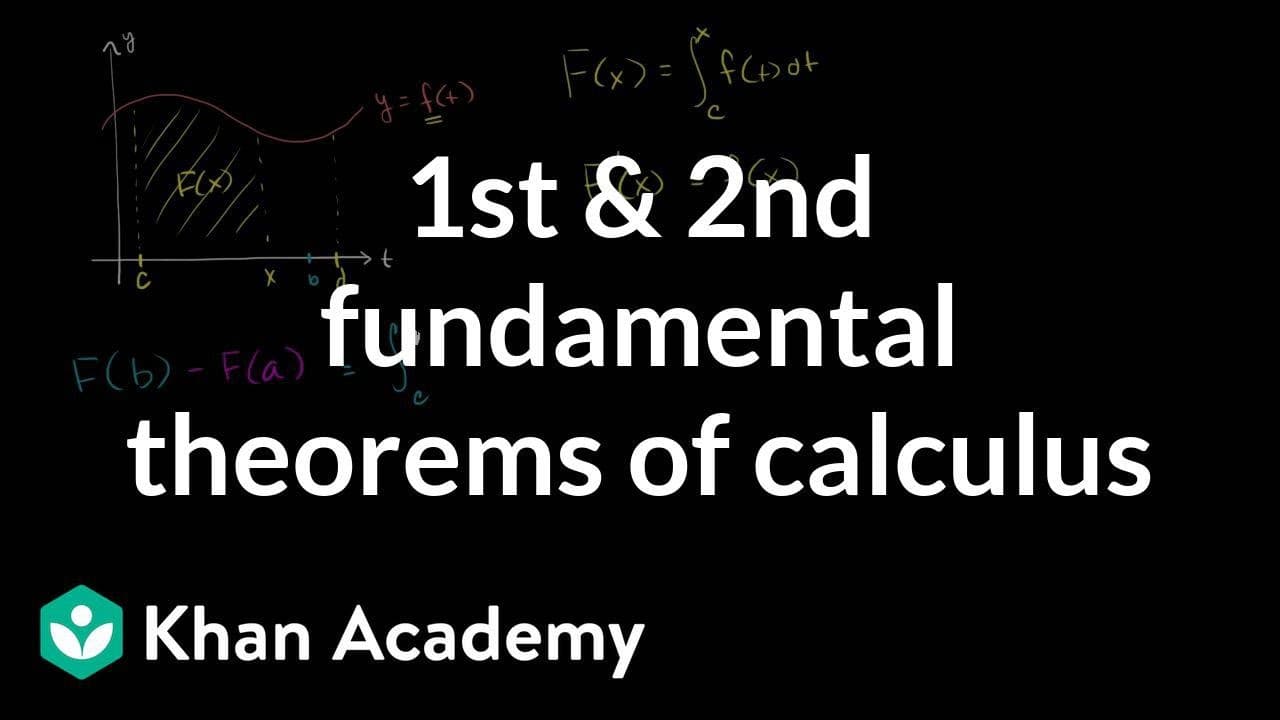
Let's say we've got some function f that is continuous over the interval between c and d. And the reason why I'm using c and d instead of a and b is so I can use a and b for later. And let's say we set up some function capital F of x which is defined as the area under the curve between c and some value x, where x is in this interval where f is cont... Read More
Key Insights
- ❓ The fundamental theorem of calculus connects finding the area under a curve (definite integral) to evaluating antiderivatives.
- 😥 Continuous functions have differentiable antiderivatives at every point in their intervals.
- 👻 The second fundamental theorem allows for the evaluation of definite integrals using antiderivatives.
- 💯 The connection between definite integrals and antiderivatives is the core of integral calculus.
- ❓ The antiderivative of a function is equivalent to the indefinite integral of the function.
- ❓ The second fundamental theorem of calculus is used to evaluate definite integrals efficiently.
- ❓ The second fundamental theorem provides a shortcut for calculating the area under a curve.
Install to Summarize YouTube Videos and Get Transcripts
Explore YouTube Video Summarizer or Get YouTube Transcript Extractor
Questions & Answers
Q: What is the fundamental theorem of calculus?
The fundamental theorem of calculus states that if a function is continuous over an interval, its antiderivative is differentiable at every point in that interval, and the derivative of the antiderivative is equal to the original function.
Q: How does the first fundamental theorem of calculus relate to the second part?
The first fundamental theorem of calculus establishes that the derivative of the antiderivative of a function is equal to the original function. The second part allows for the evaluation of definite integrals using antiderivatives.
Q: What does the second fundamental theorem of calculus state?
The second fundamental theorem of calculus states that the definite integral of a function from a to b is equal to the antiderivative of the function evaluated at b, minus the antiderivative evaluated at a.
Q: How does the second fundamental theorem help in evaluating definite integrals?
The second fundamental theorem of calculus provides a way to evaluate definite integrals by finding the antiderivative of the function and subtracting the values of the antiderivative at the limits of integration.
Summary & Key Takeaways
-
The fundamental theorem of calculus connects the area under a curve (a definite integral) to the antiderivative of a function.
-
If a function is continuous over an interval, its antiderivative is differentiable at every point in that interval.
-
The second part of the fundamental theorem of calculus allows for the evaluation of definite integrals by using antiderivatives.
Read in Other Languages (beta)
Share This Summary 📚
Summarize YouTube Videos and Get Video Transcripts with 1-Click
Try YouTube Summary with ChatGPT & Claude or YouTube Transcript Generator
Explore More Summaries from Khan Academy 📚



Summarize YouTube Videos and Get Video Transcripts with 1-Click
Try YouTube Summary with ChatGPT & Claude or YouTube Transcript Generator