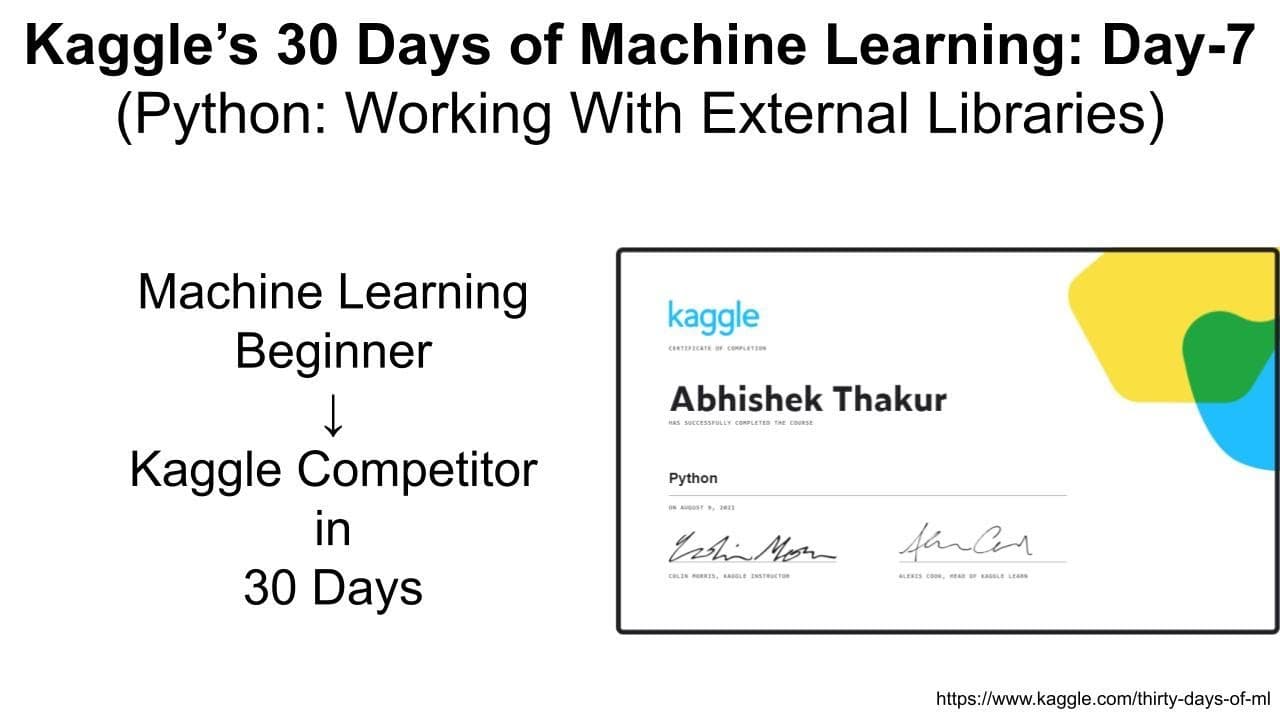
Kaggle's 30 Days Of ML (Day-7): Working with external libraries in Python (final python day)
TL;DR
This content covers the topics of imports in Python, operator overloading, and creating custom classes with hands-on exercises.
Transcript
hello everyone and welcome to day 7 of kaggle's 30 days of machine learning challenge and today this is the last day of python so today when we finish this exercise we are going to get a certificate for python let's see what we are going to learn today today we are going to learn about imports in python and get some tips for working with unfamiliar... Read More
Key Insights
- 📚 Python provides a wide range of standard libraries and custom libraries that can be imported to enhance the functionality of programs.
- 🪡 Using the "import" keyword, you can import specific functions or the entire library, but it is recommended to import only what is needed to avoid conflicts.
- 🛃 Operator overloading allows you to define custom behavior for operators in your custom classes, providing more flexibility and functionality.
- 👻 Creating custom classes in Python allows you to create objects with their own properties and methods, and enables you to compare and perform operations on these objects.
Install to Summarize YouTube Videos and Get Transcripts
Explore YouTube Video Summarizer or Get YouTube Transcript Extractor
Questions & Answers
Q: What is the purpose of imports in Python?
Imports allow you to access pre-written code in the form of libraries, both standard and custom, to enhance the functionality of your programs. They save time and effort by providing ready-to-use functions and classes.
Q: Why is importing "star" discouraged?
Importing "*" (star) imports all the functions and classes from a library, making it difficult to determine which functions are being used in the code. It can lead to naming conflicts and make code less readable. It is recommended to import only what is needed.
Q: What is operator overloading?
Operator overloading is the ability to define custom behavior for operators (+, -, *, etc.) for objects of custom classes. It allows you to perform specific operations on objects using operators in a way that makes sense for the class.
Q: How can you import a library with an alias?
You can import a library with an alias using the "import libraryname as alias" syntax. For example, "import math as m" allows you to refer to the math library as "m" in your code.
Summary & Key Takeaways
-
The video introduces the concept of imports in Python and explains the use of standard libraries and custom libraries. It demonstrates how to import and use the math library as an example.
-
It provides an overview of operator overloading and its purpose in Python. The video shows examples of how to use operator overloading for mathematical operations.
-
The content includes hands-on exercises on creating and comparing custom classes in Python.
Read in Other Languages (beta)
Share This Summary 📚
Summarize YouTube Videos and Get Video Transcripts with 1-Click
Try YouTube Summary with ChatGPT & Claude or YouTube Transcript Generator
Explore More Summaries from Abhishek Thakur 📚

Summarize YouTube Videos and Get Video Transcripts with 1-Click
Try YouTube Summary with ChatGPT & Claude or YouTube Transcript Generator