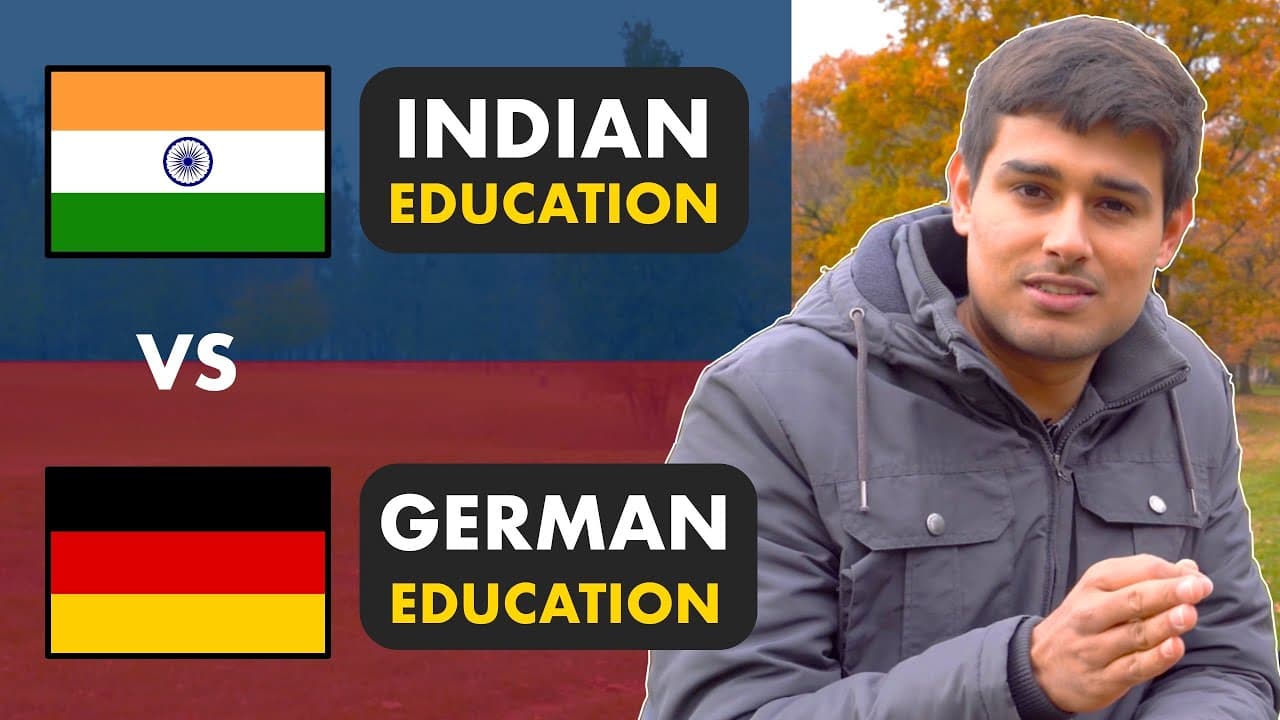
India vs Germany | Education System Analysis by Dhruv Rathee
TL;DR
A detailed comparison of Indian and German education systems, highlighting key differences and insights.
Transcript
Hello friends A lot of you have made a lot of demands for this video Come let us indulge in an analysis of the Indian education system along with the German education system A lot of you might already know I have completed my University level education- Both bachelors and masters, from Germany And for this video, in this video, I have with me, Bhar... Read More
Key Insights
- 🧑🎓 Germany provides three educational paths after primary schooling that cater to individual student abilities, promoting a tailored educational experience.
- 😘 Vocational training in Germany holds equal respect and salary potential compared to traditional university degrees, unlike the low regard for vocational skills in India.
- 😮 Higher education in Germany is largely subsidized, making it more accessible, while Indian students are facing rising costs and deteriorating infrastructure.
- 🌍 The practical approach in German universities fosters deep understanding and real-world application, contrasting with India's often theoretical focus.
- 🧑🎓 Flexibility in subject selection encourages students in Germany to pursue diverse interests, whereas Indian students are frequently confined to predetermined streams, limiting their potential.
- 🙈 The absence of structured campus placements in Germany encourages proactive networking and internships, contrasting with the heavily structured placement processes seen in Indian universities.
- ☠️ Dropout rates in German engineering programs highlight that students are more likely to leave when they do not feel aligned with the rigorous demands, emphasizing the need to follow one's passion.
Install to Summarize YouTube Videos and Get Transcripts
Explore YouTube Video Summarizer or Get YouTube Transcript Extractor
Questions & Answers
Q: What are the main differences in school structures between India and Germany?
In Germany, after fourth grade, students can choose from three types of secondary schools—Gymnasium, Realschule, and Hauptschule—based on their academic abilities. This choice allows students to pursue education in line with their strengths, unlike India, where students typically follow a more rigid curriculum without such options.
Q: How does vocational training in Germany compare to India's perception of similar jobs?
In Germany, vocational training is respected and provides graduates with practical skills and decent salaries, making it an attractive option. In contrast, India often views vocational jobs as less desirable, leading to social stigma against trades like carpentry and plumbing, despite the potential for similar earnings.
Q: What role do tuition fees play in the accessibility of higher education in both countries?
German universities generally have low or no tuition fees, funded by taxpayer money, ensuring education remains accessible. In contrast, students in India often face high tuition, increasing financial barriers and making higher education less attainable for economically weak individuals.
Q: How do university experiences differ between the two countries?
The German system emphasizes practical learning and real-life application of knowledge, with reduced focus on theoretical aspects compared to India. Indian universities often enforce strict attendance policies and may lack practical exposure, leading to a more theoretical experience for students.
Q: What is the significance of student freedom in subject selection during higher education?
In Germany, students enjoy the flexibility to choose their subjects even in higher classes, allowing them to tailor their education according to their interests. Conversely, Indian education often restricts students to predetermined streams, limiting their choices and furthering the rigidity of their educational paths.
Q: How does the concept of placements differ in Germany compared to India?
In Germany, companies typically do not conduct formal campus placements, with students relying on internships and networking to secure jobs after graduation. This contrasts with India, where placement drives and corporate recruitment are significant aspects of university life.
Q: What might explain the high dropout rates in engineering programs in Germany?
Many students enter engineering programs in Germany without strong external pressures, leading to higher dropout rates when they discover that the field is demanding. Instead of pursuing engineering for monetary gains, students are encouraged to follow their passions, leading some to opt for vocational training instead.
Q: What recommendations did the speakers give for improvements in the Indian education system?
The speakers suggested that India could benefit from reducing tuition fees through subsidies, increasing flexibility in subject choices, and enhancing the perception and value of vocational training. Such changes could foster a more supportive educational environment that accommodates diverse student interests and aspirations.
Summary & Key Takeaways
-
The discussion contrasts the Indian educational system with the German model, focusing on structural differences, such as the variety of schooling options available in Germany after primary education.
-
Vocational training in Germany is viewed positively, offering respect and similar earning potential compared to traditional academic routes, which isn't the case in India, where vocational jobs often face stigma.
-
The video emphasizes the affordability of higher education in Germany due to government subsidies, contrasting sharply with rising tuition fees and poor infrastructural conditions in Indian universities.
Read in Other Languages (beta)
Share This Summary 📚
Summarize YouTube Videos and Get Video Transcripts with 1-Click
Try YouTube Summary with ChatGPT & Claude or YouTube Transcript Generator
Explore More Summaries from Dhruv Rathee 📚





Summarize YouTube Videos and Get Video Transcripts with 1-Click
Try YouTube Summary with ChatGPT & Claude or YouTube Transcript Generator